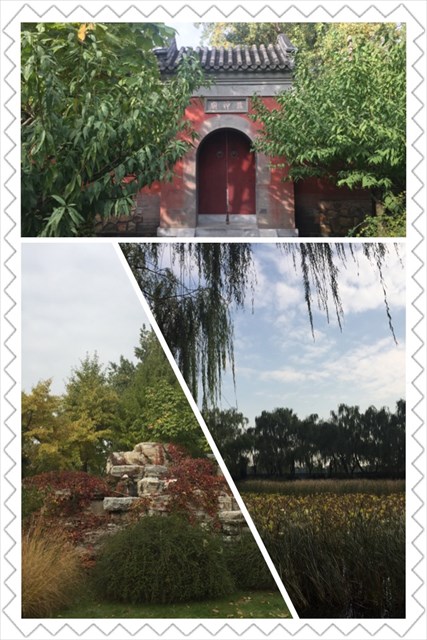
 The Summer Palace (Yiheyuan) is mainly dominated by Longevity Hill(Wanshoushan, 60 meters high) and the Kunming Lake. It covers an expanse of 2.9 square kilometers, three quarters of which is water. The central Kunming Lake covering 2.2 square kilometers and it is divided into few parts by West Dyke. It was entirely man made and the excavated soil was used to build Longevity Hill. In its compact 70,000 square meters of building space, one finds a variety of palaces, gardens, and other classical-style architectural structures.
The Summer Palace (Yiheyuan)started out life as the Garden of Clear Ripples(Qingyiyuan) in 1750 (Reign Year 15 of Emperor Qianlong). Artisans reproduced the garden architecture styles of various palaces in China. Kunming Lake was created by extending an existing body of water to imitate the West Lake in Hangzhou. The palace complex suffered two major attacks--during the Anglo-French allied invasion of 1860 (with the Old Summer Palace also ransacked at the same time), and during the Boxer Rebellion, in an attack by the eight allied powers in 1900. The garden survived and was rebuilt in 1886 and 1902. In 1888, it was given the current name, Yiheyuan. It served as a summer resort for Empress Dowager Cixi, who diverted 30 million taels of silver, said to be originally designated for the Chinese navy, into the reconstruction and enlargement of the Summer Palace.
This Temple was first built in the regin of Emperor Qianlong(1736-1795). During the period of Qingyiyuan (Garden of Clear Ripples), the weaving and Dyeing Bureau paid annual tribute here to the Goddess of Silkworm in the 9th month of the lunar calendar. The Temple was burnt down in 1860 (Emperor Xianfeng 10th year) by the Anglo-French Allied Forces and rebuilt in 2003.