[ITA]
Porta Garibaldi (già Porta Comasina fino al 1860) è una delle sei porte principali di Milano, ricavata all'interno dei Bastioni. Posta a nord della città, si apriva lungo la strada per Como. Caratterizzata oggi dalla presenza dell'arco neoclassico del Moraglia (1826-1828) e degli annessi caselli daziari (1834), sorge al centro di piazza XXV Aprile, allo sbocco di corso Garibaldi.
In passato Porta Comasina identificava inoltre uno dei sei sestieri storici in cui era divisa la città, il Sestiere di Porta Comasina.
Storia: La porta spagnola (XVI secolo)
La Porta Garibaldi attuale che si apre nei Bastioni di Milano sorse sullo stesso asse viario (oggi corso Garibaldi) su cui erano sorte in precedenza le omonime porte di epoca romana (sul tracciato delle Mura romane) e di epoca medievale (sul tracciato delle Mura medievali)
Il rifacimento del Moraglia (1826-1828)
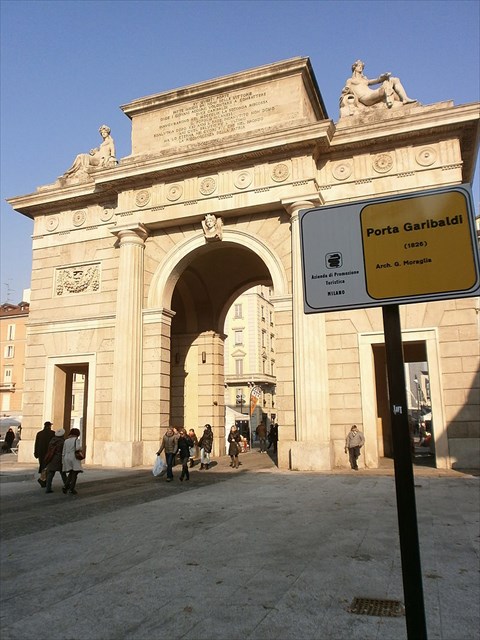
La porta
La porta in una cartolina d'epoca
In epoca napoleonica, il governo di Francesco Melzi d'Eril pianificò un generale rifacimento delle porte di ingresso a Milano, previa alberazione dei bastioni e demolizione delle porte spagnole, la cui funzione militare era ormai superata. Il progetto intendeva convertirle in caselli daziari, ma di foggia adeguata al prestigio della capitale del Regno d'Italia. La cinta daziaria di Milano avrebbe corrisposto dunque con il tracciato spagnolo.
Inizialmente affidato a Luigi Cagnola, il progetto fu sospeso dal nuovo governo austriaco, a causa della spesa eccessiva e della compromissione di Cagnola con il periodo napoleonico. La scelta del governo austriaco fu di affidare un nuovo incarico al giovane architetto Giacomo Moraglia, obbligando i negozianti milanesi a finanziare la costruzione della porta. L'architetto riprese la tipologia cagnoliana dell'arco trionfale fiancheggiato dai due caselli, affacciato verso l'asse stradale di penetrazione principale in Milano. Egli disegnò un arco trionfale, a un fornice con due passaggi pedonali aperti ai fianchi, fiancheggiato da due caselli daziari, porticati ed affacciati sull'asse stradale. L'arco è di ordine dorico, in pietra di Viggiù, con due passaggi aperti ai fianchi. La muratura è ingentilita da fregi incassati nella muratura a bugnato. Sulla sommità dell'arco vennero collocati quattro "colossi", opera di Giambattista Perabò, a simboleggiare i principali fiumi della Lombardia: Po, Adda, Ticino e Olona.
La porta venne definitivamente completata tra il 1826 e il 1828. Per un brevissimo periodo la nuova porta coesistette con la precedente, del XVI secolo, un edificio assolutamente modestissimo e facilmente confondibile con una qualsiasi abitazione della zona. Venne in seguito demolita, liberando lo spazio antistante la nuova costruzione, a cui verranno poi affiancati i caselli daziari nel 1834.
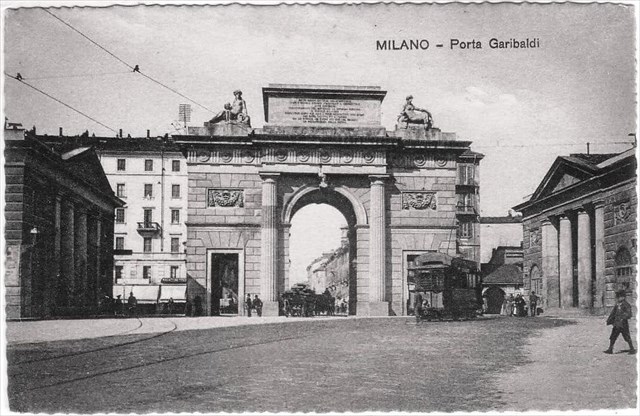
The Door in the 1900
L'intitolazione
L'arco, non ancora completato, venne inizialmente dedicato all'imperatore Francesco I d'Austria, sovrano del Lombardo-Veneto, a ricordo della sua seconda visita in città nel 1825, proveniente da Como, dove era giunto attraverso la nuova strada dello Stelvio.
La dedica recitava:
« A Francesco I / Pio Ottimo Massimo / I negozianti milanesi eressero »
Pare che l'epigrafe venisse commentata aggiungendo un ultimo verso: “sebbene poca volontà ne avessero”, che venne attribuito ad Alessandro Manzoni, forse perché sembrava ben riuscita.
Il 22 marzo 1848, durante le Cinque giornate di Milano, fu la seconda ad essere espugnata dagli insorti, dopo Porta Tosa. Nel 1859 vi fece il suo ingresso Giuseppe Garibaldi, proveniente da Como dove aveva conseguito le brillanti vittorie di Varese e di San Fermo. Nel 1860 la porta gli venne dedicata in commemorazione dell'evento. Venne rimossa l'iscrizione dedicata a Francesco I d'Austria e sostituita da un'altra epigrafe, ancora esistente:
« Qui sull'orme del nome nemico / Il ferro dell'italica gioventù / incise le vittorie comensi / MDCCCLIX »
Ai lati, le iscrizioni «VARESE» e «SAN FERMO», in riferimento alle battaglie di Varese e San Fermo, combattute da Giuseppe Garibaldi prima di entrare in città nel 1859.

Sign dedicated to Garibaldi
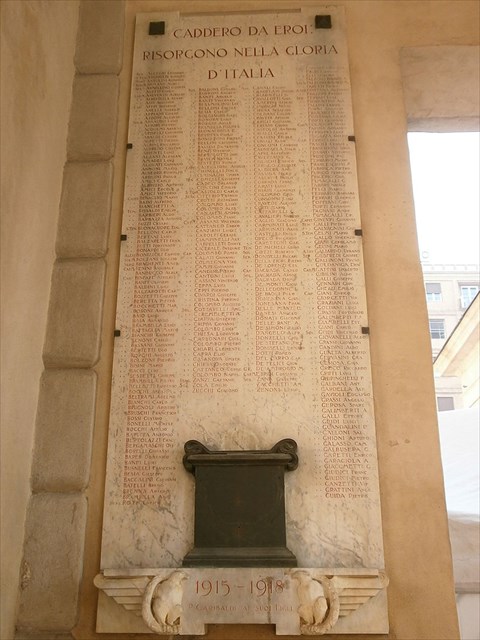
Dedicated to died in WAR
Corso Como
Oltre alla bellissima Porta nella zona è presente la rinomata zona di Corso Como.
In questa zona sono presenti diversi locali, pizzerie, ristoranti e lounge bar molto "trendy and cool".
Pur non essendo una prerogativa dei geocacher vivere in questo mondo è corretto potervi far apprezzare la Storia di Milano e il futuro di questa zona.
La Cache
L'area è piena di babbani a qualsiasi ora. La precedente cache è stata ripetutamente vandalizzata quindi vi chiedo gentilmente di usare la massima cautela nel recuperare e riposizionare la cache.
La cache è posizionata all'interno della porta.
E' equivalente ad una micro slim con il solo logbook.
[ENG] Porta Garibaldi (Porta already Comasina until 1860) is one of six main gates of Milan, built inside the ramparts. Located in the north of the city, it opened along the road to Como. Characterized today by the presence of the neo-classical arc Moraglia (1826-1828) and associated toll daziari (1834), it stands at the center of Piazza XXV Aprile, at Corso Garibaldi outlet.
In the past Porta Comasina also he identified one of the six historic districts in which was divided the city, the District of Porta Comasina.
History: The Spanish port (XVI century)
The Porta Garibaldi current which opens in the Bastions of Milan arose on the same road axis (now Corso Garibaldi) which had arisen earlier the same name from the Roman period doors (on the track of the Roman Walls) and medieval times (on the track of the Medieval walls )
The remaking of Moraglia (1826-1828)
La porta
The door in a vintage postcard
In the Napoleonic era, the government of Francesco Melzi planned a general makeover of the entrances to Milan after alberazione of the ramparts and the demolition of the Spanish ports, whose military function was outdated. The project aimed to convert them to toll booths daziari but adequate shape to the prestige of the capital of the Kingdom of Italy. The boundary walls of Milan would have corresponded thus with the Spanish track.
The Door in the 1900
Initially entrusted to Luigi Cagnola, the project was suspended by the new Austrian government, because of excessive spending and impairment of Cagnola with the Napoleonic period. The choice of the Austrian government was to entrust a new mandate to the young architect Giacomo Moraglia, forcing the Milanese merchants to finance the construction of the port. The architect resumed cagnoliana type the triumphal arch flanked by two toll, facing towards the main road axis of penetration in Milan. He drew a triumphal arch, a barrel-vault with two walkways open to the sides, flanked by two toll daziari, porches and looking out on the main road. The arch is of the Doric order, in Viggiù stone, with two steps open to the sides. The walls are embellished by friezes Built in ashlar masonry. On the summit they were placed four "giants", by Giambattista Perabò, symbolizing the main rivers of Lombardy: Po, Adda, Ticino and Olona.
The door was finally completed between 1826 and 1828. For a brief period the new port coexisted with the previous, the sixteenth century, a very modest building and easily confused with any of the area home. It was later demolished, freeing up space in front of the new building, to which the toll daziari in 1834 will then be joined.
The dedication
The arch, not yet completed, was initially dedicated to the Emperor Francis I of Austria, ruler of the Lombardo-Veneto, in memory of his second visit to the city in 1825, coming from Como, where he had gone through the new Stelvio road .
The dedication read:
"A Francesco I / Pio Optimus Maximus / The Milanese shopkeepers erected"
It seems that the inscription was commented by adding a last verse: "although they had little desire," which was attributed to Alessandro Manzoni, perhaps because it seemed successful.
Sign dedicated to Garibaldi
Dedicated to died in WAR
March 22, 1848, during the Five Days of Milan, was the second to be conquered by the insurgents, after Porta Tosa. In 1859 he made its entry Giuseppe Garibaldi, from Como where he had obtained the brilliant victories of Varese and San Fermo. In 1860 the port was dedicated in commemoration of the event. It was removed the inscription dedicated to Francis I of Austria, and replaced by another inscription, which still exists:
"Here sull'orme name of the enemy / Iron dell'italica Youth / engraved victories Comensi / MDCCCLIX"
On the sides, the inscriptions "VARESE" and "SAN STOPPED", in reference to the battles of Varese and San Fermo, fought by Giuseppe Garibaldi before entering the city in 1859.
Corso Como
Except for the beautiful port in the area is the renowned Corso Como area.
In this area are several local present, pizzerias, very "trendy and cool" restaurants and lounge bars.
While not a prerogative of geocachers to live in this world is able to properly appreciate the history of Milan and the future of this area.
The Cache
The area is full of Muggles at any time. The previous cache has been repeatedly vandalized so I kindly ask you to use extreme caution in recovering and replacing the cache.
The cache is located inside the door and look like a micro slim one with only the logbook.