Nederlands
De stadspoorten van Brugge werden gebouwd in drie fasen: de eerste maal tijdens de eerste helft van de 9e eeuw, bij de versterking van de huidige Burg, de tweede maal in 1127-1128, tijdens de aanleg van de eerste stadsomwalling rond Brugge (met onder andere de huidige binnenreien), en de derde maal in 1297, bij de aanleg van de tweede en grotere omwalling rond de stad.
WP 1: Boeveriepoort - N 51 12.058, E 3 12.921
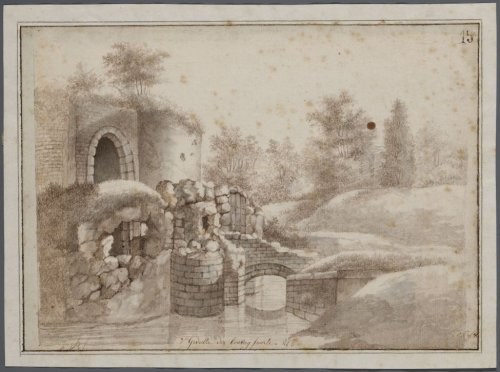
De eerste Boeveriepoort werd in 1312 in gebruik genomen en werd reeds in 1366-1367 door Jan Slabbaert herbouwd. Al begin 17e eeuw was ze er erg vervallen en werd ze gedeeltelijk gesloopt, om dan in 1807 een laatste maal herbouwd te worden; een leven van korte duur want in 1863 werd ze definitief gesloopt. Behalve de naam, thans gebruikt voor de plaats waar de poort vroeger lag, resten enkel nog de funderingen in de binnengracht.
VRAAG: Nabij de coördinaten staat een ijzeren hek/poort. Als je goed kijkt op het hek kan je woorden herkennen. Welk woord staat op het linkse hekhelft, op het einde van de tweede lijn.
| Bladzijde |
A=9 |
| Dag |
A=7 |
| Schone |
A=1 |
| Achtergrondmuziek |
A=4 |
WP2: Katelijnepoort - N 51 11.988, E 3 13.778
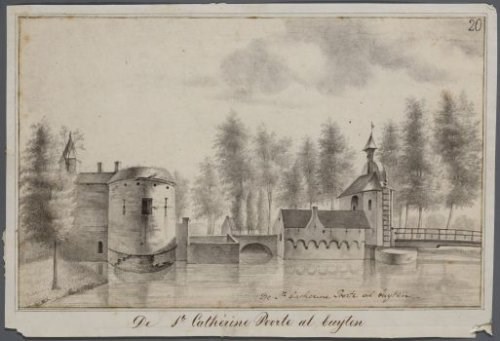
De Katelijnepoort werd gerealiseerd in 1297. De poort leidde destijds naar de Sint-Catharinaparochie, waarvan de kerk buiten de stadsmuren lag. Die kerk werd echter gesloopt in 1578. Reeds in 1401 was de Katelijnepoort bouwvallig. Na sloping werd ze onmiddellijk herbouwd. De voorpoort was pas in 1753 herbouwd. In 1782 werd de binnenpoort afgebroken; de rest van het complex volgde in 1862.
VRAAG: Nabij de huidige Katelijnepoortbrug, kan je bovenaan in de gevel van café Baron Ruzette een afbeelding zien van
| de zon |
B=6 |
| de sterren |
B=4 |
| een maan |
B=2 |
| de aarde |
B=3 |
WP3: Gentpoort - N 51 12.183, E 3 14.076
De Gentpoort is een van Brugges vier bewaarde middeleeuwse stadspoorten. Voor vreemden een toegang tot de stad, voor Bruggelingen een grens met de buitenwereld. De poort moest de stad verdedigen, maar fungeerde ook als doorgang voor goederen die in- of uitgevoerd werden. Let op het beeld in de nis boven de doorgang: dit is de heilige Adriaan, die Brugge tegen de pest moest beschermen. De Gentpoort is op zijn mooist ’s avonds, wanneer hij volop in de schijnwerpers staat.
De Gentpoort is, net als de Kruispoort en de Katelijnepoort, gebouwd naar een ontwerp van Maarten van Leuven en Jan van Oudernaerde. De poorten komen gelijktijdig tot stand tussen 1400 en 1406.
Ontdek in het museum hoe de stad en haar omwalling langzaam groeien en hoe belangrijk stadspoorten zijn voor het middeleeuwse Brugge in oorlogstijd.
VRAAG: welke tekening hoort bij deze poort (zie onderaan)
| Tekening A |
C=1 |
| Tekening B |
C=7 |
| Tekening C |
C=3 |
| Tekening D |
C=6 |
WP4: Kruispoort - N 51 12.754, E 3 14.403
De oudste Kruispoort werd opgetrokken bij de tweede omwalling (1297-1304) en al in 1366 vervangen. Filips van Artevelde vernielde die poort toen hij in 1382 met de Gentenaars de stad innam. In 1400 volgde poort nummer drie. Alleen de twee zware torens met hun smalle doorgang en twee achthoekige torentjes bleven bewaard. Karel V, Napoleon, het Duitse leger, ze wandelden allemaal via deze poort Brugge binnen.
VRAAG: welke tekening hoort bij deze poort (zie onderaan)
| Tekening A |
D=8 |
| Tekening B |
D=1 |
| Tekening C |
D=2 |
| Tekening D |
D=5 |
WP5: Dampoort - N 51 13.283, E 3 13.970
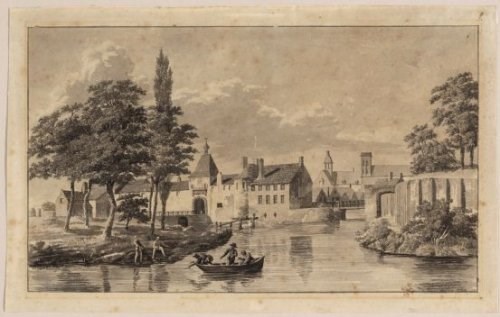
Oorspronkelijk stonden hier drie poorten (de Sint-Nikolaaspoort, ook wel Koolkerkse Poort genaamd, de Sint-Leonarduspoort, ook wel Dudzelepoort genaamd, en de Spejepoort). Deze werden vervangen door de Dampoort die echter rond 1870 ook werd gesloopt. Als je goed kijkt, kan je echter nog wel een stukje herkennen van één van de verdedigingstorens in de bistro die er is gehuisvest.
VRAAG: Wat is de naam van de bistro?
| The Cosy Bistro |
E=0 |
| Bistro Tableau |
E=4 |
| Bistro Du Phare |
E=8 |
| Bistro Maurice |
E=6 |
WP6: Ezelpoort - N 51 12.929, E 3 12.937
Bij de aanleg van de omwallingen in 1297, wordt ook de Ezelpoort gebouwd. In 1369 wordt de poort herbouwd en tot 17de eeuw volgen nog verschillende aanpassingen. Uiteindelijk wordt de bovenbouw afgebroken. De benedenpoort blijft al die tijd bewaard. In 1906 wordt de poort grondig gerestaureerd. De laatste restauratie dateert van 1991-1993. Vandaag huisvest de Ezelpoort het orkest Anima Eterna Brugge.
VRAAG: welke tekening hoort bij deze poort (zie onderaan)
| Tekening A |
F=3 |
| Tekening B |
F=1 |
| Tekening C |
F=7 |
| Tekening D |
F=5 |
WP7: Smedenpoort - N 51 12.276, E 3 12.738
De eerste Smedenpoort dateert van 1297-1299, op die restanten werd in 1367 het huidige exemplaar gebouwd. Door de eeuwen heen onderging de poort vele veranderingen. De bronzen schedel boven de linkerdoorgang herinnert aan de terechtstelling van François Vander Straeten die op het eind van de 17de eeuw vijandige Franse troepen de stad wou binnenloodsen. Zijn afgehakte verradershoofd sierde daarna lange tijd de poort.
VRAAG: welke tekening hoort bij deze poort (zie onderaan)
| Tekening A |
G=2 |
| Tekening B |
G=4 |
| Tekening C |
G=5 |
| Tekening D |
G=6 |
FORMULE STASH
N51 12.ABC E003 1D.EFG

English
The gates of Bruges were built in three phases. The first time during the first half of the 9th century, when fortifying the ‘Burg’, a second time in 1127-1128, when building the first town walls (current canals (‘reien’) of Bruges). A third time in 1297 while building the second and bigger town walls around the city.
WP 1: Boeveriepoort - N 51 12.058, E 3 12.921
The first Boeveriepoort was put into use in 1312 and has already been rebuilt in 1366-1367 by Jan Slabbaert. As early as 17th century, it was very run down and she was partially demolished, only to be rebuilt for the last time in 1807; a life of short duration because it was demolished definitively in 1863. Except for the name, currently used for the place where the gate once stood, only the remains of the foundations can still be seen in the canal when there is not much water in it.
QUESTION: Near the coordinates you’ll find an iron fence/gate. If you look closely you can recognize words… What word is on the left fence part at the end of the second line.
| Bladzijde |
A=9 |
| Dag |
A=7 |
| Schone |
A=1 |
| Achtergrondmuziek |
A=4 |
WP2: Katelijnepoort - N 51 11.988, E 3 13.778
The Katelijnepoort was realized in 1297. The gate led then to the St. Catherine Parish, whose church was outside the city walls. But that church was demolished in 1578. Already in 1401 the Katelijnepoort was dilapidated. After demolition it was rebuilt immediately. The frontgate was only rebuilt in 1753. In 1782 the inner gate was demolished; the rest of the complex followed in 1862.
QUESTION: Close to the current Katelijne gate bridge, you can find an image at the top of the facade of the bar Baron Ruzette:
| sun |
B=6 |
| stars |
B=4 |
| moon |
B=2 |
| earth |
B=3 |
WP3: Gentpoort - N 51 12.183, E 3 14.076
The Gate of Ghent is one of four remaining medieval city gates. An entrance for foreigners, a border with the outside world for the townspeople of Bruges. The gate was a part of the city’s defences as well as a passageway for the movement of produce and merchandise. Note the statue in the niche above the roadway: this is Saint Adrian, who was believed to protect the city during times of plague. The Ghent Gate is at its most beautiful in the evening, when it is quite literally in the spotlight.
The Gentpoort, along with the Kruispoort and the Katelijnepoort, was designed by Maarten van Leuven and Jan van Oudernaerde. The gates were all built around the same time, between 1400 and 1406.
Visitors to the museum will discover how the city and her ramparts slowly grew and how important city gates were for the medieval Bruges during wartime.
QUESTION: what painting do you associate with this gate (scroll below)
| Painting A |
C=1 |
| Painting B |
C=7 |
| Painting C |
C=3 |
| Painting D |
C=6 |
WP4: Kruispoort - N 51 12.754, E 3 14.403
The first Kruispoort was built simultaneously with the second rampart (1297-1304) and already rebuilt in 1366. Philip van Artevelde destroyed the gate when he captured the city with the Ghent militia in 1382. In 1400 the third gate was constructed. Only the two heavy towers with their narrow passage and two octagonal turrets were preserved. Holy Roman Emperor Charles V, Napoleon and the German army all entered Bruges through this gate.
QUESTION: what painting do you associate with this gate (scroll below)
| Painting A |
D=8 |
| Painting B |
D=1 |
| Painting C |
D=2 |
| Painting D |
D=5 |
WP5: Dampoort - N 51 13.283, E 3 13.970
Originally there were three gates (St. Nicholas Gate, also called Koolkerkse Gate, St Leonardus Gate, also called Dudzele Gate, and Spejepoort). These were replaced by the Dampoort which, however, was demolished around 1870. However if you look closely, you still can recognize a piece of one of the defense towers where a bistro is housed. What is the name of the bistro?
| The Cosy Bistro |
E=0 |
| Bistro Tableau |
E=4 |
| Bistro Du Phare |
E=8 |
| Bistro Maurice |
E=6 |
WP6: Ezelpoort - N 51 12.929, E 3 12.937
The Ezelpoort was built during the construction of the second ring of ramparts in 1297. It was rebuilt in 1369 to a new design by Jan Slabbaerd and Mathias Saghen, who were also responsible for the construction of the Boeveriepoort and the Smedenpoort. Various alterations were carried out between the 14th and 17th centuries. The lower section of the brick gate is authentic, but the old medieval gate was much higher. The original appearance of the gate was significantly altered in the 17th century, following the removal of the top part of the structure.
QUESTION: what painting do you associate with this gate (scroll below)
| Painting A |
F=3 |
| Painting B |
F=1 |
| Painting C |
F=7 |
| Painting D |
F=5 |
WP7: Smedenpoort - N 51 12.276, E 3 12.738
The first Blacksmith’s Gate (Smedenpoort) dates from 1297-1299; the current gate was built on the remains of the old one in 1367. Throughout the centuries the gate has undergone many changes. The bronze skull above the left passage recalls the execution of François Vander Straeten, who wanted to let hostile French troops into the city at the end of the 17th century. The severed head of this traitor was fixed to the gate.
QUESTION: what painting do you associate with this gate (scroll below)
| Painting A |
G=2 |
| Painting B |
G=4 |
| Painting C |
G=5 |
| Painting D |
G=6 |
FORMULE STASH
N51 12.ABC E003 1D.EFG
Foto / Photo A:

Foto / Photo B:

Foto / Photo C:

Foto / Photo D:

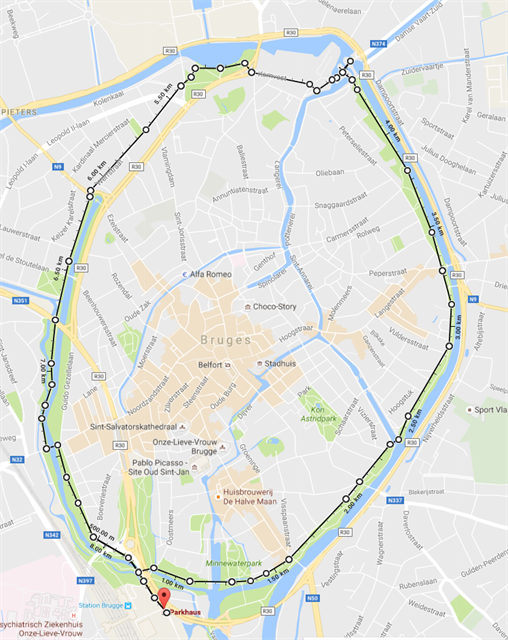
Wandelroute / hiking map:
Links: