The coordinates will take you along a public footpath to a river bank and a nearby waterfall through the site of the derelect Neath Abbey Ironworks .
The River Clydach or Afon Clydach is a small river in the county borough of Neath Port Talbot, Wales. It runs generally southwards from the western slopes of Mynnydd Marchywel for about 9 km and past Fforest Goch, Bryncoch and Neath Abbey to join the Neath River in the town centre. For generations the river was used to produce energy for industry.
Successive ice ages, in the last couple of million years , have shaped the Vale of Neath and gouging out by glacial ice has reduced its floor by hundreds of metres lower than it would have been prior to the ice ages. This has resulted in the various tributary rivers of the Neath being rejuvenated - cutting down into their beds to form the deep gorges, such is the case here.
A gorge is a very deep crevice between two mountains or hills. Gorges are formed by rivers running through and eroding rock over a very long period of time. The Latin root of gorge means "throat," or "narrow passage". This constriction is an important reason the site was chosen to harvest hydro-power, (hint Q1).
In the late Westphalian, the influx of arenaceous fluvial channel deposits formed the Pennant Sandstone Formation and the overlying mudstone-dominated fluvial floodplain deposits of the Grovesend Formation.
What this means is that rock that you see in front of you has been washed in by a river (fluvial) and is mainly composed of sediment which is quartz sand (arenaceous) . You can see the grains clearly. The underlying rocks are mudstone which is made up of tiny clay particles (less than 0.05mm) that can’t be seen with the naked eye. These tiny particles are deposited in quiet low-energy environments like tidal flats, shallow lakes, etc.
The importance of waterfalls in this area is that they are likely to be at the interface of GEOLOGICAL AGES That is, a marked climate change and/or significant earth movement, when this area was close to the equator. It was part as part of Pangea, also spelled Pangaea, a super-continent that included the today's land masses. Then all continents were joined, from about 300 to 200 million years ago. It is believed to have been in existence before the continents broke apart during the Triassic and Jurassic Periods.
 You are standing in a gorge where you would expect "down-cutting" into the bedrock of softer mudstone, whilst sandstone beds offer more resistance, and are responsible for the falls and rapids. This often occurs at other sites in this valley.
Waterfall formation.
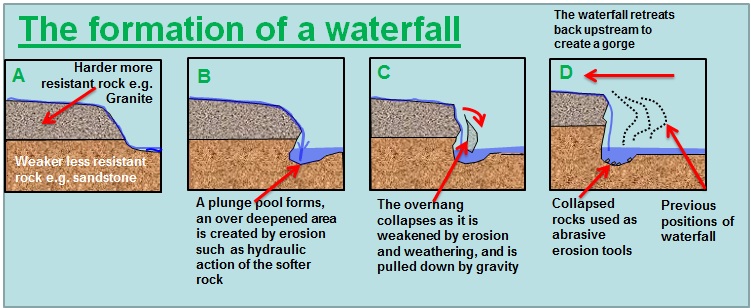 <.
<.
(NB There is no granite locally, as in the illustration, but the principle is the same), .
Hydroelectric energy is made by moving water. "Hydro" comes from the Greek word for water. Water power has been in use for thousands of years. Ancient Romans built turbines, which are wheels turned by flowing water. Roman turbines were not used for electricity, but for grinding grains to make flour and breads.
Water mills provided another source of hydro-energy. Water mills, which were common until the Industrial Revolution, are large wheels usually located on the banks of moderately flowing rivers. Water mills generated energy that powered such diverse activities as grinding grain, cutting timber, or creating hot fires to smelt iron.
Just below this waterfall a forge and rolling mill was constructed by Neath Abbey Ironworks in 1825, using a water-wheel for power. However, in 1870 the forge was converted to a textile mill.
Your walk takes you through the ruins of what was once the Neath Abbey Ironworks. The listed blast furnaces, were set up in 1793. Their purpose was to produce pig iron for sale and for their Cornish mines. The Works received the patronage of Richard Trevithick and built engines for him.

A VIEW FROM ABOVE OF THE OLD IRON WORKS THE BLAST FURNACES AND THE VIADUCT
The Works produced the cast iron rails for the Stockton and Darlington Railway, and George Stephenson visited Neath Abbey to see the rails being produced. Sir Benjamin Baker of Forth Bridge fame served his apprenticeship here.
Here, where you stand, upstream from the furnaces, was a forge and rolling mill which, being constructed in 1825, used water from this the Clydach River. The site was then converted to produce textiles. The Neath Abbey Woollen Mill was to survive until the 1970's. It was the last of the major mills in the area to close. The contents of the Mill were moved to the Swansea Maritime & Industrial Museum as a working exhibit.
Initially the woollen mill was powered by an enormous, twenty ton water-wheel and later by a water turbine, and the pool above these falls has also been used by locals for hundreds of years for bathing and swimming.
LOGGING REQUIREMENT
VISIT THE SITE, STAND AT THE GIVEN COORDINATES and also wander up above the waterfall.
Then CONSIDER THE QUESTIONS and then message or email us your responses. Go ahead and log your find, but PLEASE don't put answers in your log. I will you contact ASAP either through the message centre or email.
1. Can you suggest why the geology and the landscape you see has made this is a good place for turbines, even centuries apart?
2. Describe the rocks around the waterfall. Can you see any differences?
3. Is this a 100% natural waterfall, if not, say what you see and why you think the work was done? Give a description to support your view
4. This ALWAYS was an industrial site. How would you feel about a new project to use river again to produce energy, albeit in a different form from the 1800’s? ~ “Blessing or a curse?” what do you think?
By all means, DO POST PICTURES, BUT AVOID SPOILERS.
Well done "Jabawokee" on your answers and your FTF