
Biotite is a name used for a large group of black mica minerals that are commonly found in igneous and metamorphic rocks. These include annite, phlogopite, siderophyllite, fluorophlogopite, fluorannite, eastonite, and many others. These micas vary in chemical composition but are all sheet silicate minerals with very similar physical properties.
A generalized chemical composition for the biotite group is:
K(Mg,Fe)2-3Al1-2Si2-3O10(OH,F)2
The name "biotite" is used in the field and in entry-level geology courses because these minerals generally cannot be distinguished without optical, chemical, or x-ray analysis.
Biotite is a primary mineral found in a wide range of crystalline igneous rocks such as granite, diorite, gabbro, peridotite and pegmatite. It also forms under metamorphic conditions when argillaceous rocks are exposed to heat and pressure to form schist and gneiss. Although biotite is not very resistant to weathering and transforms into clay minerals, it is sometimes found in sediments and sandstones.
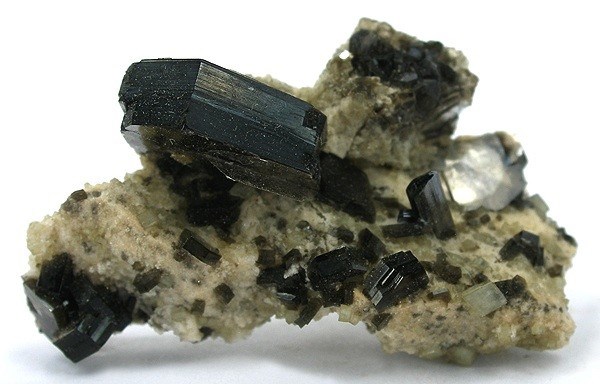
Properties of Biotite
Biotite is very easy to identify, and with a little experience a person will be able to recognize it on sight. It is a black mica with perfect cleavage and a vitreous luster on the cleavage faces. When biotite is separated into thin sheets, the sheets are flexible but will break upon severe bending. When held up to the light, the sheets are transparent to translucent with a brown, gray, or greenish color. Experienced observers can sometimes recognize phlogopite by its brown color.

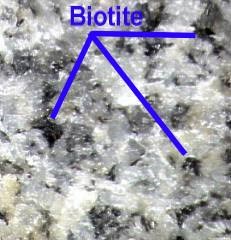
You will normally find the biotite like this in a stone, and not in a big sized mineral as the photos above, so here is what you will be looking for at the stone at gz. (Example photo under, not from gz)
To log this cache.
To get to log this cache you will have to read the cache text and visit the coordinates given. After that you will have to answer the questions which are related to the text and the coordinates given.
When answers are collected, send them to CO for verification. I will accept answers sent via email or through the Message Centre.
You can log immediately after answers are sent the CO. If there are any questions about your answers CO will contact you.
Logs without answers to CO or with pending questions from CO will be deleted without any further notice.
Please do not include pictures in your log that may answer the questions.
Questions
1. Answer the questions under by visiting the Coordinates.
A. How can you easily identify the Biotite? Also describe the biotite at GZ with its shape and colour
B. The coordinates lead you to the Gordon Highlander statue. Have a look around the statue - what percentage of the rock, do you think, is made up of biotite?
C. What average size are the black 'spots' that you find within the rock?
D. At the back part of the stone where you can read: “… the finest regiment in the world”, do you think there are more spots to find at this part of the stone than the other three sides?
2. It’s voluntary to post a photo in your online log. Without revealing any answers!
