Geology of the Australian Alps
Because the Australian Alps cover a large area, they display a wide range of rock types and a complex geological history spanning 520 million years.
When talking about the geological history, I use the abbreviation Ma to mean "million years ago".
There is still debate about when the Australian Alps came into existence, with some geologists arguing that they arose only a few million years ago, while the majority argue that the Alps arose around 100-60 Ma, based on evidence collected over the last 30 years. This account takes the majority view.
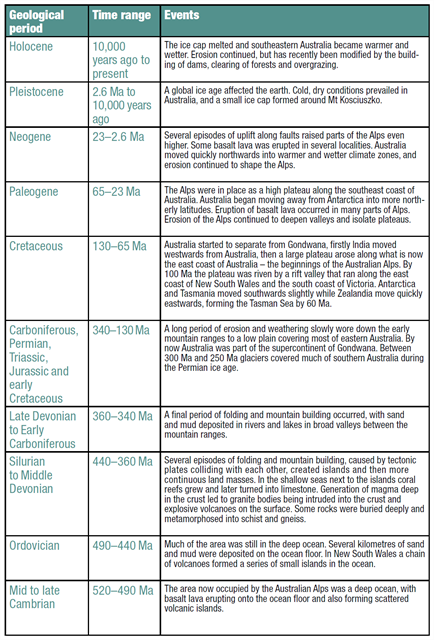
About 130 Ma stirrings in the deep mantle began to break up eastern Gondwana. Australia began the long process of breaking away from Antarctica and Zealandia (a now largely submerged continent stretching from New Zealand to New Caledonia). The process began with magma moving upwards into the lithosphere, causing it to heat and expand upward, forming a dome-shaped plateau running along what is now the east coast of Australia. By 100 Ma the plateau was possibly over 2000 m high in its highest area, the site of today’s Australian Alps. Gondwana split apart along this line of magma upwelling, and a rift valley formed along the centre of the plateau, with an east-west trending branch where Tasmania moved southward away from Victoria. The rift valley, similar to today’s East African Rift Valley, was formed by stretching of the crust leading to the valley floor dropping along a series of faults.
Zealandia moved eastwards, with the Tasman Sea filling in the gap, while Tasmania only moved a short distance southwards, forming the shallow Bass Strait. The Australian Alps were left behind as a remnant of the original plateau, with a steep seaward side and a gentle slope toward the inland. |
 |
A brief resume of the Australian Alps region's history:
Are the Australian Alps geologically unique?
The shape of the Australian Alps is quite different to that of the more famous mountain ranges such as the European Alps or the Himalayas. Those mountains contain many sharp peaks and deep glacial valleys. In contrast, the skyline of the Australian Alps is rather flat and rounded. It is often said that this is because the Australian Alps are much older than the European Alps and Himalayas, and erosion over time has worn them down. However this is only a small part of the answer.
There are two main reasons the Australian Alps are flat and smooth. Firstly, they originated by a different plate tectonic process, continental splitting, rather than continental collision which formed the European Alps and the Himalayas. Uplift in continental collisions is much faster and often of greater magnitude than the slow process of uplift during continental splitting. Secondly, the Australian Alps were never high enough to have large ice sheets and glaciers, and it is the erosion by ice that produces the sharp and jagged peaks of the Himalayas and European Alps.
But around the world there are many mountain ranges formed in the same way as the Australian Alps.
Geology of Mt. Buffalo
Formed well below the earth’s surface hundreds of millions of years ago as molten rock from the mantle tried to force its way to the surface (but it did not succeed) the rock that is now the mountain formed a huge bubble underground and then cooled, forming granite with an unusual weathering characteristics (it tends to peel away like an onion which accounts for the rounding of the cliffs and boulders). The most common minerals in this type of rock that are easy to see are quartz (white and hard), felspar (often cream, light pink or brown) and mica (the black or silver shiny bits).
Time wind, water and ice have eroded away the overlying rock leaving behind the mountain's amazing granite formations. The sedimentary rocks that originally covered the area (and some of the metamorphic rocks of the contact zones) can still be seen at places on the road to the mountain top.
Granite
Granite is a common type of felsic intrusive igneous rock that is granular and phaneritic in texture (the crystals are large enough to be distinguished with the unaided eye). It is currently known to exist only on Earth, where it forms a major part of the continental crust. Granites can be predominantly white, pink, or gray in color, depending on their mineralogy. The word "granite" comes from the Latin granum, a grain, in reference to the coarse-grained structure of this rock. By definition, granite is an igneous rock with at least 20% quartz and up to 65% alkali feldspar by volume. Granite is a very hard type of rock. It's hard because it formed as hot liquid stone, and so the molecules inside it are all jumbled up any which way, instead of lying in layers as in sedimentary rocks like limestone or slate. The speed at which granite cools directly relates to the size of the crystals. The slower the cooling is, the more time the minerals have to form large crystals.

TO LOG:
Before logging this cache as visited, please send me the replies to the following questions using the link in my profile. Logs without permission will be deleted.
Questions:
- What is the grain size of the Monolith? (refer to the simple schema above)
- Based on the size of the crystals, did this granite cool down slowly or quickly?
- What are the predominant colours of this granite?
- Who was the first to perform a recorded climb of the Monolith? When? (month and year)
- How many people do you count in the ladder’s picture?
- Are the Australian Alps geologically unique? Why?
- Add a picture of you and your GPS at the Monolith.
References:


