A brief summary of a survey of FTF motivations: Methods
A year ago, I posted an open-ended question to some of my geocaching groups on social media (mostly Ontario-based), and asked what they feel their motivations are for seeking FTFs. I collected 21 responses and analyzed these responses for common themes. It's common to make up a questionnaire from your own perceptions of what is important to ask, but it's a bit more scientifically valid to first probe what a large group of people feel are the important themes, and design your questions around that. The preliminary results I got were as follows:
Number of times each theme was mentioned by 21 respondents:
Spontaneous opportunity to cache (3)
To meet other cachers (8)
To look for something unknown/original hide (4)
The challenge/competition aspect (9)
Adrenaline rush to be first/thrill/excitement (5)
Love when an accidental one happens (1)
No other clear themes were mentioned by these first respondents. I used the responses to create the questions in my short quiz, which asked for gender, age, # of FTFs, one main motivation for seeking FTFs, all motivations for seeking FTFs, and rating of each motivation on a 7 point scale.
The method of first collecting open-ended responses and then analyzing them for common themes is frequently used in the social sciences, and seems to have social validity in this case as well. One survey-taker commented: "Great survey. The questions are spot on." Another factor that is evidence that the questions were socially valid was the fact that only 6/100 people felt the need to add an "other" category to the question regarding their one main motivation for seeking FTFs.
141 people have taken the survey to date; however, I was only able to analyze the data of the first 100 people, as that is all the free version of the survey website allows me to see. If you would like to take the survey and add to the data pool that someone else may one day eventually use, you can do so here: Click Link.
Results
I like visual representations of data and find them helpful, so I have taken screenshots of the answers to each of the 6 questions. These first three are the descriptive data of the first 100 people to take the questionnaire:
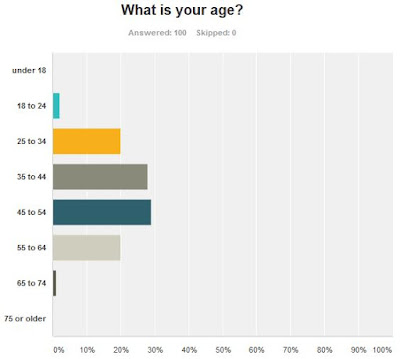
58% of people were in the 35-54 range. Even though many individuals say they only have the opportunity to seek FTFs because they are retired, or that they DON'T seek FTFs because they have jobs, it appears that a significant number of geocachers in the non-retired age ranges still nevertheless find ways to seek FTFs.
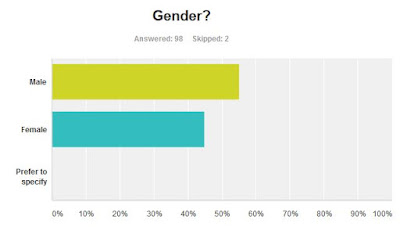
55% males and 44% females. I'm not sure if I have a large enough sample size to say that this is representative, however, so take the gender differences with the necessary grain of salt. 2 individuals elected to leave this question blank, despite the 'prefer to specify' option. One person did select this option and wrote "caching team", but since this was intended to find out personal feelings towards FTFs I was concerned that someone trying to respond for two people at once would give inaccurate results, so I opted to remove this data from the main results like a good researcher, while keeping any of their valuable written comments.
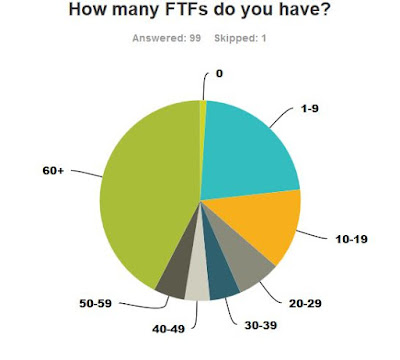
36% of people had 0-19 FTFs; 21% had 20-59; and 42% had 60+. I found it interesting that, according to this data, people either have a very modest amount of FTFs (0-19) or a really large amount (60+).
These next three images show their answers to questions. I've made some notes with further explanations of data under each image; I'll discuss/interpret the data further at the end.

This is, perhaps, the most interesting result. When given a forced choice, 58% of people said their main reason for seeking FTFs was to experience an adrenaline rush or a sense of excitement. Only 7% said their main reason was to compete with other geocachers. 3% said it was to meet other cachers, and 8% said it was to look for something that no one has seen before. A modest amount (17%) said it was for a spontaneous opportunity to go caching. 6 people used the "other" category to give me their own main reason: if it just happens to occur; can no longer get them due to having inside knowledge of when they will be published; for statistical reasons; to give new excitement to the game; opportunity to give unbiased feedback on location and placement; FTF prizes). One person apparently just couldn't decide and left the question blank!
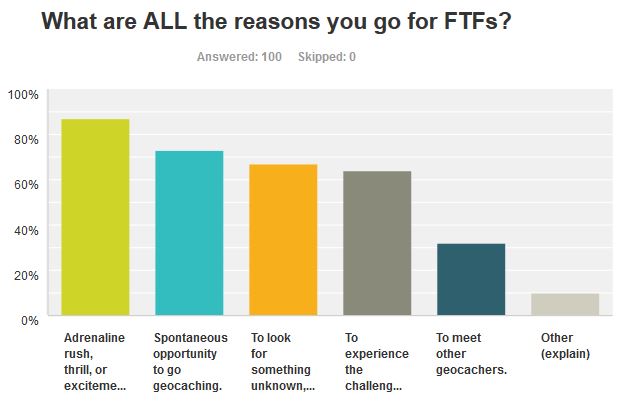
87% of people chose the adrenaline rush as at least one reason they seek FTFs. Meeting other cachers was only chosen as a reason by 32% of individuals, which is still about a third. The "other" responses that were given were as follows: Complete an FTF calendar/keep streak going (x4); seeing a cache as owner intended (x2) (could fall into something unknown); to experience fun stories that can be re-told at gatherings (could fall into meeting other cachers) (x1); FTF prizes (x1); to get themselves out of the house (x1) (could fall into spontaneous opportunity); nice to get but they don't go out of their way (x1).

Individuals were asked to rate how strongly they felt about each of the motivations, and their data was averaged. It seems that people feel the most strongly about the adrenaline rush/thrill, but that looking for something unknown, the spontaneous opportunity to cache, and experiencing a challenge with other cachers are also moderate motivators. 26% of people rated meeting other geocachers as a 5-7 on the scale, which matches the rough third of geocachers that reported it as a motivation at all in the previous question.
Discussion
Disclaimer: The following discussion of the results is my best attempt to uncover the story that the data is telling, by looking at averages and patterns. It is by no means an attempt to say that all FTF-seekers fall into this story; there are many people who do it for different reasons than the majority. This is what quantitative research does - it looks for majority trends and significant patterns, while recognizing that those that fall outside these patterns have valid stories and truths as well... spin-off research projects are often created from these "outliers"! So, if you're one of the outliers and find these interpretations don't apply to you, fear not - perhaps one day someone else will continue this preliminary research and uncover further patterns that you feel you better fit into!
While many people anecdotally report that one of their main reasons for seeking FTFs is to encounter other geocachers, and non-FTF seekers seem to believe that the FTF-ers do it for competition, the data tells a different story.
A significant number of people (87%) seem to race to be first to experience a sense of thrill or excitement during the drive or hike to the cache, and anecdotally report not minding so much if someone gets there before them, because it is the race that motivates them. Once you arrive and open the logbook to see if you're first, the thrill is over.
There seems to be about a third of geocachers that expressly report running into other geocachers as one of their main reasons for racing to get to a cache first. This desire for spontaneous human encounters with other people that share the same interest is intriguing. Surely it would be easier to message a random geocacher and plan an actual date to meet each other - why is the spontaneous encounter so much more enticing for this third of cachers? Perhaps it lies in the motivations that draw people to geocache in the first place. That desire to find something unexpected, hidden, unknown doesn't just apply to containers in the woods, perhaps it applies to people, too.
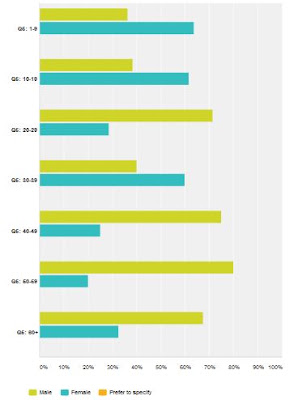
# of FTFs by gender
The website allows for some comparisons of data between questions, and I did notice some interesting things. Individuals who have 40+ FTFs are more likely to be male (74%). (Again, I'm not sure I have a large enough sample size to be representative).
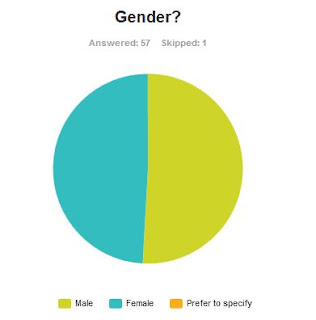
Gender differences in those who selected adrenaline rush/thrill/excitement as their one main reason
Another interesting thing was that there were no gender differences between males and females when it came to who selected the adrenaline rush as the one main reason for their FTF seeking.
There were no real age differences that I could tell from my sample - people of all ages were equally likely to have any number of FTFs as well as seek them for the thrill/excitement/adrenaline rush reason. 100 people was too small a sample size to make comments about any of the differences in age, gender, or # of FTFs for any of the other reasons.
Conclusions
I'd like to thank everyone that participated in my questionnaire - interesting and meaningful data/research is not possible without volunteers like you! The fact that so many people took the survey in such a short amount of time was fascinating in and of itself. We all engage in a variety of unique behaviours each and every day, and many of them can be incomprehensible to the people around us.
One example of this is the motivation that causes many geocachers to drop what they are in the middle of doing when they get an email of a newly published cache, hop into their car, and drive off - sometimes to a different city! It seems bizarre to those around us that are not geocachers.
Perhaps this mini-research project of mine will help shed some light on the nature of this behaviour, and the next time someone stares at you funny when you tell them about your FTF-seeking, you can direct them to this page. For what the data shows clearly is that for the large majority of FTF seekers, the sense of thrill, excitement, and the adrenaline rush are the strongest motivators. These are common human experiences that many people can relate to. Why do we get worked up over watching our favourite sports team? Why do we play board games with each other? Why do we engage in extreme sports like bungee jumping? Why do we travel to new countries, try a new recipe, meet a new friend, perform art on stage in front of thousands?
There are obviously dozens of different components to all of these things, but one common thread that runs through much of human behaviour is that desire for newness, a sense of thrill, excitement, or even that adrenaline rush. This is something people can relate to. So the next time someone looks at you strangely when you tell them you hopped into your car at 11pm at night, in your pajamas, and drove for an hour and a half to go look for a plastic container hidden in the woods with a headlamp, you can reassure them that you are just seeking an adrenaline rush in the same way that they themselves probably seek in their own unique way, and find a bond in your common human experience.
Questions:
A. What percentage of people had more than 60 FTFs? Minus 3.
B. What percentage of people said their main reason for seeking FTFs was to compete with other geocachers?
C. How many people couldn't decide what their main reason was? Minus 1.
D. What percentage of people said their main reason for seeking FTFs was for the adrenaline rush? Take the first digit of that number and minus 2.
E. What percentage of people chose adrenaline rush as AT LEAST ONE of the reasons they seek FTFs? Minus 68.
F. How many people skipped answering the question in the third-last image on this page?
G. Are there gender differences in those who seek FTFs for the adrenaline rush? Yes = 7, No = 3.
H. How many people seek FTFs to keep some sort of streak going?