Please note coords are slightly out so you can see the other physical cache that is here.
Mt Buffalo Geology
Welcome to Torpedo Rock at Mt Buffalo in the Alpine National Park. Formed well below the earth’s surface hundreds of millions of years ago as molten rock, the mantle tried to force its way to the surface (but it did not succeed) the rock that is now the mountain formed a huge bubble underground and then cooled, forming granite with an unusual weathering characteristics. Time wind, water and ice have eroded away the overlying rock leaving behind the mountain's amazing granite formations. The sedimentary rocks that originally covered the area (and some of the metamorphic rocks of the contact zones) can still be seen at places on the road to the mountain top.
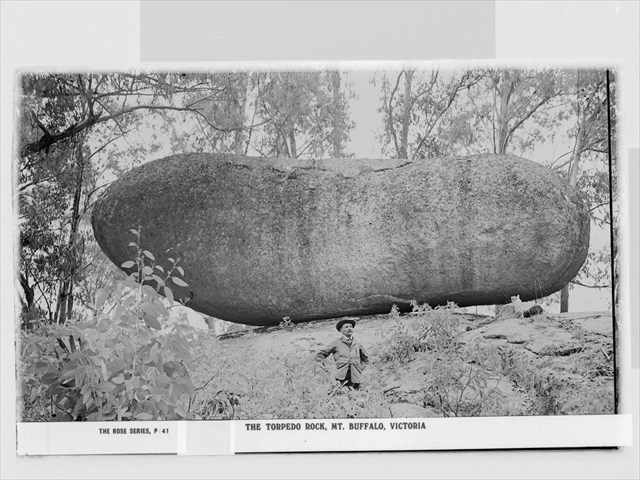
Lone Rocks
Usually, when there is just a lone roundish rock, it indicates that the rock was formed elsewhere and then shaped and carried to its location by processes such as glaciation. These are appropriately called erratics. Sometimes, though, a lone boulder can be native to an area and be shaped through the weathering and erosion process.
Glacial Erratics
A glacial erratic is a piece of rock that differs from the size and type of rock native to the area in which it rests. Erratics take their name from the Latin word errare, and are carried by glacial ice, often over distances of hundreds of kilometres. Erratics can range in size from pebbles to large boulders. Geologists identify erratics by studying the rocks surrounding the position of the erratic and the composition of the erratic itself. Erratics are formed by glacialice erosion resulting from the movement of ice. Glaciers erode by multiple processes: abrasion/scouring, plucking and ice thrusting. Glaciers crack pieces of bedrock off in the process of plucking, producing the larger erratics. In an abrasion process, debris in the basal ice scrapes along the bed, polishing and gouging the underlying rocks, similar to sandpaper on wood, producing smaller glacial till. In ice thrusting, the glacier freezes to its bed, then as it surges forward, it moves large sheets of frozen sediment at the base along with the glacier.
Weathering and Erosion
Large granite blocks are formed when magma (liquid rock) crystallises and hardens deep in the earth's crust. Thick layers of sandstone on top of the granite exerted extreme downward pressure on the granite. Physical and chemical weathering then occur. Mechanical or physical weathering involves the breakdown of rocks and soils through direct contact with atmospheric conditions, such as heat, water, ice and pressure. Chemical weathering, involves the direct effect of atmospheric chemicals or biologically produced chemicals also known as biological weathering in the breakdown of rocks, soils and minerals. Erosion then occurs exposing the top layer of the granite formation, which can then expose the boulders. Water and wind erosion now takes away the surrounding gravel and soil, and contributes to further rounding. Over time this continuous process sometimes exposes rounded boulders.
Logging the Cache
Your task is to answer a few simple questions:
1. Estimate the height (in the centre) and circumference (tip to tip) of Torpedo Rock.
2. Do you think this lone rock was carried here (ie. is it erratic), or do you think it was formed right here by erosion and weathering of the surrounding granite? Why do you think this?
Once you complete the Earthcache requirements you can post your find without delay, as per the guidelines. You will also need to verify your find by sending me an email providing answers to the questions. This can be through the message centre or via gemmasiemensma@gmail.com
Thanks for visiting this Earthcache. I hope you enjoy it.