An ANSI is an Area of Natural and Scientific Interest that holds a Life or Earth Science value that relates to the environment. The Quarry Wall is recognized by the City of Hamilton, and the Ministry of Natural Resources and Forestry, as an Earth Science ANSI. It highlights the Guelph and Eramosa Formations that you can see in the exposed bedrock wall.
These formations belong to the distinct geological Albemarle Group, which was formed approximately 430 million years ago during the Silurian Period, in the Paleozoic area.

(https://media1.britannica.com/eb-media/37/136137-004-E08437F3.jpg)
The earth has changed significantly since this wall was formed. As the picture illustrates, the area that you are standing on today was once a shallow sea. This wall was formed by hundreds of thousands of years of sediment and sea life falling to the 0cean floor and eventually compacting to form the calcium rich limestone that you can see before you now.
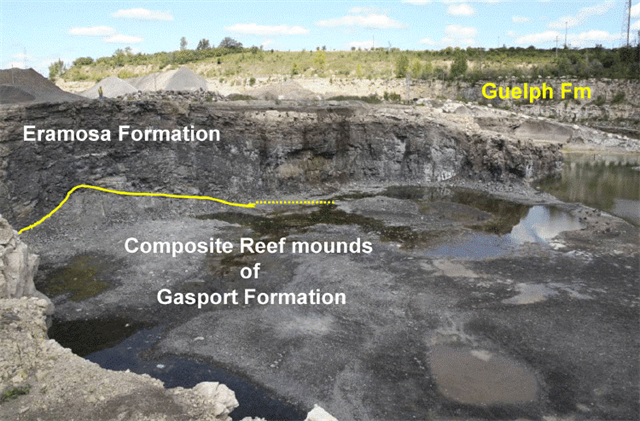
The Quarry Wall is exposed because man has found use and profit to take from the earth and change what he finds there into what he needs. The rock that is extracted here is classified as bituminous dolomitic limestone. There are two benches, (defined as a ledge in a mine or quarry from which work is carried out.) The top bench is primarily the Guelph Formation and is metallurgical grade limestone prized by the steel industry. The bottom bench is primarily in the Eramosa Formation and is dolostone. The picture below was taken in the Guelph Dolime Quarry area, and illustrates the difference between the two formations.
(https://www.researchgate.net/profile/Frank_Brunton/publication/304540214/viewer/AS:378021472161792@1467138750529/background/11.png)
Limestone in the Steel Industry
“The top bench is primarily the Guelph Formation and is metallurgical grade limestone prized by the steel industry.”
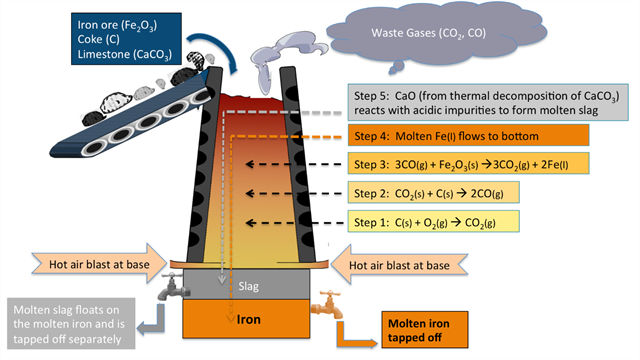
Metallurgy is defined as the science of working or heating metals so as to make or compound alloys, and/or separate metals from their ores. Steel is an alloy of Iron (usually Iron and Carbon plus various other elements). In order to make Steel, you first need Iron. Iron ore is a naturally occurring element, man uses blast furnaces to purify it and that is where limestone comes into the picture.
(http://www.steel.org/making-steel/how-its-made/processes/how-a-blast-furnace-works.aspx
Basically limestone is used as a slag former. The process of iron making is to reduce iron ore to produce iron. Iron ore is not pure, it normally contains other elements such as silica, alumina, sulphur and phosphorus. Removal of these is done by adding limestone, which is composed primarily of calcium; and coke, which is baked carbon, with the iron ore. A series of chemical reactions occur when the mixture is heated to extremely high temperatures (2000-2300’C) inside the blast furnace. The end result is the limestone combining with the impurities in the iron ore to produce slag. Slag consists of low melting point complex compounds such as calcium silicate, calcium aluminate etc. The molten Slag floats on top of the molten Iron, and is tapped off separately. The now-refined pig iron goes on to be further processed to produce steel.
To log this earthcache, send me the answers via my profile, do not answer in your log!
1-The plaque at posted coords: What is special about the fish that made its first appearance in the Silurian Period?
2-Estimate how high the quarry wall is
3-Using the picture on the cache page and your own observation, can you differentiate the Guelph formation and the Eramosa formation? Describe if you can.
4-Name 4 items at or near GZ that are made with iron, or an iron compound.
Thank you for visiting!
Resources
http://ispatguru.com/limestone-and-dolomite-flux-and-their-use-in-iron-and-steel-plant/
http://www.lafargedundas.com/questions-and-answer/
https://secondaryscience4all.files.wordpress.com/2014/07/blast-furnace-iron-extraction.png
http://www.dictionary.com/browse/metallurgy
http://www.thefreedictionary.com/bench
http://www.steel.org/making-steel/how-its-made/processes/how-a-blast-furnace-works.aspx
https://media1.britannica.com/eb-media/37/136137-004-E08437F3.jpg">
https://www.researchgate.net/profile/Frank_Brunton/publication/304540214/viewer/AS:378021472161792@1467138750529/background/11.png
https://media1.britannica.com/eb-media/37/136137-004-E08437F3.jpg