Warning!!! The geocache is not at the posted coordinates!!! Do not look there!!!
Read below to learn how to solve a puzzle and find the actual geocache coordinates.
You do not have to go off the path!! Do not go over the rail!!
Good Luck
Puzzle caches take a lot of time to create and maintain, so if you would like me to continue placing quality caches, please don't leave generic logs like "TFTC" or "I found it at 12:00". Logs like this are rude to the cache owner and show a lack of appreciation. Thanks
퍼즐 캐시는 만들고 유지하는 데 많은 시간을 필요로하기 때문에 계속해서 고품질 캐시를 배치하려면 "TFTC"또는 "12:00에 찾았습니다"와 같은 일반 로그를 남기지 마십시오. 이와 같은 로그는 캐시 소유자에게 무례하고 감사의 부족을 보여줍니다. 감사합니다
Hello Geocachers! There are many of us out there who are addicted to the thrill of geocaching, and there are many types of geocaches. I don't know about you, but whenever I find a great geocache I get excited that I was able to figure out where it was hidden. However, with puzzle caches I get to experience that thrill twice, once when I solve the puzzle and then again after I find it.
After setting up many puzzle caches in Korea I have noticed that there are quite a few geocachers who actively avoid finding puzzle caches. Perhaps it is because the puzzle seems difficult, is a tedious extra step to excitement, or just don't know where to start. I want everyone to experience the joy of finding puzzle caches so I have set out to create a new series of easy puzzle caches designed to teach you how to become a puzzle master.
This puzzle is a teaching puzzle designed to teach about mathematics puzzles. However, it seems that this kind of puzzle, while common elsewhere, is not common in Korea and therefore a bit more difficult than geocachers expected. I'll be creating a series of puzzles that will hopefully be able to help anyone solve each and every mystery and give them the tools to do so. More mathematics beginners, and intermediate lessons will be introduced later. This is the advanced mathematics puzzle.
Mathematics is one of the most popular methods used on puzzle caches in Korea. This kind of puzzle can be found all over the country. Some using equations that must be solved and others asking you to find a number in a long string of numbers.
Irrational Constants e π φ γ
These may not look like numbers but they all represent mathematical constants. These can be cleverly used in geocaching puzzles because they contain decimal places that never repeat.
The number e is an important mathematical constant that is the base of the natural logarithm. It is approximately equal to 2.71828 and is the limit of (1 + 1/n)^n as n approaches infinity. The number e is also known as Napier's constant, but Euler's choice of the symbol e is said to have been retained in his honor. The constant was discovered by the Swiss mathematician Jacob Bernoulli while studying compound interest. e is an irrational number, meaning that it cannot be written as the ratio of two integers. Since e is irrational, it has an infinite number of digits in its decimal representation and it does not end with an infinitely repeating pattern of digits.
The number π (pi) is a mathematical constant with a decimal value of about 3.141592. This value is the ratio of a circle's circumference to its diameter. π is an irrational number, meaning that it cannot be written as the ratio of two integers. Since π is irrational, it has an infinite number of digits in its decimal representation and it does not end with an infinitely repeating pattern of digits.
In mathematics, two quantities are in the golden ratio φ if their ratio is the same as the ratio of their sum to the larger of the two quantities. φ is approximately equal to 1.61803. φ is an irrational number, meaning that it cannot be written as the ratio of two integers. Since φ is irrational, it has an infinite number of digits in its decimal representation and it does not end with an infinitely repeating pattern of digits.
The Euler–Mascheroni constant (also called Euler's constant) is a mathematical constant recurring in analysis and number theory, usually denoted by the lowercase Greek letter gamma (γ). It is approximately equal to 0.57722 and it is not known whether γ is irrational.
There are many online tools that can be found that show millions of digits in these numbers. This is useful because if you see numbers on a page with some reference to a Greek letter it is likely a simple mathematical puzzle. For example: if you see the numbers 628961 582065 and a reference to Gamma Rays or something Gamma related, then it probably relates to the lowercase Greek letter gamma (γ).
Different Numerals
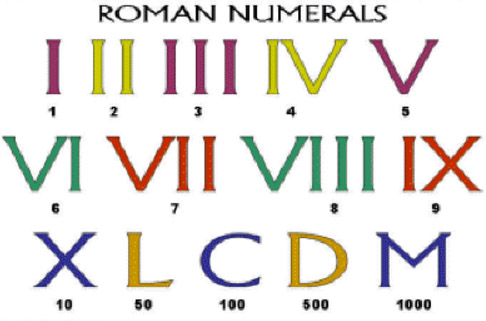
A common form to represent numbers in the past was Roman Numerals. Roman numerals, the numeric system in ancient Rome, uses combinations of letters from the Latin alphabet to signify values. Roman numerals, as used today, are based on seven symbols.Roman numerals are formed by combining symbols together and adding the values. Generally, symbols are placed in order of value, starting with the largest values. When smaller values precede larger values, the smaller values are subtracted from the larger values, and the result is added to the total.
Now it's your turn. Try to decode this for practice: XXIX CMLVIII LVI DCCCLXXXVIII . If you do this you will find the virtual coordinates for this cache.
Babylonian numerals were written in cuneiform. The Babylonians, who were famous for their astronomical observations and calculations (aided by their invention of the abacus), used a sexagesimal (base-60) positional numeral system inherited from either the Sumerian or the Eblaite civilizations. You can see an example below.
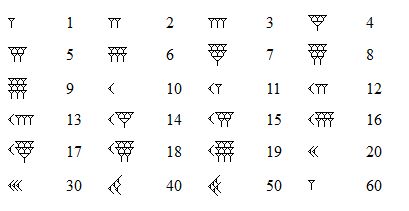
These are only two of the most popular number systems, but civilizations ranging from China to South America created unique number systems with different base numbers. Arabic numerals which have a base 10 are what we use today and are easiest to interpret, so you might have to think outside the box for some of the more obscure number systems.
Number Games
Sudoku is probably the most common type of number puzzle used on puzzle geocaches in Korea. Sudoku (数独), is a logic-based, combinatorial number-placement puzzle. The objective is to fill a 9×9 grid with digits so that each column, each row, and each of the nine 3×3 subgrids that compose the grid contains all of the digits from 1 to 9. The puzzle setter provides a partially completed grid, which for a well-posed puzzle has a unique solution. You can either solve a sudoku by hand or use one of the many online solvers like this one.
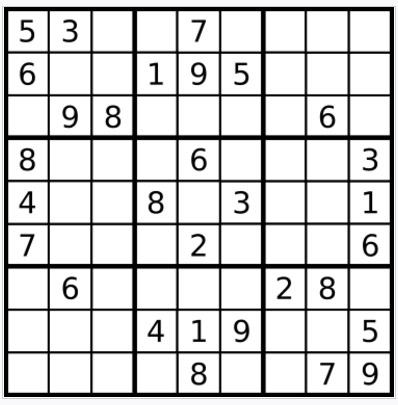
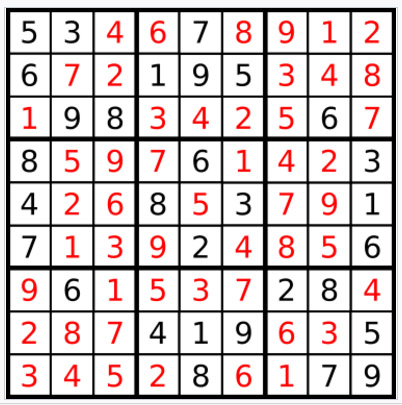
Another popular type of number puzzle in Korea is a nonogram. Nonograms, also known as Hanjie, Picross or Griddlers, are picture logic puzzles in which cells in a grid must be colored or left blank according to numbers at the side of the grid to reveal a hidden picture. In this puzzle type, the numbers are a form of discrete tomography that measures how many unbroken lines of filled-in squares there are in any given row or column. For example, a clue of "4 8 3" would mean there are sets of four, eight, and three filled squares, in that order, with at least one blank square between successive groups. Here is a good nonogram solver.
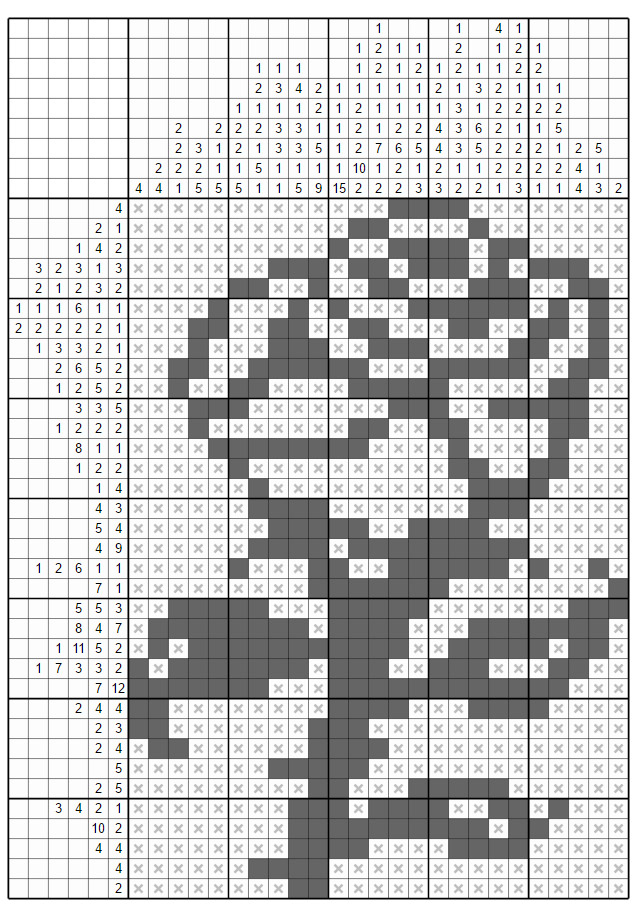
There are many other possibilities for number puzzles. Now it's your turn to put the information you learned to the test. Let's see if you can solve this puzzle and find the geocache.
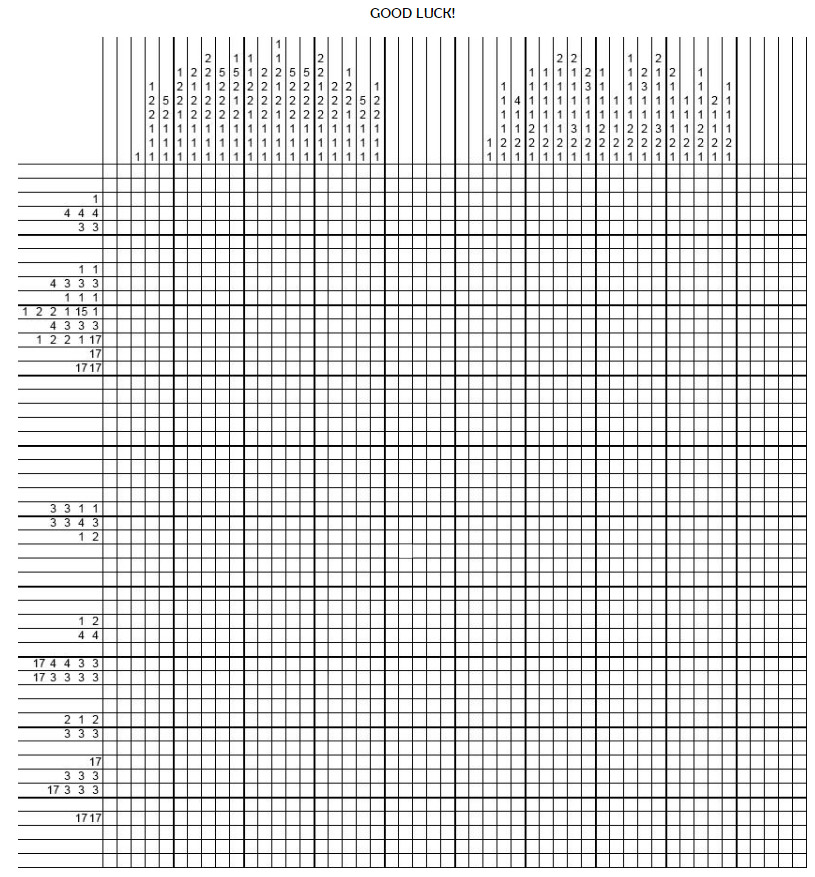

You can validate your puzzle solution with certitude.