
Chester Keeler Wentworth was born in Aspen, Colorado, on May 7, 1891, one of five children of Frank Louis Wentworth and Anna Maria Keeler Wentworth. Chester graduated from the University of Chicago with an A.B. degree in geology in June 1918. Chester took his M.S. degree in 1921, and his Ph.D. in 1923, both at the University of Iowa. It was during his time as a student at Iowa that Chester’s unusual combination of aptitudes led to the achievement for which he is most widely known — the Wentworth scale for the classification of clastic sedimentary rocks.
Chester K. Wentworth, Fellow of The Geological Society of America since 1923, died in Hilo, Hawaii, on January 6, 1969, after several years of illness. He is survived by his widow, Juliette Oliveira Wentworth, and by two sons by a former marriage, Robert and Gordon. Another son, Thomas, was killed in France in 1944.
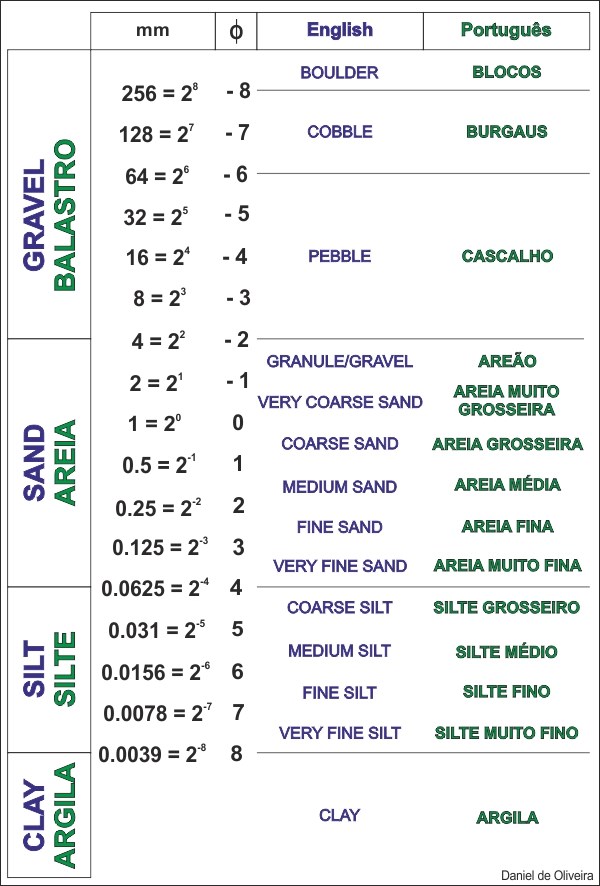
The original scale was devised in 1898 by the American sedimentary petrologist J.A. Udden was adapted (1922) by C.K. Wentworth, who expanded the definitions of the various grades to conform with actual usage by researchers; most sedimentologists have adopted the Udden scale with the Wentworth modifications.
Grain size
Grain size scale, in sedimentology, division of a continuous range of particle sizes into a series of discrete groups. Several such scales have been devised for the purpose of standardizing terms and providing a basis for statistical analysis. On most scales, the finest particles are designated clay, followed by silt, sand, granules, gravel, pebbles, cobbles, and boulders. The size limits for each grade vary from scale to scale.
In order to claim a find in this EarthCache you have to get yourself to the coordinates supplied. There, answer the following three (3) questions:
1. Using the Wentworth Scale above in the listing classify the sediment according to grain size that formed the yellow rock on the path.
2. If you rub the rock, what happens? a- You scratch the rock; b- the rocks scratches you; c- you get a red smear on your finger; d- you get a yellow smear on your finger; or e- none of the above
3. Following the strata (layers of rock), how are they orientated?
If you feel you have all the answers correct, please log your found but also send me the answers via e-mail so I can check them. If I don’t answer you it is because they are correct and you have another found.Please note that when you e-mail me, please supply the reference (GC702HM) and name (The Wentworth Scale (Cape Town) - DP/EC82) of the cache and please click on the “I want to send my e-mail address along with this message” so that when I reply to you the messages don’t go into e-mail heaven (or hell).

Cape Geology

The late-Precambrian age Malmesbury Group is the oldest rock formation in the area, consisting of alternating layers of dark grey fine-grained greywacke sandstone and slate, seen along the rocky Sea Point and Bloubergstrand shorelines. These sediments were originally deposited on an ancient continental slope by submarine slumping and turbidity currents. The sequence was subsequently metamorphosed by heat and pressure and folded tightly in a NW direction so that the rock layers are now almost vertical.(Source)
 The most exciting way to learn about the Earth and its processes is to get into the outdoors and experience it first-hand. Visiting an Earthcache is a great outdoor activity the whole family can enjoy. An Earthcache is a special place that people can visit to learn about a unique geoscience feature or aspect of our Earth. Earthcaches include a set of educational notes and the details about where to find the location (latitude and longitude). Visitors to Earthcaches can see how our planet has been shaped by geological processes, how we manage the resources and how scientists gather evidence to learn about the Earth. To find out more click HERE.