Portsmouth International Ferry Port experiences many thousands of foot passengers, cars, lorries, coaches, caravans, bicycles, and other such charabancs passing through it every year, to and from various areas of NW Europe. The Ferry Port lies immediately north of Britain’s main banana importation site, and seaward access can only be gained by passing past and through Her Majesty’s Naval Base Portsmouth, itself one of the main naval bases in the whole of Europe.
PLEASE NOTE: Because of the above, please try to avoid 'acting suspiciously' when one is at the coordinates - the GZ itself is the pavement area adjacent to the main Ferry Port building, alongside the main ‘Drop-Off Point’ and bus/coach park. The cacher does not have to gain access to the Concourse Building. Please - if any security / police / customs personnel happen to wander over to you and enquire as to what you are doing, please freely explain why you are staring at the walls. Please do explain to them all about geocaching and what EarthCaches are. There are many signs warning everyone that numerous cameras are scrutinising this area, plus other signage warning against leaving belongings unattended (such items can and WILL be taken away to be exploded away from this location!).
As usual with EarthCaches there is no physical cache. To log this EarthCache, the cacher is required to read the information below, make some specific observations, then email or message me the answers to the Tasks and questions that I have set.
At the coordinates one will find yourself on a pavement outside a large cuboid building – this building houses the facilities for vehicle- and foot-passengers that use the ‘public’ (as opposed to ‘commercial’), International Ferry Port. The GZ for this EarthCache is sited on the The Pilgrims' Trail, also called the Hampshire Millennium Pilgrims' Trail. This forms part of a longer route (called 'St Michael’s Way'), that follows the footsteps of the Miquelots, pilgrims who made the long journey from Winchester, England, to worship St Michael at Mont Saint Michel in Normandy, northern France. It follows a route dating from medieval times when pilgrims visited Winchester Cathedral from the country, and abroad, to worship at the shrine of St Swithun, a former teacher of the young Alfred the Great. The English section is 47km long, starting at Winchester and ending at the Ferry Port. Clearly, this prehistoric route has been 'modernised' to include our present-day landscape, features and urban sprawls - in prehistoric times this area would have been either solely or partly submerged by the sea, maybe in the inter-tidal coastal area, or possibly a deep, dark, very boggy marsh area.
Geology is the study of the Earth; its rocks; its structure; everything within it - and also the processes that shape its surface. Forensics is the use of science and technology to investigate and establish facts. Geologists, and especially palaeontologists, use the evidence found in rocks to deduce the environment that a sedimentary rock or fossil was deposited in, or the 'story' of how the crystals in a metamorphic or igneous rock formed.
As stated, there are three main types of rock:
1 – Igneous Rocks
These form when molten rock (known as ‘magma’), cools. As a general rule, the slower it cools, the larger the crystals found within it, and vice versa. Common examples include:
- Granite - formed when a specific type of magma cools slowly underground over millions of years, granites typically have an overall paler colour, containing large crystals, giving some quite pretty textures. The crystals of the solidified minerals can have various 3D forms, but are generally rectangular (and probably larger) if they formed (crystallised) first, with that later crystals forming in ‘the gaps between the older crystals
- Gabbro - formed when magma of different chemistry to granites cools slowly underground over millions of years. Gabbros typically have a darker colour than granites, but do have larger (>1cm) crystals.
- Basalt – formed by magma being extruded as lava at the Earth’s surface from a volcano. These typically cool very quickly, giving us igneous rocks which contain small (millimetre-sized) crystals, the overall rock having a very dark colour due to the lack of quartz minerals within it
- Obsidian – formed in the same way as basalt, these cool even more rapidly, forming microscopic crystals, often giving a very glassy, dark appearance.
2 – Sedimentary Rocks
These form when older rocks have been weathered and eroded, then transported, and then deposited, usually in layers. Over time, these layers are then squashed by the weight of overlying sediments, slowly turning the sediments into sedimentary rocks. Common examples include:
- Mudstone and sandstone - the names are determined by the size of the ‘grain’ in the rocks (mud being a smaller grain size than sand)
- Limestone – generally formed in ancient warmer, shallow seas (e.g. like the present-day barrier reef off NE Australia), these can be formed around beautiful coral reefs, where fish, snails, worms, and various shelled creatures all lived, inter-acting with each other as a community, living in and on the mud and sand that made up the ancient sea-floor. They have the name ‘lime’ due to the calcium carbonate that helps bind the rock together. Limestones can also contain mud and sand particles.
- Coal – formed in ancient (up to 300 million year old!) swamps, full of massive trees, ferns and other plants.
3 – Metamorphic Rocks
These form when older rocks are buried deep within the Earth’s crust over millions of years, squashing and heating the rocks, so deforming them and causing the original structure within the rock to crystallise or re-crystallise, depending on the original rock. Common examples include:
- Marble – formed when ancient limestones are crystallised, destroying the delicate fossils that may have been present, giving the rock a typically ‘sugary’ texture.
- Slate – formed when ancient mudstones are crystallised, squashing the mud grains together, turning these grains into flatter minerals, all elongated in the same direction, so giving slate its characteristic property of being about to be easily split (e.g. as used for roof tiles).
- Schist – formed when slate is further deformed, causing the already-elongated minerals to grow larger and more prominent.
- Gneiss (pronounced ‘nice’) – formed when schist is further deformed, causing the already-elongated minerals to grow even larger still, creating bands of colour within the rock, these themselves also being deformed, taking on the appearance of wavy lines of differing colour to the ‘main’ mass of crystals that surround it.
Fossils
A ‘fossil’ is the preserved remains of an ancient organism, now found in a sedimentary rock. An organism would have undergone this process to turn it into a fossil:
- creature dies
- creature is rapidly buried (soft parts decay, leaving the hard parts such as shells / teeth, etc.)
- further sedimentation above the buried remains compact the sediment around the remains
- over millions of years, salts within the underground groundwater slowly precipitate in and around the remains, slowly turning it (and the surrounding particles) to stone.
- at the present day, the now-fossilised remains can be found at the surface for us to find and marvel at!
As stated, a limestone can be identified (and dated) by the fossils contained within it. Fossils can also help the Geologist deduce the environment that the rock was originally formed in (i.e. a hot, land-locked desert, a shallow sea, or a muddy river bank, to name but a few).
Some common fossils we can find in rocks:
Shells
A shell is the hard ‘casing’ that usually surrounds the soft creature that lives within the shell for protection. Two different types of fossilised shells typically found within sedimentary rocks in Southern England include:
1 - Brachiopods
Brachiopods are marine animals and first appeared around 550 million years ago. Their descendants survive, albeit relatively rarely, in today's oceans and seas, from the Tropics to Antarctica. They were particularly abundant during the Palaeozoic Era (248 to 545 million years ago), and are often the most common fossils in rock of that age. They are virtually defenceless and their shell, enclosing the animal's organs, is and was their only protection.
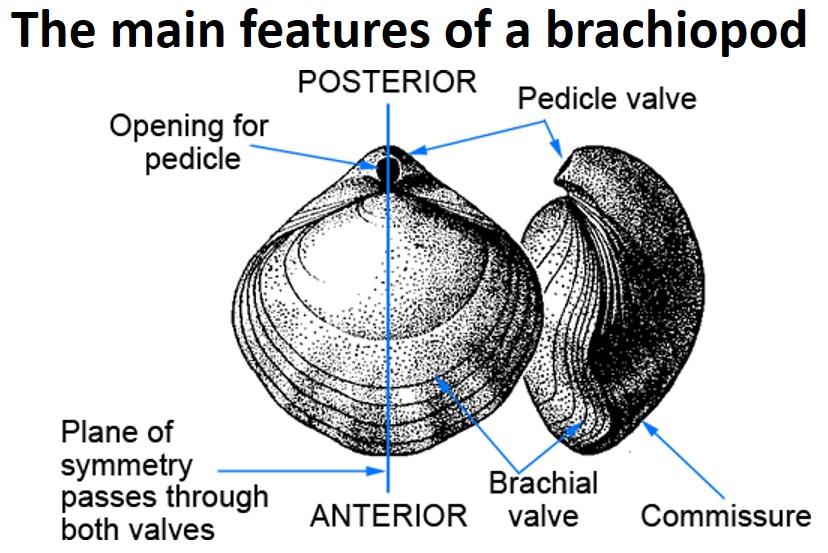
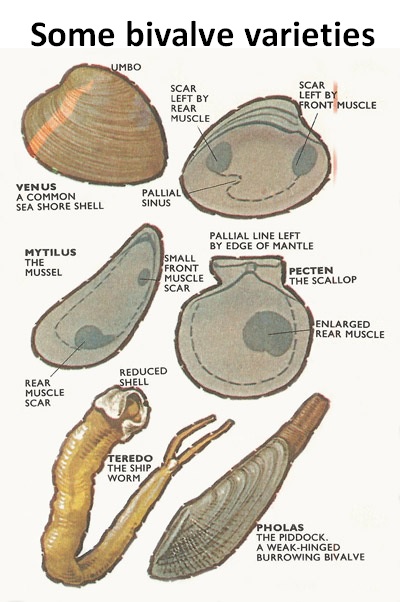
2 - Bivalves
Bivalves first appeared over 500 million years ago. Bivalves have two (‘bi’) hard, usually bowl-shaped, shells (called valves) enclosing their soft body. The valves are the parts usually found as fossils, and due to the elastic hinge tissue that joins the valves together also decaying, the valves are rarely preserved together.
.
Trilobites
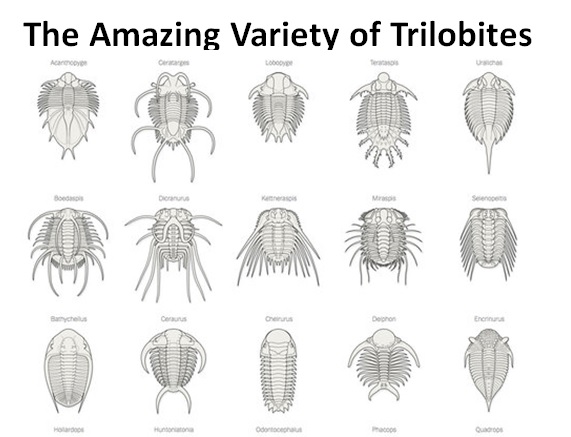
Trilobites were among the earliest arthropods, being hard-shelled, segmented creatures that existed over 520 million years ago in the Earth's ancient seas, becoming extinct before dinosaurs even came into existence. There are over 20,000 described species, with new species unearthed and described every year, making trilobites the single most diverse class of extinct organisms. The smallest known trilobite species is under a millimetre long, while the largest were over 70 cm in length.
.
Ammonites
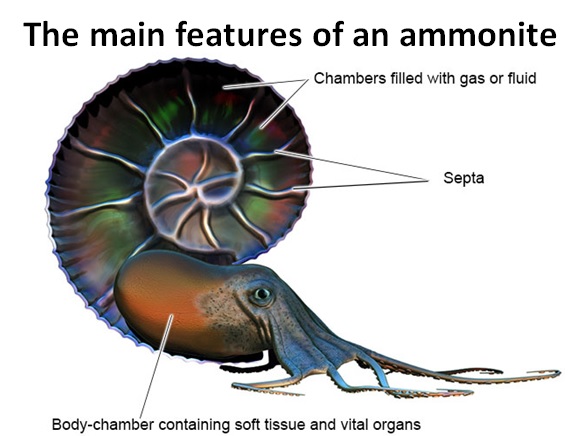
Ammonites lived during the Jurassic and Cretaceous periods, from around 200 million years ago, to around 66 million years ago, spanning about 140 million years. They became extinct at roughly the same time as the dinosaurs disappeared. Ammonites are commonly found as fossils, although hardly ever the soft parts, with just their external coiled shell being preserved.
.
Belemnites
Belemnites are extinct marine animals, living during the Jurassic and Cretaceous Periods, between 201 million and 66 million years ago. Their closest living relatives are squid and cuttlefish, having a squid-like soft body but, unlike modern squid, they had a hard internal skeleton – in their tail, this formed a bullet-shaped feature called a ‘guard’, and are the parts which are normally found as fossils. The guard, located furthest from its head, was composed of calcite and tapered to a point at the extremity. At the end closest to the head, the guard was indented by a conical cavity called the alveolus. Within this was found the base of the phragmacone, which extended out of the guard – it was a conical feature, divided up by simple, concave sutures, and was used to regulate the animal’s buoyancy. This part of the belemnite is less commonly found as fossils than the guard, due to its more fragile nature.
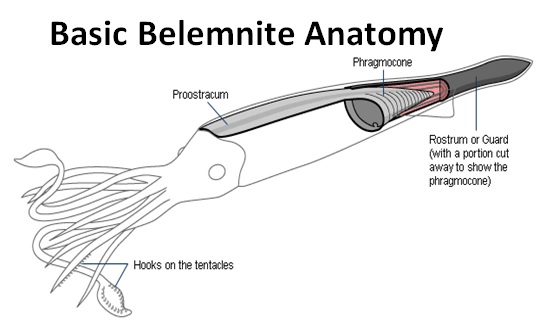
.
Corals
Corals comprise a soft bodied animal (polyp) that lives in a calcareous skeleton, made by the polyp removing calcium carbonate from water to create a skeleton of calcite or aragonite. The cup in which the polyp lives is strengthened by septa (radiating plates), and tabulae (floors which build up one on the other). Present-day corals can live at 6000m below sea level but are most common at depths of less than 500 metres. Fossil varieties of corals include solitary and colonial forms.
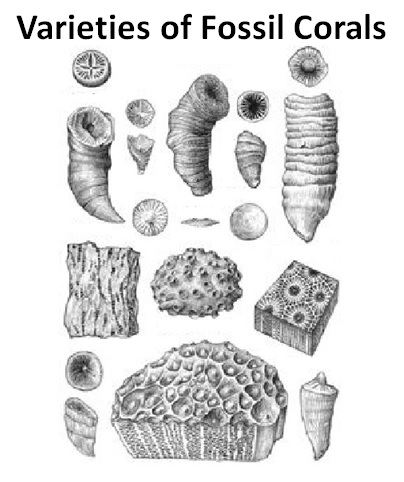
.
.
.
The Tasks
To claim this EarthCache, please follow the set Tasks, then email or message me the answers to the questions:
As one stands looking at the building, the southern section of the east-facing façade is faced with glass windows. The northern third of the façade is covered with stone slabs – please study them. From a distance, the stone slabs have an overall creamy appearance, but on closer inspection, they are not uniform at all – they are mottled, and appear to contain many ‘things’. Please study these stone slabs – you may have to get VERY close to them to study them in detail!
To aid the cacher, I have made a map of the slabbed section of wall – please use this to help answer the Questions.
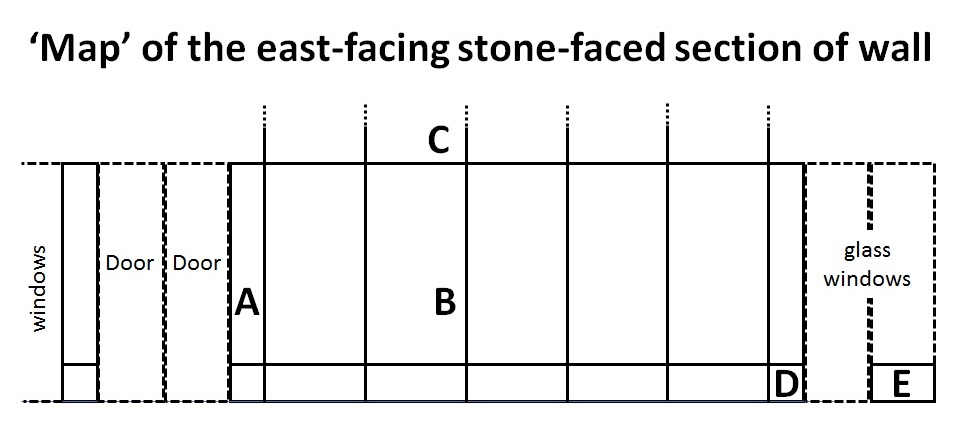
Location A = Please describe the obvious fossil at Location A.
Location B = Please describe the obvious fossil at Location B.
After studying the two fossils at Locations A and B which do you think is better preserved? Please explain your reasoning.
Location C = If this were the hands of a clock, what would time would this fossil be displaying?
Location D = Please describe the obvious fossil at Location D. What creature was this, and how wide was it?
Location E = Please describe the grey vertical ‘slab’ at Location E. Was it formed in place of quarried elsewhere? Please explain your reasoning.
Please walk to the south-eastern corner of the building. Here you will see three benches arranged in a ‘zig-zag pattern’.
Please compare these benches to the bench closest to the corner of the building. Please describe the rock that was used to carve this singular bench, then tell me what rock it is.
.
Once you have all the information for the above Tasks and questions, please send me your answers via email or through the Message Centre before logging your visit. I endeavour to respond ASAP, however if I have not within 48 hours, please do email again. Please feel free to add photos with your log, but please, do not post any photos that give away any of the answers, thank you.
Good luck!