The Irish Equitation School is an asset that is invaluable to Ireland’s economy and Irish Sports Horse industry. Since the foundation of the Equitation School riders have been the backbone of Irish show-jumping and event teams. Army riders have represented Ireland at Olympic, World and European Championship level in Show-jumping and Three Day Eventing.
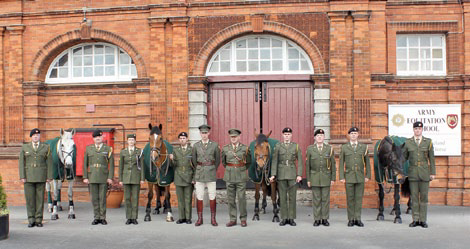
The Irish Army Equitation School is located at McKee Barracks in the Phoenix Park. The red-bricked Victorian stable block built in 1888. The School was established in 1926 under extraordinary circumstances. In 1926 Ireland had come out of a period of revolution; the 1916 Rising, followed by the War Of Independence 1919 – 1921, followed again by the Civil War until 1923.

Under those circumstances the founding fathers were a unique combination. Judge William Wylie, a Presbyterian from Coleraine, educated in Trinity College who graduated with a first-class honours Law Degree to become the Crown prosecutor at the Military Court Marshal Tribunals, which tried the captured rebels after 1916. William T. Cosgrave, a volunteer who saw action in the 1916 Rising, and was subsequently arrested, court marshalled, and sentenced to death. The death sentence was commuted to penal servitude for life and Judge Wylie is credited with having been influential in that computation of the sentence.
Both of these men were passionate about the Irish Horse. They put their differences aside in order to establish an Irish Army Equitation School at McKee Barracks, formerly known as Marlborough Barracks in Dublin.
This ambitious undertaking was first mooted in the autumn of 1925 and was facilitated by the Royal Dublin Society of which Judge Wylie was a prominent council member. The proposal was made to the Government of which William T. Cosgrave was President of the Executive Council (An Taoiseach today) and the go ahead was given in the summer of 1926. A decision was taken that the Equitation School would have a full Army Team competing at the RDS Horse Show in August three months later.

Horses had to be found as the Irish Army did not have a cavalry. Three months to acquire horses pick riders and train them to compete against international teams was going to be a challenge so in May 1926 £1,615 was spent on potential showjumpers. Those first horses, who were trained from scratch, were given ancient heroic Irish names: Finghin, An Craobh Ruadh, Roisin Dubh and Ferdia.
In the RDS Horse Show in August 1926 Captain Jed O’Dwyer took runner-up position, and Captain Dan Corry took fourth place, in the first competition for the confined Military Class, a great achievement.
For the Nations’ Cup, Captains Dan Corry, Jed O’Dwyer and Cyril Harty lined up for the Irish Army against Army teams from Britain, France, Belgium, Holland and Switzerland. A record crowd of 34,000 thronged every available space around the RDS arena. The stage was set. An heroic performance by Captain Dan Corry on Finghin, Captain Cyril Harty on Cuchulainn and Captain Jed O’Dwyer on Oisin produced an outstanding performance to reach the runner-up spot behind Switzerland. Second place was greeted as a win by the Irish supporters and euphoria permeated the entire Irish equestrian world.
The team rose from strength to strength. In the Nations’ Cup at the RDS in1928 they defeated Britain and France. To the strains of the National Anthem, the Aga Khan Trophy was presented to the Irish trio by the Governor General of the Irish Free State, James McNeill.
During the 1930s the team performed very well in Nations’ Cup events and Grand Prix in the major cities of Europe right up to the outbreak of the Second World War. The Army Team and its horses flew the Irish flag and promoted an exceptionally positive image of Ireland internationally at a time when little was known of this new nation. The Irish horse was promoted so positively that it led to sales and exports to countries around Europe. The present day positive image of the Irish horse had its foundations in the performances of the Irish Army on horseback.
Nonetheless, finance was still a problem during the 1930s. Just three riders were sent on the 1933 North American tour. Captains Dan Corry, Fred Aherne and Cyril Harty. Corry on Shannon Power and Aherne on Ireland’s Own scored individual wins, while Corry on Slievenamon and Aherne on Ireland’s Own teamed up to take the pair event. However, their curtailed team of three hit a major snag at when it was discovered that the relay event had been changed to teams of four. Corry called on one of his grooms to fill the extra slot. Twenty-seven-year-old Cavan man William Finlay did the honours on the difficult ride Ireland’s Own to help Ireland win the event. On this, the first and only occasion in which one of the grooms rode an army horse in major international competition, Captain Corry insisted that Private Finlay ride forward to receive the Westchester Cup. According to newspaper reports of the event, Finlay got a massive reception from the packed Madison Square crowd.
After the war the format for the Nations’ Cup Games had changed and from 1946 Nations’ Cup events would no longer be confined to military riders. That were now competing in national and international shows against trained professionals. Nonetheless, the Army Team won the Aga Khan Trophy at the RDS Dublin Horse Show in 1946.

At the end of the 1950s and early 1960s, live television contributed to a huge upsurge of interest in showjumping. The team, has gone from strength to strength since bringing us many riders and horses winning many trophies. Civilian riders provided great competition with the likes of Paul Darraghon on Heather Honey, James Kiernan on Condy and Eddie Macken on Boomerang. At the end of the 1970s new recruits such as Pat McCartan, David Foster, John Roche and Pat Coleman along with John Ledingham on horses such as Kilbaha, and Kilcoltrin, became frequent winning combinations during the 1990s. Sean Daly, Eamonn O’Donoghue, Billy Ringrose, and Ned Campion flew the flag for Ireland in many capitals around Europe and the USA. With horses such as Garraun, Rincoola Abú, Castle Pollard, Millstreet Ruby, and Cruising to the fore. Famous victories in places such as Hickstead and Spruce Meadows in Calgary were achieved.

The first decade of the new millennium saw the first female riding officer, Lieutenant Danielle Quinlivan from Kanturk, Co. Cork. Also a new influx including Shane Carey, David O’Brien and Gerry Flynn were to make their mark during the decade. Gerry Flynn won the Grand Prix at the 2007 Dublin Horse Show with Mo Chroí and Captain Geoff Curran and Kilkishan won the Eventing World Cup Qualifier in Tattersalls in 2008.
N53 08.641 W006 51.809
Magnetic behind Fly No Aircraft sign. Please be discreet.