Building Stones of Spring Garden Road
This Earthcache is a multi-level Earthcache that takes you for a short walk down one of best known streets in Halifax, NS. Many people walk this street very day and have no idea of the geological history of the buildings. Pictures are always welcome but they are optional. There is no need to contact me for confirmation before logging this cache but the information should be sent in, either via email or the message system on geocaching.com, in a timely manner. Should there be any difficulty, I will contact you. I hope you appreciate this geological walk down Spring Garden Road and learning about the different rocks and fossils that make up our history.
Information regarding this Earthcache has been obtained from the Department of Mines and Energy, Nova Scotia and geology information websites.
These are your tasks but I do hope that you take the time to preuse the information below.
- At Step #1- Looking at the fossils in the library walls, find an example of a brachiopod (shell). Using a coin as a guide, would the size of the brachiopod be bigger than, smaller than or the same size as a 25 cent coin?
- At Step #2- From the plaque nearby, who laid the first stone and on what date? Based on the material used (ironstone and grey granite), why do you suppose the façade lacks detailed carving?
- At Step #3- How many columns of red granite grace the Barrington Street entrance?
- At Step #4- The lion depicted on the top of the tome shows signs of weathering as opposed to the rest of the tome. Can you speculate why in terms of the material used?
- At Step #5- How many human heads are there on this building? How many lion heads? What stone are they carved from?
- At Step #6- How many names are on the front panels of the building? Name two of them.
- Please include a photo memory of your walk to prove that you were there. Thank you.
Background information
Rocks used as building stones along Spring Garden Road tell an exciting story of the history of the Earth’s crust. These rocks vary in age and were quarried in many places in North America and Europe. The granite building stone from the Halifax, Shelburne and Queensport areas is approximately 370 million years old. Most Nova Scotia quarried sandstone comes from Wallace and is 310 million years old. New Brunswick has provided 390 million year old granite from St. George and sandstone from Sackville (310 million year old) and Mary’s Point (320 million year old). Much of the brick was produced with clay from Nova Scotia or New Brunswick. Other building stone are from Ontario, Québec, Alabama, Vermont, Scotland, Italy, Norway and Sweden.
A building stone, whether sedimentary, igneous or metamorphic, can reveal a great deal of information about its geological history.
Sedimentary rocks, such as sandstone and mudstone, have been formed by the deposition of particles layer upon layer. Structures which result from this layering, such as bedding and channels, are sometimes visible on building stones. If the sandstone is composed of very small particles (fine sand grains), this indicates that they were deposited by sluggish, slow-moving currents which allowed such small particles to settle out of the water. Limestone is another type of sedimentary rock; it is produced by precipitation of calcium carbonate and sometimes contains the fossilized remains of coral, snails and other shells. Fossils such as those visible in rocks on the Royal Bank Building and the Memorial Library indicate that the limestone was deposited in warm, shallow seas.
Igneous rocks such as granite, gabbro, syenite and anorthosite have formed by the cooling and solidification of hot molten material (magma). Individual crystals such as quartz, feldspar and mica are easily identified on the polish granite surface of the building stone. If the crystals are large we can deduce that the magma cooled slowly, allowing adequate time for large crystals to form. Conversely, small crystals indicate a short period of cooling.
Metamorphic rocks such as marble, quartzite and ironstone have been changed (metamorphosed) by extremes of heat and pressure. Under pressure, original features in these rocks are often deformed or partially destroyed. The degree of deformation reflects the degree of pressure that the rock has experienced. The rocks underlying the Halifax area were altered by the heat of molten granite more than 370 million years ago. This thermal metamorphism in the rocks can be identified by the numerous small pits on their surface- these pits result from the weathering-out of minerals which were formed by the heat of the nearby granite intrusion.
Building on the Past
The building stone industry of Nova Scotia has had a very successful past. In 1911, four Wallace quarries produced about 10000 tons of sandstone which was used entirely as building stone. This olive to tan sandstone was widely used in buildings throughout the Maritimes, Ontario, Quebec and the United States. In 1910, over 4000 tons of granite was extracted from granite quarries around Purcell’s Cove. For further information about this quarry, I would recommend Purcell’s Cove Quarry Earthcache (GC18VWR). Nova Scotia building stone is of excellent quality and durability; its high standard is comparable with that of European stone which has been imported for decorative use on Halifax buildings contracted in the last two or three decades. Grey granite from Shelburne, NS has also been a component. There is an Earthcache there as well called Granite Quarry Site – The Islands Provincial Park (GC1WKZJ).
To help you with your rock journey, here are a few of the rocks that you will be seeing on your quest.
Limestone is a sedimentary rock composed principally of calcium carbonate (calcite) or the double carbonate of calcium and magnesium (dolomite). It is commonly composed of tiny fossils, shell fragments and other fossilized debris.
Sandstone is a classic sedimentary rock composed mainly of sand-sized minerals or rock grains. Most sandstone is composed of quartz or feldspar because these are the most common minerals in the Earth's crust. Like sand, sandstone may be any color, but the most common colors are tan, brown, yellow, red, grey, pink, white, and black.
Granite is a light-colored igneous rock with grains large enough to be visible with the unaided eye. It forms from the slow crystallization of magma below Earth's surface. Granite is composed mainly of quartz and feldspar with minor amounts of mica, amphiboles, and other minerals. This mineral composition usually gives granite a red, pink, gray, or white color with dark mineral grains visible throughout the rock.
Ironstones are reddish-brown rocks that are very hard. When the sand was being deposited, living organisms became trapped in the sand or mud. This organic material slowly attracts molecules of iron mineral around it. Slowly, over millions and millions of years, layer upon layer of iron, an ironstone concretion is formed.
Mudstone is an extremely fine-grained sedimentary rock consisting of a mixture of clay and silt-sized particles. Mudstone and shale are made of silt and clay-sized particles that are too small to see. The only difference between mudstone and shale is that mudstones break into blocky pieces whereas shale breaks into thin chips with roughly parallel tops and bottoms. Both are made of ancient mud.
Marble is a metamorphic rock that forms when limestone is subjected to the heat and pressure of metamorphism. It is composed primarily of the mineral calcite (CaCO3) and usually contains other minerals, such as clay minerals, micas, quartz, pyrite, iron oxides, and graphite. Marble is usually a light-coloured rock. When it is formed from a limestone with very few impurities, it will be white in color. Marble that contains impurities such as clay minerals, iron oxides, or bituminous material can be bluish, gray, pink, yellow, or black in color.
Geological and Human History of Spring Garden Road
Beneath the man-made concrete and asphalt of Spring Garden Road lies slate and siltstone bedrock- Rock formed hundreds of millions of years before humankind. Over 450 million years of geological history have been imprinted in them, recording the story of the changing earth.
The slates began as mud- particles of pre-existing rocks which were transport by water and deposited in the deep water of an ancient ocean. The sediments were re-worked by ocean currents to produce a fine-grained mud which was then compacted over millions of years to produce shale. Approximately 400 million years ago, the shale was metamorphosed into slate by the heat and pressure of folding during the formation of the Appalachian Mountains. These folds can be seen at Chain Rock and Martello Tower in Point Pleasant Park.
The slates underlying the city of Halifax are part of the gold-bearing Meguma Group found in the southern Nova Scotia. Gold was first found in these rocks in the 1860’s. For an Earthcache regarding the Meguma Group use this code GC13JB3.
Glaciers greatly changed the landscape. The last major ice age ended 10000 years ago. Glaciers scraped and eroded large areas of land and deposited the loose material in new landforms. In some areas, the land was gouged and existing valleys deepened. Today, in the Halifax area, there is only about 1 metre of soil- the Public Gardens had to import soil to support its trees and shrubs. In other areas, glacier deposited sand- to boulder-sized material (glacial till) and shaped it into hills called drumlins. Citadel Hill and Georges Island are both drumlins. The Halifax Citadel Drumlin (GC120KJ) is available as an Earthcache.
Artifacts which have been dated 10600 years old suggest that after the retreat of the glaciers a nomadic people moved into what is now Nova Scotia. After the glaciers melted, a brook formed beside the hill now known as Citadel Hill. Freshwater River, as this brook was later named, began its course in the Commons, flowed through what is now the Public Gardens, crossed Spring Garden Road where it presently intersects South Park Street, ran across “Pleasant Street” (Barrington Street) and flowed into Halifax Harbour near Point Pleasant Park.
In the past, Freshwater River was a chief supply of water to the British naval fleet and to merchant ships. A brewery on Spring Garden Road obtained a constant supply of fresh water from springs which fed Freshwater River. A bridge spanning the brook on “Pleasant Street” (Barrington Street) was affectionately named the “Kissing Bridge” and was a perfect place for midnight strolls. Today, Freshwater River flows through underground pipes. All that remains of the brooks original course is Griffin’s Pond, located in the Public Gardens.
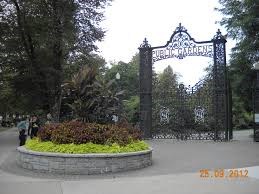
Spring Garden Road was originally a residential area. At the turn of the century, stores and businesses began to move into the area, which gradually grew into the busy shopping area it is today. It was named by nostalgic Londoners who were reminded of the spring garden they had seen in Britain. The Public Gardens, modelled after St. James Park in London, have existed since the 1830’s. In 1848, several lots of land were leased from ‘the city fathers’ to the Horticultural Society. The citizens of Halifax cultivated gardens on this land until 1874, when it was transferred to the Commissioner of the Common. The Public Gardens have many varieties of shrubs and flowers from all over the world, appropriately reflecting the global distribution of building stone which Spring Garden Road buildings have to offer.
A Stroll down Spring Garden Road
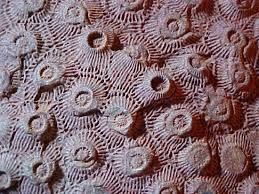
Step #1 takes you down to 5410 Spring Garden Road to the old Halifax City Memorial Library opened in 1951. The outside of this building is a decorative veneer of limestone (420 million years old) from Queenston, Ontario. Fossils such as crinoid stems, rugose corals and brachiopods are found in this limestone; being an ideal sedimentary rock for fossils. The granite found in the foundation is from Shelburne, NS. The new Halifax library opened in 2014 and is an architectural wonder. I encourage taking time to visit and enjoy. The second floor is dedicated to children.

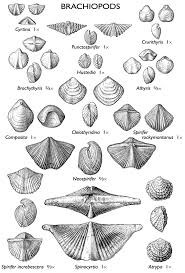
Crinoid Stems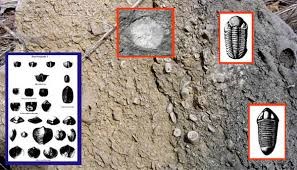
Rugose Corals
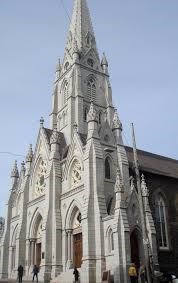
Step #2 takes you to Saint Mary’s Basilica. This beautiful cathedral is approximately 32m long, 20m wide (160ft. long, 66ft. wide), possesses the tallest freestanding granite spire in North America at about 45m (150ft.). Construction of the Basilica began in 1820 to replace the old wooden church of St. Peter’s. The design was chosen by Edmund Burke, archbishop at the time and opened on November 29, 1829. The main section was constructed of ironstone and grey granite, which surrounds the side windows and doors, both from the quarry in Purcell’s Cove, Halifax, NS; The sandstone strip around the first floor and corners is from Wallace, NS; Red granite (700 million years old) of columns at main entrance is from Rubislaw Quarry in Aberdeen, Scotland.
Step #3 is the Saint Mary’s Glebe located on 1508 Barrington Street. This is the Parish office built in 1891. The Glebe is a solid structure of Nova Scotia brick; pale red sandstone trim from quarries in Sackville, NB; grey granite forms the foundation, steps and surrounding wall is from Purcell’s Cove; Columns of red granite from St. George, NB grace the Barrington Street entrance.
Step #4 is across the street at St. Paul’s Cemetery on the corner of Barrington Street and Spring Garden Road. This principal burial ground for the first Protestant settlers closed in 1844. The Sebastopol monument is a memorial constructed by George Lang to commemorate two Nova Scotians who were killed during the Crimean War. The grey granite of the foundation is from the Northwest Arm, Halifax, NS and the lion was craved from almost 14 tonnes of sandstone from Albert Quarries, Mary’s Point, NB.
Step #5 is a trip to the Provincial Court built by Georg Lang. The walls are supported solely by blocks of pink sandstone from Mary’s Points, NB. The brick structure supports the west side and it has a tan sandstone exterior. The granite foundation and steps are from the Northwest Arm. Interesting to note the difference in weathering of rocks: sandstone peels while granite only discolours.
Step #6, located on 5410 Spring Garden Road, is the Technical University of Nova Scotia (TUNS) - School of Architecture. It was built on the former site of a military drill shed originally owned by the Province of NS but under the conditions of the British North America Art, the land was transferred the Dominion of Canada during Confederation in 1867. When the shed was destroyed in 1903, the property was given to the NS Government to build the Technical College provide that the mandatory military instruction was part of the curriculum. The School of Architecture was built in 1908 constructed mainly of Nova Scotia brick with trimming, entrance and columns of Wallace sandstone; Grey granite of the step from the Northwest Arm.
To successfully accomplish the requirements for this Earthcache, please answer the following questions. If you enjoy this Earthcache, I would appreciate a favourite point. You do not have to complete the waypoints in any order but I have placed them so that you can walk down the street from the starting point, cross the road at the lights and continue back up the same street.
- At Step #1- Looking at the fossils in the library walls, find an example of a brachiopod (shell). Using a coin as a guide, would the size of the brachiopod be bigger than, smaller than or the same size as a 25 cent coin?
- At Step #2- From the plaque nearby, who laid the first stone and on what date? Based on the material used (ironstone and grey granite), why do you suppose the façade lacks detailed carving?
- At Step #3- How many columns of red granite grace the Barrington Street entrance?
- At Step #4- The lion depicted on the top of the tome shows signs of weathering as opposed to the rest of the tome. Can you speculate why in terms of the material used?
- At Step #5- How many human heads are there on this building? How many lion heads? What stone are they carved from?
- At Step #6- How many names are on the front panels of the building? Name two of them.
- Please include a photo memory of your walk to prove that you were there. Thank you.