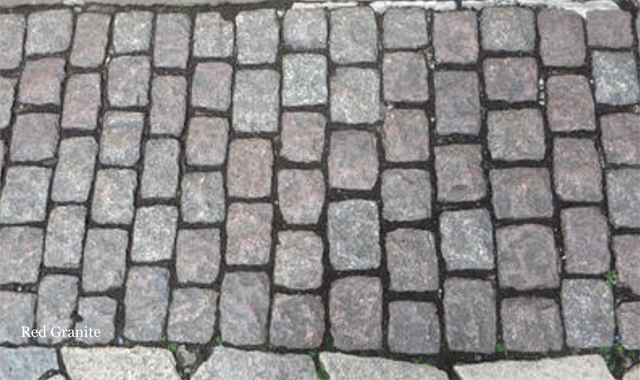
Red granite:
From a distance, red granite looks reddish or pink. Here the granite is made mostly of the minerals feldspar and quartz. The feldspar gives this granite its red hue and the quartz crystals appear as a semi-clear gray or purple color. There are also small crystals of mica and other darker minerals which appear as specks in the rock.
Because of its hardness and comparative cheapness in relation to marble, granite has been used for thousands of years for both internal and external features. It is commonly used outdoors in construction of buildings, bridges, paving, for monuments and indoors for items such as tiles, countertops, stair treads and much more. It can be cut into virtually any shape, and is practically unscratchable.
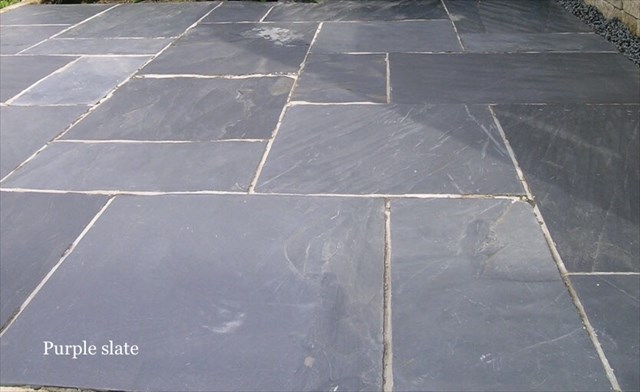
 Slate:
Slate is a fine-grained, foliated, Metamorphic rock derived from an original shale - type sedimentary rock composed of clay or volcanic ash through low-grade metamorphism. It is the finest grained foliated metamorphic rock. It is caused by strong compression causing fine grained clay flakes to regrow in planes perpendicular to the compression.
Slate comes in different colours and can be grey, black, blue, red, green and even purple. The purple slate here carries iron oxide (hematite). Examples of the many uses for slate are building stones, roof tiles, flooring, road paving, pool tables, writing tablets and blackboards.
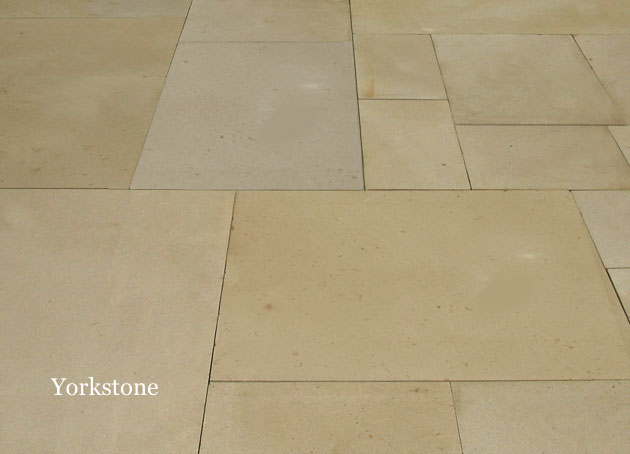
Yorkstone
Yorkstone is a variety of sandstone, specifically from quarries in York. Yorkstone is a tight grained, Carboniferous sedimentary rock. The stone consists of sand sized grains of quartz, mica, feldspar, clay and iron oxides geologically cemented together. Layers of sand accumulates as the result of sedimentation, either from water or from air. The sand becomes compacted by pressure of overlying deposits and cemented by the precipitation of minerals within the pore spaces between sand grains.
Known for being hard wearing, reasonably weather resistant, and durable, but also soft enough to be easy to carve Yorkstone has been used in a wide array of temples, homes and other buildings around the world for many years. Also used for artistic purposes to create fountains and statues and it is also the stone used for the traditional London paving.
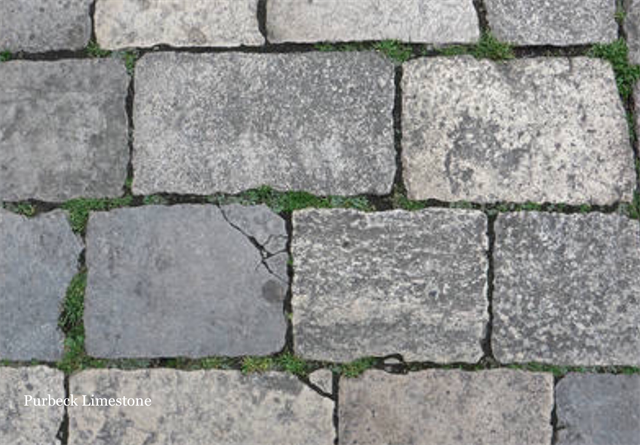
Purbeck Limestone
Limestone is a sedimentary rock formed most commonly in clear, warm, shallow marine waters, usually from the accumulation of shell, coral, algal, and fecal debris. It can also be a chemical sedimentary rock formed by the precipitation of calcium carbonate from lake or ocean water.
Purbeck Limestone is from the isle of Purbeck in Dorset and differs obviously from the massive Portland limestone beneath it not only by the thin-bedding but also by the generally non-marine fauna and rarity of thick-shelled molluscs and absence of ammonites.
Widely used for building in the Purbeck area the dark colour of the Purbeck Marble meant that it was used for its decorative quality in churches and cathedrals across England, particularly for items such as fonts, tombs, flooring and shafts. Although often known as marble it is in fact Limestone.
To log this earthcache
Please contact me through my profile with the answer to the following questions. Please send the answers before logging your find, you don't have to wait for a reply to log it, if there is a problem I will contact you.
1. Of the four types of rock described above and found here only one has been repaired in places. Which rock type is it ? Do you think the repairs are well done?
2. Of the four types of rock which one do you think shows the least amount of damage and erosion. Why do you think this is.
3. Which one shows the most damage and erosion, again, why.
4. Some of the large slabs of slate and Yorkstone have cracked. Apart from general wear and tear why do you think this is.
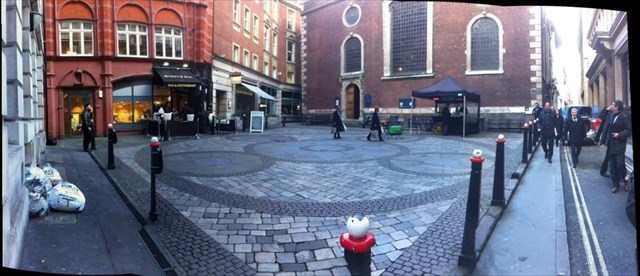
5. Please provide a photo of you or a personal item showing the church in the background
NB.If you decide to visit this cache during a sunny lunchtime of after work when it's not raining you can expect it to be very busy and therefore more difficult to find what you're looking for.
