The city's name is a combination of two words. "Franken" represents the Province of Franconia in the Kingdom of Bavaria, home of the Franks, where the original settlers were from. The German word "Mut" means courage; thus, the name Frankenmuth means "courage of the Franconians." The area was settled and named in 1845 by conservative Lutheran immigrants from Roßtal area of Franconia in Germany.
The group of settlers left Germany on April 20, 1845 and arrived at Castle Garden seven weeks later. They traveled via canals and the Great Lakes from New York to Detroit and arrived in August 1845. Sailing on the Nelson Smith, the settlers made their way to Saginaw and travelled over land to the present location the city of Frankenmuth. Originally part of Bridgeport Township and later Frankenmuth Township, Frankenmuth became a village in 1904 and finally a city on October 1, 1959
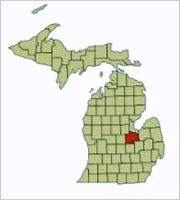
The nearby villages of Frankenlust, Frankentrost, and Frankenhilf illustrate that the area remained a magnet for other Germans from the same region even after it lost its original purpose as a mission post for the spread of Christianity to the Ojibwe.
Bronner's Christmas Wonderland, which bills itself as "the World's Largest Christmas Store", is located in Frankenmuth. The most popular nickname is "Little Bavaria", but the city is also nicknamed "Muth".
The strong influence of Franconian-style architecture can be found in most areas of the city. Most buildings in the commercial district, as well as many homes, feature stylistic interpretations of the timber-framed buildings found in the Franconia region of Germany. This style is marked by the use of timbers in "square" and "X" patterns on the outside of buildings, as well as the use of "X" patterns on windows, doors, and other building features.
Zehnder's Holz Brucke (German for wooden bridge) is a wooden covered bridge, built in a style similar to that of the Black Forest or a river valley in Switzerland, located over the Cass River in the middle of town. Though completed in 1979, the structure is constructed using traditional covered-bridge timber framing techniques. The floor joists and three-span Town lattice truss system of the 239' bridge are made of 15,960 board feet of four inch planks. The portion receiving the greatest wear is of oak while the remaining portion is spruce. 20,000 board feet of Douglas Fir make up the rafters and the roof is shingled with cedar. An additional 4,340 board feet of pine was required for the bridge side boards. In addition to two lanes for automobile traffic, the bridge also has two pedestrian walkways.