As with any earthcache, there is no “container” to find. Rather, you discover something about the geology of the area or in this case, man made changes that are hoping to fix an environmental issue.
What is a Rain Garden?
A rain garden is a garden which takes advantage of rainfall and stormwater runoff in its design and plant selection. Rain gardens are sited ideally close to the source of the runoff and serve to slow the stormwater as it travels downhill, giving the stormwater more time to infiltrate the ground via a rain garden.
Rain gardens are usually a small garden which is designed to withstand the extremes of moisture and concentrations of nutrients, particularly Nitrogen and Phosphorus, which are found in stormwater runoff. Most rain gardens drain within 24 hours so there is no worry about attracting mosquitoes that need wet conditions to multiply.
Rain gardens are gaining in popularity in municipalities as a way to beautify a neighbourhood and increase curb appeal by directing rainfall and storm water into rain gardens located along boulevards, municipal parking lots and adjacent to municipal buildings. Rain gardens are also gaining in popularity with home owners as a way to divert rainwater directly out of the storm sewers and use the water to maintain a healthy lawn and garden rather than having to take water from the local drinking supply.
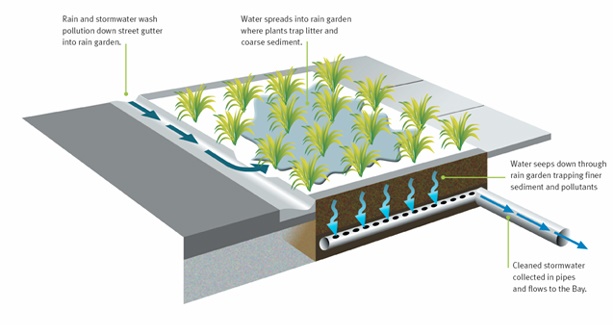
Advantages of Rain gardens:
- Limit the amount of water that enters the local storm drain system.
- Reduce the potential for flooding, drainage problems and stream bank erosion.
- Reduce or eliminate the need to water with municipal water
- Reduce garden maintenance
- Increase garden enjoyment
- Sustainability and urban enhancement
- Reduce the quantity of pollutants that run from our yards and roads straight into our waterways.
- Restore and recharge our groundwater system.
- They are planted with beautiful, hardy plants that require little to no watering.
- Attract birds, butterflies and beneficial insects, such as mosquito-consuming dragonflies.
- Complement any style of landscape and enhance the beauty of the surrounding neighbourhood.
Types of Rain Gardens
Full Infiltration: These rain gardens are used where all inflow is intended to infiltrate into the underlying subsoil. Sources suggest candidate sites have soil permeability greater than 30 mm/hr. An overflow for large events is provided by pipe or swale to the storm drain system.
Full Infiltration with Reservoir: Infiltration gardens with a reservoir have a drain rock reservoir so that surface water can move quickly through the installed growing medium and infiltrate slowly into subsoils from the reservoir below. This type of garden is a candidate for sites with subsoil permeability greater than 15 mm/hr.
Partial Infiltration: These rain gardens are designed so that most water can infiltrate into the underlying soil, while any surplus overflow is drained by perforated pipes that are placed near the top of the drain rock reservoir. This type of garden is suitable for sites with subsoil permeability of greater than 1.0 mm/hr and less than 15 mm/hr.
Partial Infiltration with Flow Restriction: Flow restrictor rain garden variations are used where subsoil permeability is less than 1 mm/hr. The added feature is a flow restrictor assembly with a small orifice which slowly decants the top portion of the reservoir and rain garden. This type of rain garden provides water quality treatment and some infiltration, while acting like a small detention facility.
Benefits of going native!
Native plants are well suited to rain gardens for many reasons. First they have developed a tolerance for the local climate over centuries and require very low maintenance as well as being more hardy and adaptable than most exotic plants. Native plants are more resistive to frost damage, drought and common diseases and herbivores. When mature, native plants form self- sustaining plan communities and since they have long root systems, will hold soil in place and resist erosion.
To log this earthcache:
Rules:
Parking is available along Lake Driveway West or in the small parking lot at the posted coordinates.
All observations can be made from the paved trail.
Please send me your answers within 4 days of posting your found log. If there is more than one cacher in your party, include the names in your group. Only one person needs to send me the group answers. No spoiler photo's please. Found logs posted without proof you visited the site will be deleted.
Questions:
1. At the posted coordinates you will find a sign titled Ajax Waterfront Rain Gardens. What does the gravel layer do?
2. What type of grates are used in the rain garden? What else is used to act as a system overflow control?
3. When the rain garden is full, where is excess runoff redirected?
4. What is another name for “growing media” and what does it do/behave?
5. Where does treated stormwater that does not infiltrate into the ground go?
6. From your observations at the posted coordinates (Rain Garden #1), does the stormwater from the road and parking lot drain directly into the rain garden or is there a barrier between the parking lot and garden?
7. Visit Rain Garden #2 at N 43 49.214 W 79 00.975 Does stormwater enter the garden directly from the roadway from one or multiple locations?
8. OPTIONAL: Take a photo of you or your GPS along the trail, garden or waterfront. Please no spoiler photos.
References:
http://www.trca.on.ca/dotAsset/206574.pdf
https://www.crd.bc.ca/education/low-impact-development/rain-gardens

| I have earned GSA's highest level: |
 |