Caloris Basin, Mercury Bring your sunscreen! You'll catch about 7 times more rays than you do on Earth as you're so much closer to the Sun. "Calor" is Latin for heat and the basin is so-named because the Sun is almost directly overhead every second time Mercury passes perihelion
:max_bytes(150000):strip_icc()/rupes-5a8225b7c064710037a96561.jpg "pioneer 10")
Apollo 11 landing site, Sea of Tranquility, Moon There you will see the lower part of the lunar module Eagle. Be careful where you step. Your footprints and those left by Armstrong and Aldrin will last for millions of years.

Valles Marineris, Mars
Arizona’s Grand Canyon is very impressive. It’s 450 km long and about 2 km deep. However, when set next to the Valles Marineris canyon system on Mars, it is a mere ditch. Discovered in 1971 by Mariner 9 (for which it is named), Valles Marineris stretches 4,000 km across the planet. Typical canyons are 200 km across and have walls 2–5 km deep. The center of the canyon system is a depression 600 km across and 9 km deep. It has been speculated that Valles Marineris may be a fault system separating two continental plates. If so, Mars and Earth would be the only planets with surfaces shaped by plate tectonics.

Olympus Mons is the largest volcano in the solar system. It is 700 km across and rises 22 km above the surrounding Tharsis plain. The edge of Olympus Mons is a cliff 10 km high. From there it is a shallow rise to the central craters, which are 85 km across. The largest such volcano on Earth, Mauna Loa in Hawaii, is 120 km across and 9 km high, although much of it is hidden beneath the ocean.

Great Red SpotThe Great Red Spot is Jupiter’s largest surface feature, a swirling red oval storm twice the size of Earth. It has been continuously observed since 1878 and shows no signs of abating. The entire system rotates every seven days, with wind speeds at the edge of 400 km per hour. It floats above Jupiter’s main cloud layers, and it is unknown how far it extends into Jupiter’s interior. The spot itself sometimes changes color from an orange-red to gray, when it is covered by white clouds at a higher altitude. What makes the spot red is unknown, and speculation has ranged from sulfur and phosphorous compounds to organic material such as carbon compounds produced by lightning or chemical reactions with sunlight.
/https://public-media.si-cdn.com/filer/4a/c2/4ac2276a-a3cb-4458-bd73-fbd3c646b32d/35491828673_faa9d0f5c2_k.jpg "mars 2")
Saturn’s Rings The rings of Saturn are one of the most distinct planetary features in the solar system. They have a diameter of 270,000 km, but they are astonishingly thin, with a thickness of only 100 meters. The rings are made up of many particles of rock and dust and lie within what is known as the Roche limit, the radius within which a large moon would be torn apart by the great tides that Saturn would exert upon it. These tidal forces also prevent the particles in the rings from agglomerating into a larger body.

Verona Rupes,Miranda is the largest cliff in the solar system. It rises up some 20 kilometres above the surrounding landscape. For the sake of comparison, the tallest straight vertical drop on Earth is generally agreed to be Canada's Mount Thor, where the greatest vertical drop is just 1.25 kilometers. But here's the crazy thing. Because Miranda is so much smaller than Earth, is gravity is far weaker. That means any space explorer crazy enough to jump off the cliff would fall for over twelve minutes before reaching the ground. Again, in the interest of perspective, a person falling to Earth from the very edge of space would probably only take about two minutes. In the interest of somewhat less helpful perspective, a person falling from the top of Verona Rupes could listen to "Bohemian Rhapsody" all the way through twice before hitting the ground. And what else are you going to do while in freefall?

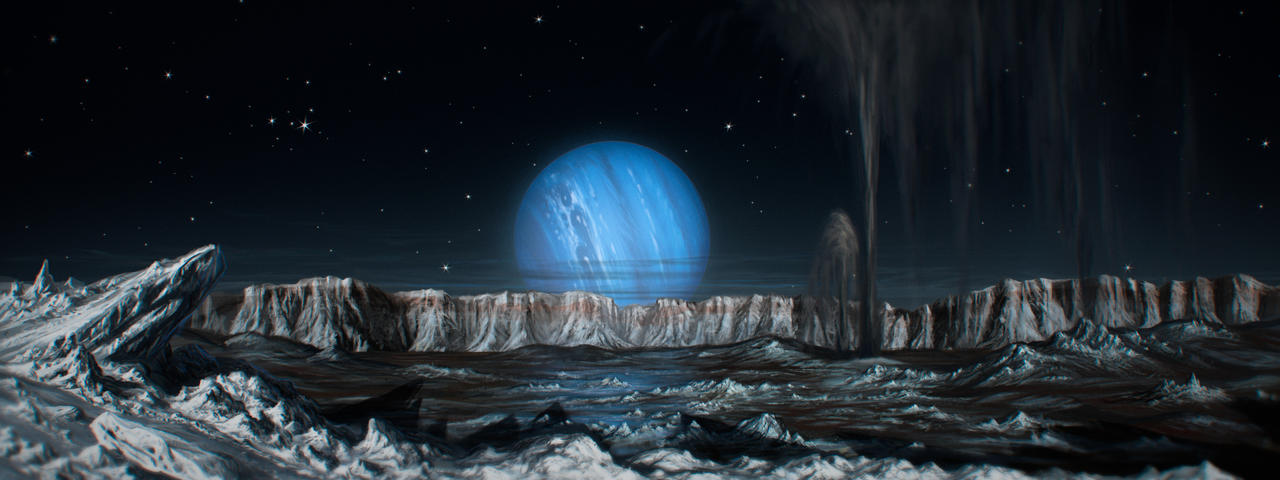
Neptune is home to the strongest winds in the solar system, with speeds of up to 2000 kilometers per hour. Not only does it have intense winds, Neptune also has the coldest temperatures in the solar system. Its moon Triton has recorded temps of -382 degrees Fahrenheit. plumes of dust and nitrogen gas that erupt out of the moon's crust, and then get gently blown around by Triton's tenuous atmosphere. It's not clear, however, how dangerous those geysers would be to anyone standing next to them.
Pluto is small and frozen, but astronomers studying the New Horizons data have been fascinated to see that much of its surface appears to be less than 100 million years old and mostly free of impact craters. The vast planes of Pluto also have mysterious ice mountains rising as high as 11,000 feet above the surface. Pluto’s distance from the sun varies thanks to its eccentric orbit, but the average distance is still almost 40 times further from the sun than Earth. Still, it’s brighter on Pluto than you might think. At “noon” on Pluto when the sun exposure is at its maximum, it’s bright enough to read a book

Venus is the nastiest place in the solar system. It rains battery acid almost every day, is hotter then an oven and is 90 times the atmospheric pressure of Earth. The Maxwell Montes are the highest mountains on Venus, rising up to 11 km above the mean planetary surface. They are therefore the coolest point on the planet with a temperature of a mere 380 °C.

N.53.XX.XXX
W006.XX.XXX