Alpena was originally part of Anomickee County founded in 1840, which in 1843 was changed to Alpena, a pseudo-Native American word — a neologism coined by Henry Schoolcraft, meaning something like "a good partridge country." This was part of a much larger effort to rename a great many of the Michigan counties at the time.
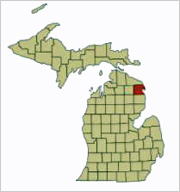
The region, known as the "Sunrise Side" from its location on the east shoreline of Michigan, was first a site of commercial fishing activity and is still home to extensive commercial fishing activities. Later the region, like much of Michigan, was shaped by the logging era of the 1800s. Today, Alpena is known for its limestone quarry, one of the largest in the world, owned and operated by the Lafarge corporation and is a major cement manufacturer and exporter. While at one time the largest in the world, the cement plant is now just the largest cement plant for Lafarge in North America with an annual capacity of almost 3 million tons of cement. Alpena is also the world headquarters of Besser Company, a manufacturer of concrete block machines. Tourism (fishing, hunting, camping and a variety of water sports) is also important to Alpena's economy.
Most of the city was lost in the Great Michigan Fire of 1871. Less than one year later, on July 12, 1872, Alpena was hit by another fire, the largest in its history, which destroyed 15 acres of homes and businesses for a total amount of 65 buildings. The blaze started in a barn and lasted for two hours, killing at least four people and causing at least $180,000 in damages. Alpena was again hit by a disastrous fire on July 11, 1888.
In February 2007 Bizjournals ranked Alpena as the hottest retirement destination in the Great Lakes area and #44 nationally.
The city has a number of notable buildings, including the Art deco Alpena County Courthouse, the I.O.O.F. Centennial Building, and Temple Beth El, one of the oldest synagogues in the United States.