By Stampeding Dinosaurs?
Just upstream from this bridge on the north bank of the river are beds of undulating and disfigured sandstone adjoining a gravel point bar.
From the south bank the site can easily be seen from the footpath and there are a couple of short paths descending to the riverside. On the north side of the river there is a steep path down on to the point bar from which you make a closer examination.
The sandstones here are sedimentary rocks belonging to the late Carboniferous Period about 310 million years ago.
First, let’s look at the diagram below on trough cross-bedding with drawings A to G . (See credit below)

In drawing B above you can see the process of sediment being deposited at a slope from the bedding plane i.e. cross-bedding. In drawing F you can see the distinctive troughs and peaks in the cross-section, hence the name trough cross-bedding. Now for some real life examples.
PICTURE 1
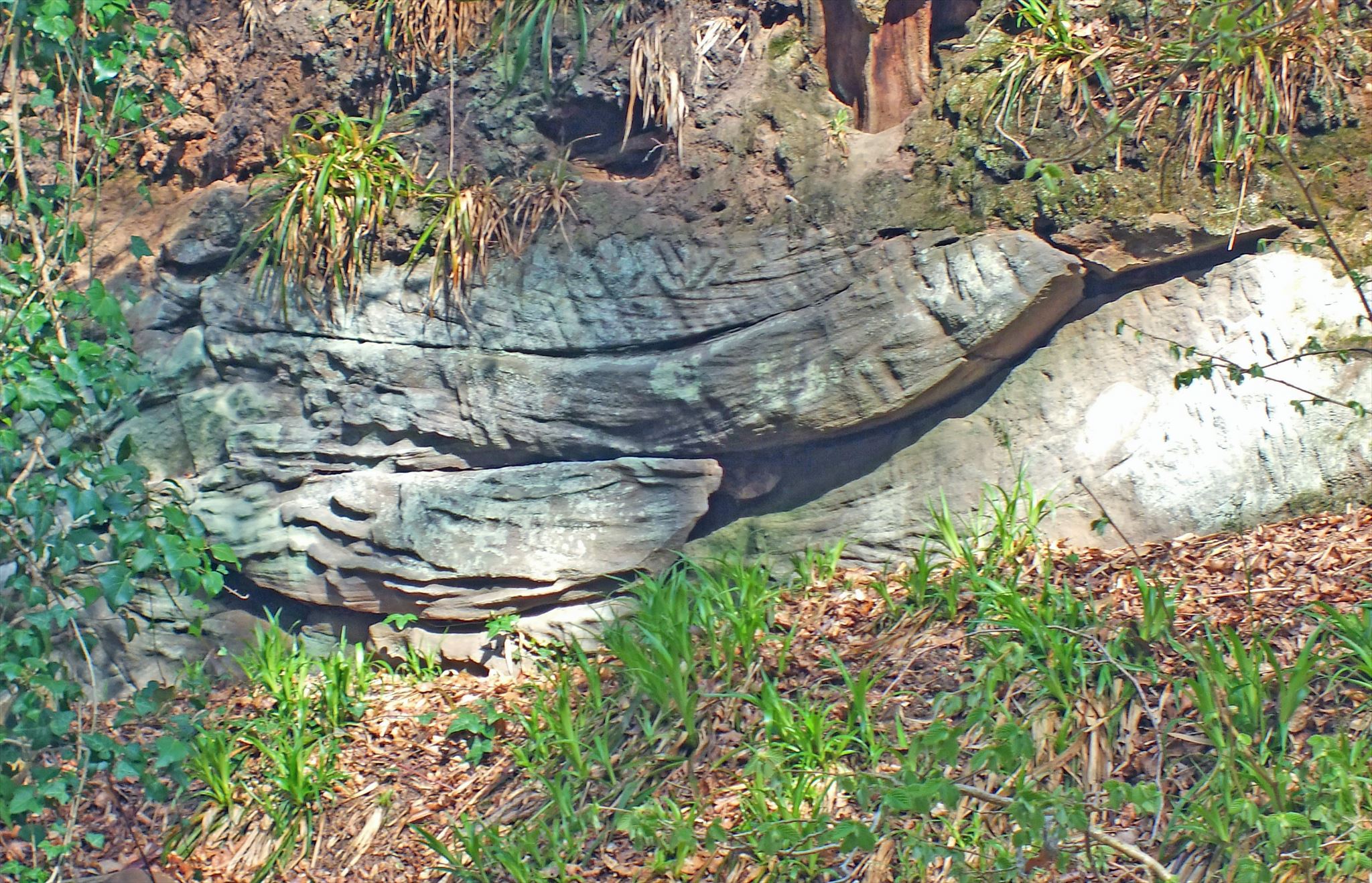
In the Picture 1 (above) you see pinkish grey sandstone beds up to 1/3rd metre thick composed of individual layers - called laminae - forming peaks and troughs. These structures are examples of trough cross- bedding and are proof of formation in a river environment. All the sandstone pictures show examples of trough cross-bedding, but there is a lot more going on. The individual layers are sometimes contorted, there is gentle arching, and domes and steep peaks. This is caused by soft sediment deformation and these structures develop when something disturbs the bedding layer when the sand is still quite wet. Sometimes the deformation is caused quite simply by the weight of more sediment arriving. Earthquakes can also be a cause. There is even a theory that the deformation has been caused by stampeding dinosaurs.
Examples of soft- sediment deformation are:
Slumping. This is when a mass of rock moves downwards a short distance from where it was originally deposited. In the examples below the rock involved in slumping is less than a metre square but slumps can be huge and devastating. Under water slumps can generate disastrous tsunamis.
Convolute bedding where the beds or laminations have been deformed by complex folding or intricate crumpling.
Seismites are unusual rock strictures caused by earthquakes. A common seismite is the sand volcano which is formed when sand is erupted by pressure from below, just like a real volcano, to form a sand cone. In the local sandstone they are quite common and only a few centimetres across.
Once again, looking at the PICTURE 1 (Above), there are hints of soft- sediment deformation in the bottom bed (centre of picture) where the laminae appear to be very gently arched.
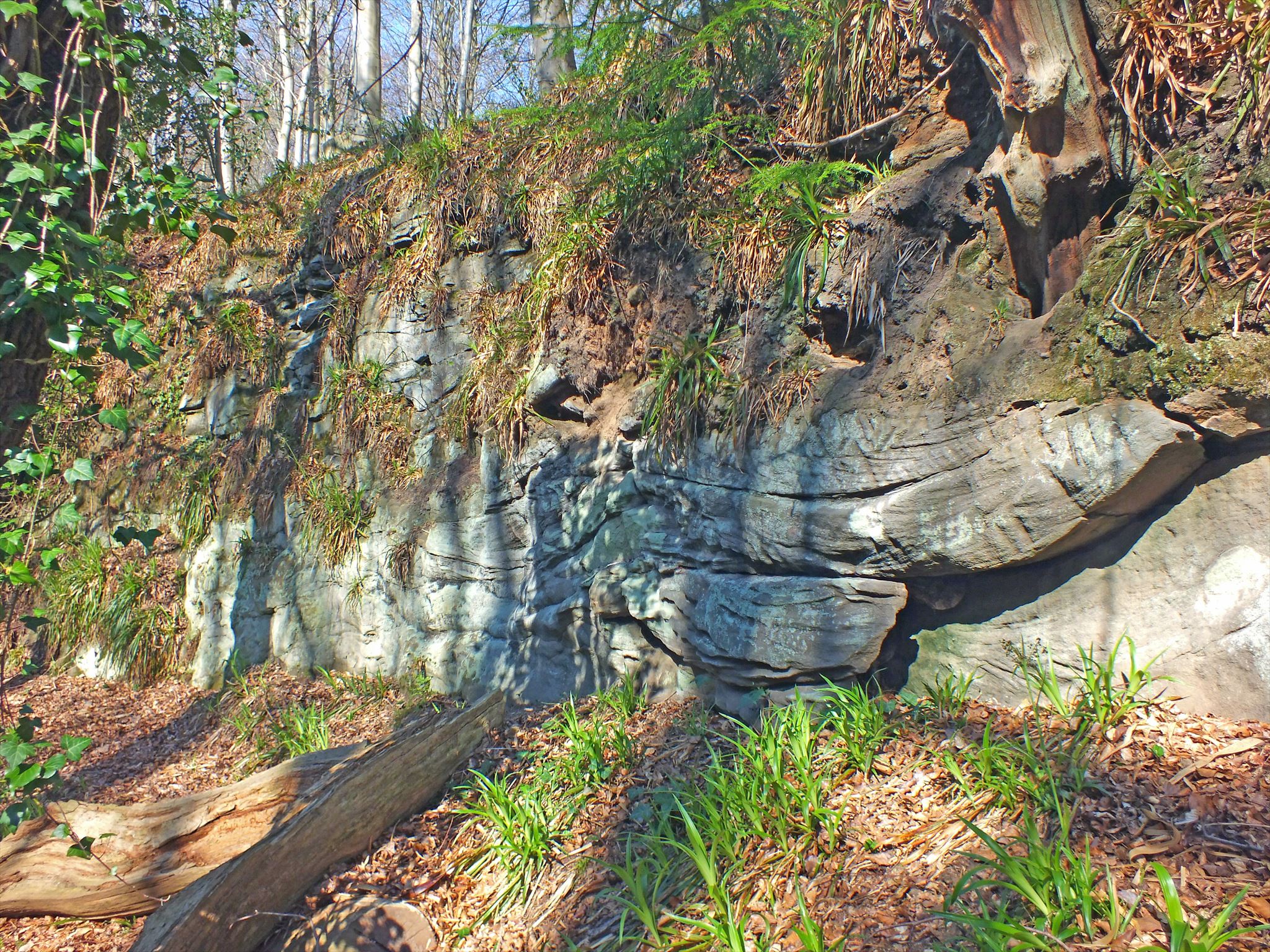
PICTURE 2
PICTURE 2 (above) shows the continuation of the beds to the left. There you see a definite dome-like structure possibly an example of convolute bedding created by the expulsion of water.
 PICTURE 3
In PICTURE 3 (Above) you can see possible examples of slumping.
>
 PICTURE 4
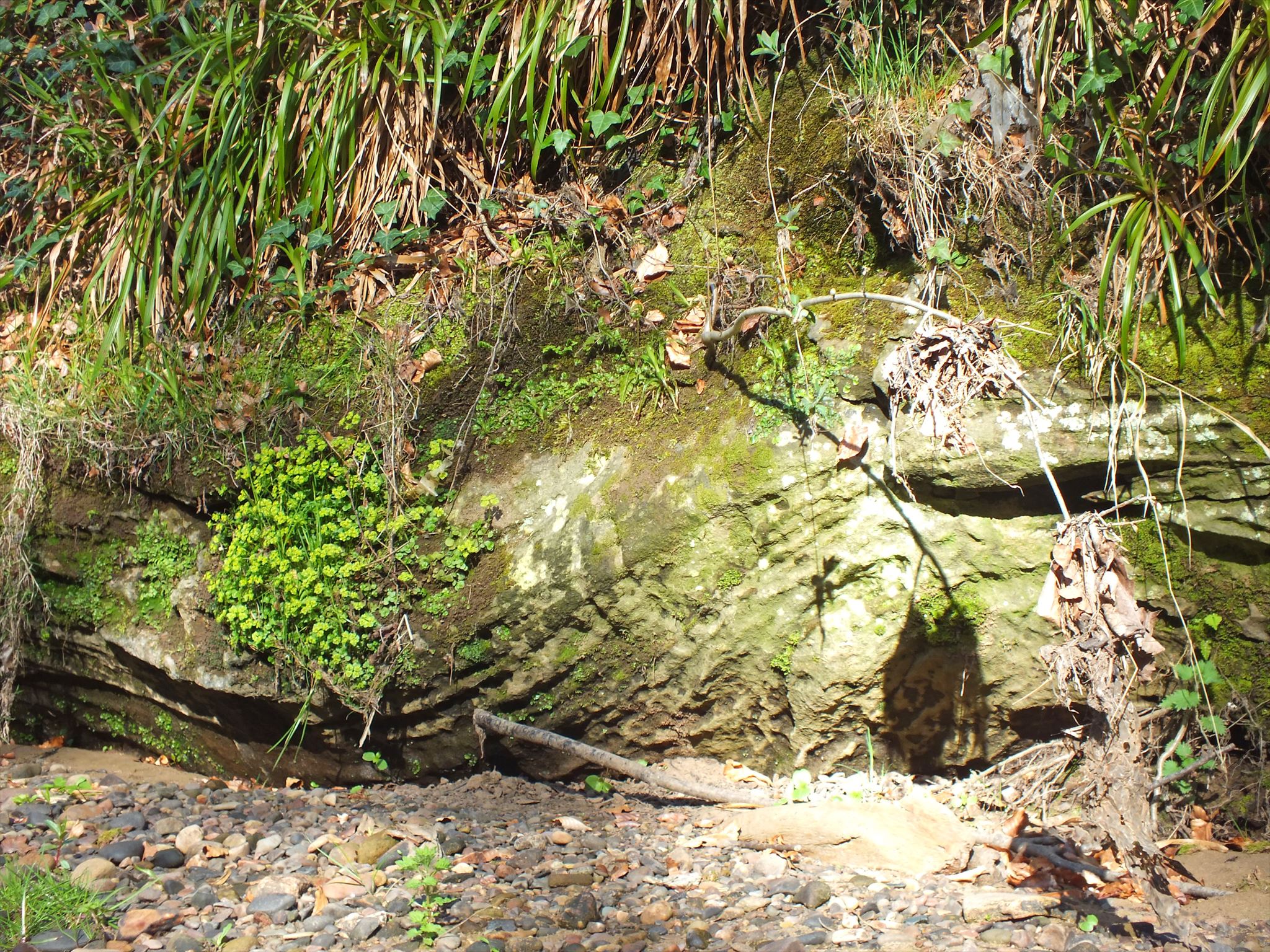
In PICTURE 4 (Above) you see trough cross-bedding but the downward curve is unusually steep and may have been caused by soft sediment deformation. Sometimes it’s hard to tell. Who said Geology was easy!
PICTURE 4
In PICTURE 4 (Above) you see trough cross-bedding but the downward curve is unusually steep and may have been caused by soft sediment deformation. Sometimes it’s hard to tell. Who said Geology was easy!
 PICTURE 5
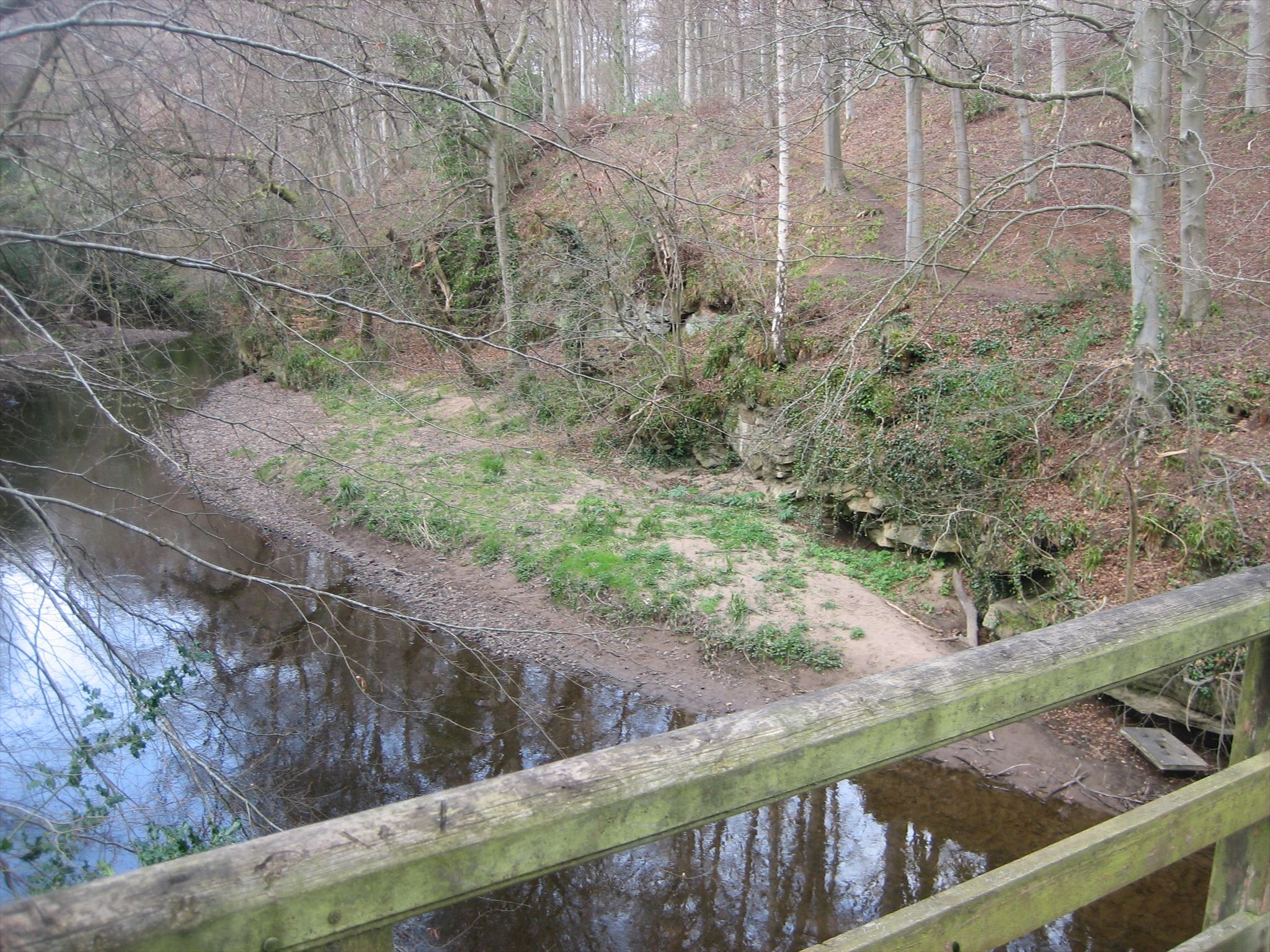
Immediately below these sandstone beds and visible most of the year is a gravel point bar. (See PICTURE 5 above) This is typical of gently meandering rivers. As the river goes into a bend the faster moving current on the outside of the bend continues to gouge into the bank while the slower moving current on the inside sweeps and rolls sand and gravel across the floor of the river into a long mound.
Where did the gravel come from? It probably started high up in the Pentland hills to the west, and here it is temporarily on the long journey to the sea. Rocks, when they first enter the river, start off in all shapes, but probably angular, and of all sizes which we call poorly sorted. Then, as the rocks continue downstream, they continue to erode, becoming smaller and rounder as they bump and chip their way to the sea. Eventually all rocks will end up the same, rounded and well sorted.
Now, please have a go at the questions below.
Q1. Which of the following is usually associated with a river rather than a marine or desert environment?
- Trough cross-bedding
- Angular and poorly sorted rock
- Fossils
- Very well sorted rough-edged grains
Q2. Of three possible causes here of soft sediment deformation, additional heavy sediment, earthquake or dinosaurs, which can we definitely dismiss?
Q3. Would you describe the stones of the point bar (PICTURE 5) here as rounded poorly sorted, rounded well sorted, angular well sorted, or angular poorly sorted?
Q4. On your way back and out of the country park you will pass Dalkeith Palace (See waypoint) built of sandstone where there are good examples of seismites, in this case small sand volcanoes, in some of the sandstone blocks. Identify an example e.g. on the west facade to left of doorway.
Please send your answers via E mail or through the message centre. You will then receive the answers and some more information about the geology of this site.
Please do not add your answers to the cache page.
This EarthCache has been provided by the Lothian and Borders GeoConservation with permission of Buccleuch Properties in cooperation with the ranger service of Dalkeith Country Park http://www.dalkeithcountrypark.co.uk/Credit. Geometry of trough cross-bedding. Grateful acknowledgement to Edinburgh Geological Society for use of diagram taken1999. Building Stones of Edinburgh, (Second edition). by McMillan, A A, Gillanders, R J, and Fairhurst, J A.