Pate
Common name: Seven-finger
Botanical name: Schefflera digitata
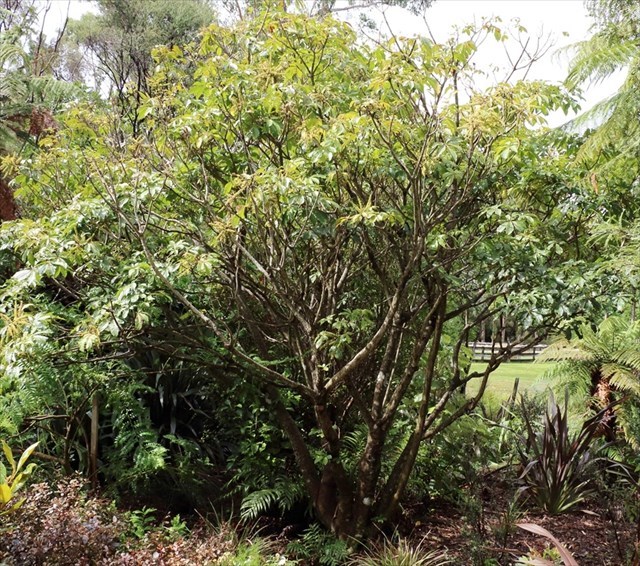
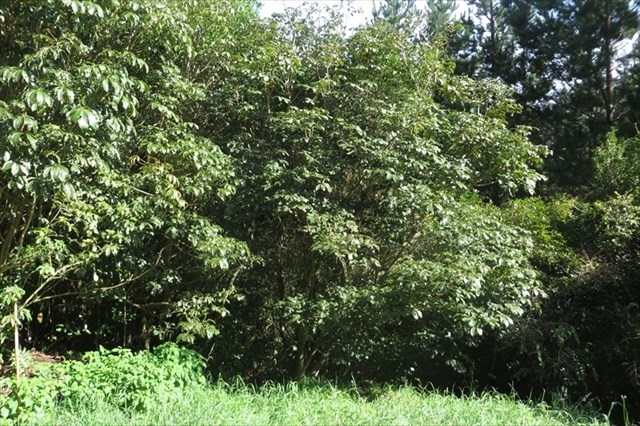
The pate is a small spreading tree that grows up to 8 metres tall and just as wide. It grows throughout the North, South and Stewart Islands from sea level to 1200m. It usually occurs in damp parts of the forest and along stream banks. It can also be found as a smaller shrub growing along shady roadsides through the bush. The pate is partially deciduous: the colder the location, the greater the proportion of leaves that the tree will shed in winter. It also tends to shed leaves when stressed by drought conditions.
A typical pate in CO's garden
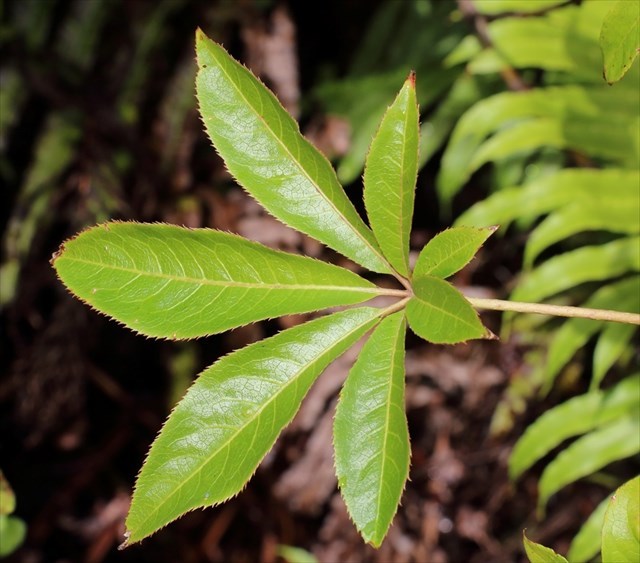
Leaves
The leaves are large and compound , consisting of from 3 to 9 lobes and at a casual glance can be easily confused with the leaves of the five-finger (puahou), which is #20 in this series of caches and is sited along the same track. However, the pate leaves are much thinner and soft to touch, quite unlike the thicker, glossy and robust puahou leaves. The leaf margins are also closely serrated, whereas on the puahou they are coarsely serrated, about one ‘tooth’ per cm, whereas pate is more like 1 ‘tooth’ per mm.
A pate leaf
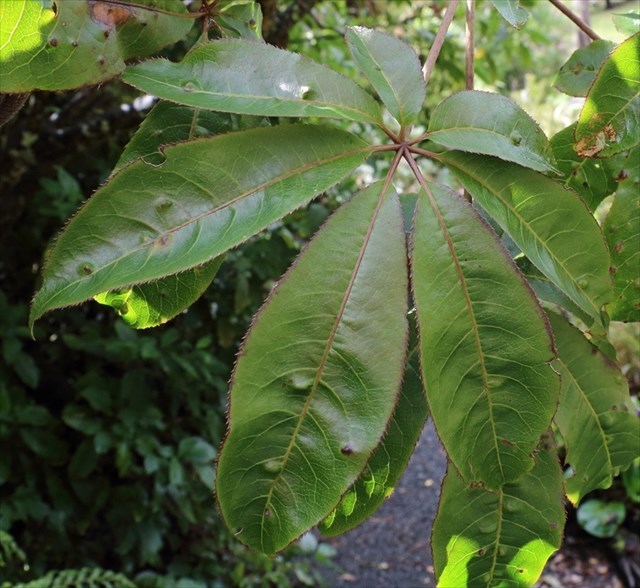
The leaves can become pockmarked with large bumps on the top surface (and pits beneath) caused by sap-sucking insects, which secrete honeydew that coats the ground and any plants beneath the tree and often the surface of its lower leaves as well. An unsightly black sooty mould grows on the honeydew and disfigures what could otherwise be an attractive tree. This problem has become so bad in our garden that I have been cutting out a lot of mature pate trees as they have become so unsightly.
A pockmarked leaf
Flowers and fruit
Flowers are small (around 7 mms across) and greenish, but are carried on a large drooping inflorescence in spring, which can be over 30 cms across.
[flower photos to follow - not in flower at time of publication]
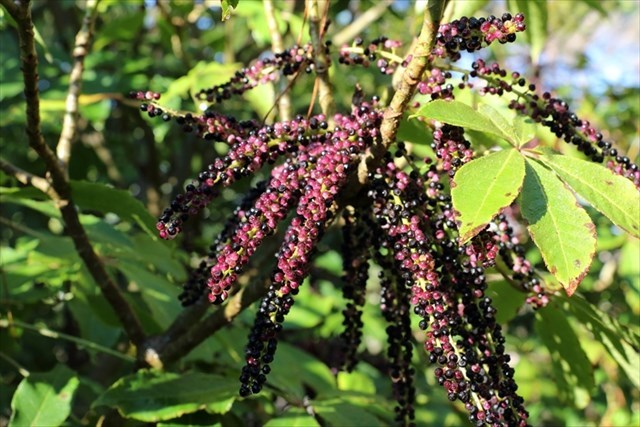
They are followed by green drupes that ripen over several months to dark violet. Native birds feed on these in the winter.
Unripe fruits
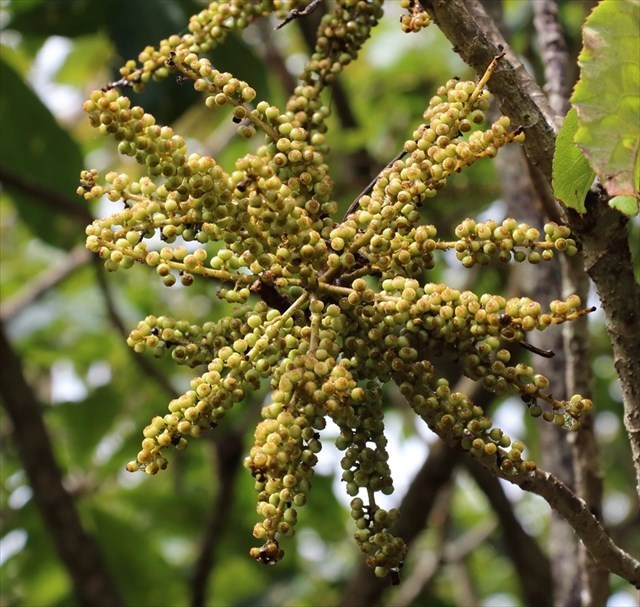
Ripening fruits
Bark
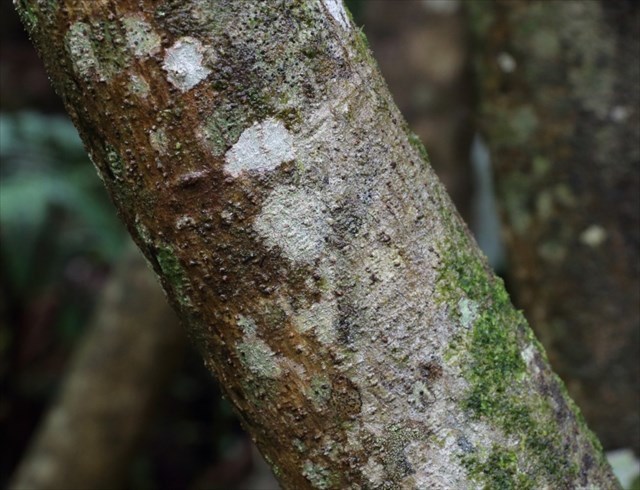
Young trees have grey slightly knobbly bark. On older trees (such as that in the photo) the bark can become quite discoloured and, due to its preference for growing in damp places, can be covered in patches of pale grey lichen and green moss.
Bark of a mature tree (in CO’s garden)
The pate at GZ
The tree at GZ is a small pate and I am happy to say doesn't seem to be afflicted by the same insect as infests our trees at home.
This is what you seek
The cache
The cache is a 400 ml plastic container. There is room for small TBs and Geocoins inside the cache. At time of placement it contained a waterproof log book and a pencil. If you are unable to sign the log for any reason please make sure you accompany your online log with a photograph of the cache log to prove you did acually visit it. Failure to prove you found the cache will result in me deleting your online log entry when I check the cache log against the online entries.
Getting to the cache requires care to avoid falling down the steep slope and this is not one for young children to try to retrieve. Please replace the cache as and where found so that it cannot be noticed by the many walkers, cyclists and horse riders who use this track. Cyclists in particular can appear rapidly along this section of track at any time over weekends and public holidays, so some stealth is required.