Welcome to Lakeside Park’s unique cobble beach.
I hope you enjoy this beach as much as I did the first time I saw it.
A very unique beach for sure.
What makes this cobble beach unique?
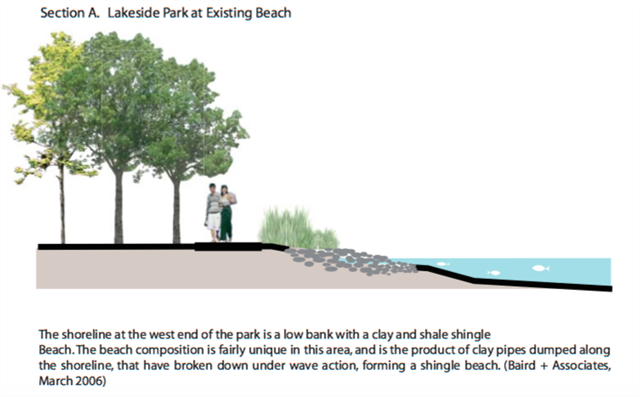
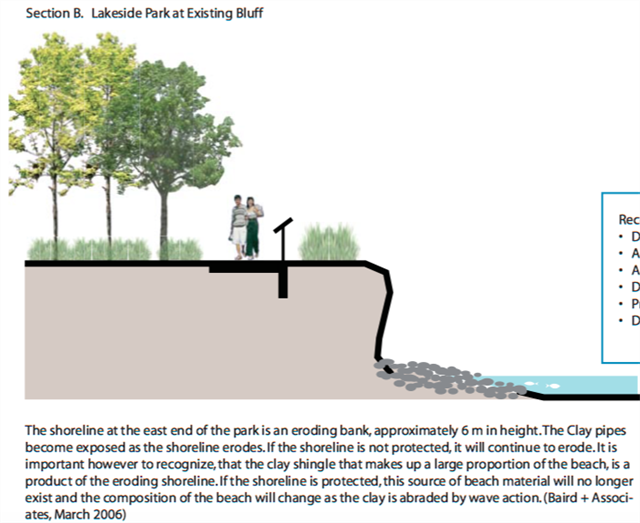
The high bank, or bluff, on the shore line at the east end of the park contains buried clay pipes, remnants from the National Sewer Pipe Company that operated here from 1955 to 1980. The red terra cotta pipes are exposed as the shore line and bank erodes. The pipes that fall into the water are rubbed against other pipes and rocks and are weathered by the waves resulting in flat clay cobbles. The cobbles are mixed with natural shale shingles eroded from the bottom of the lake.

The shoreline at the east end of the park is an eroding bank, approximately 6 m in height. The clay pipes become exposed as the shoreline erodes. If the shoreline is not protected, it will continue to erode. This newly formed clay shingle makes up a large proportion of the beach, is a product of the eroding shoreline. If the shoreline is protected, this source of beach material will no longer exist and the composition of the beach will change as the clay is abraded by wave action. (Baird + Associates, March 2006)
What is Shoreline Erosion
Erosion is the process by which soil and rocks are removed from the Earth’s surface by natural processes such as wind or water flow, and then transported and deposited in another area.
At Lakeside Park, erosion occurs when waves hit the beach and pull sediment back out with them. The most powerful waves are from the east. Some offshore waves can exceed three metres (9.9 feet) in heights.
Sediment Size
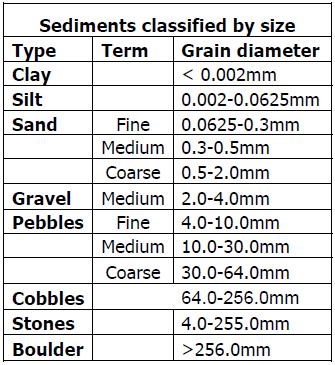
Sediment is the word geologists use for loose pieces of minerals and rock. Of course, pieces of rock come in all sizes so we have developed a way to classify them. The chart below shows how sediments are classified. Most of the names are ones you already use; sand, boulders, and clay, for example. The illustrations of sand and pebbles are shown at their actual sizes. Unfortunately silt and clay are smaller than a single pixel on your computer screen, so they don't show up well here! Cobbles and boulders are another problem - they are too big to fit on your screen!
What’s the difference between cobbles and shingles?
A cobble (sometimes a cobblestone) is a rock defined as having a particle size of 64–256 millimeters (2.5–10.1 in), larger than a pebble and smaller than a boulder. Other scales define a cobble's size in slightly different terms.
A shingle beach is a beach which is armoured with pebbles or small- to medium-sized cobbles (as opposed to fine sand). Typically, the stone composition may grade from characteristic sizes ranging from 2 to 200 millimetres (0.1 to 7.9 in) diameter.
To claim this EarthCache, please Email the answers to the following questions to the CO at the top of the page:
1) Visit the posted coordinates, and the other two listed waypoints. Describe the material you see on the beach, using the sediment size chart provided, and by describing the colour of the material.
2) After visiting each waypoint, locate the source location of the buried Terra Cotta Pipes. Describe what you see here. What are some of the things that stand out to you at this location.
3) Walking from the source location, use your GPS to measure the furthest distance, from the source location, that cobbles have been transported along the beach.
4) At the beach by the posted coordinates, estimate the percentage of Terracotta shingles, vs the natural shale shingles.
5) Completely optional of course, post a picture of one of your favourite Terra Cotta shingles, along with your GPS. Look carefully at the pieces on the beach, some shingles are very unique.
Please, No Souvenir Hunting