GEODES:
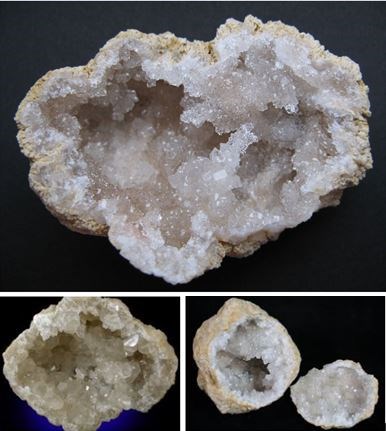
Geodes are spherical masses of mineral crystals which have formed in cavities of the surrounding rock.
These cavities may form in the following types of rock:
- Igneous: As volcanic lava or magma cools, gas bubbles may form. As the gasses dissolve and the rock hardens, the resulting cavities (vesicles) remain trapped in the rock.
- Sedimentary: In this case a mass of minerals deposited in the sediment may dissolve over time, leaving the empty cavity. Alternatively, the sediment may contain organic matter that also dissolves to form an empty space.
The next step in the formation of the geode requires water, and lots of it. As the rain water or ground water percolates through the surrounding rock, it dissolves other minerals in that rock. This mineral-rich water then seeps through into the cavity, leaving behind a thin layer of minerals on the hollow interior. Over thousands and millions of years, these continual deposits of minerals form into the crystals that you can see lining the inside of the geode cavity.
Once the outside layer of the geode (usually chalcedony) solidifies, this hardened shell means that the geode can be extracted from its surroundings as a separate rock.
It is only once the geode is broken open that the type of crystal inside can be revealed. The type of crystal depends on the temperature, acidity and minerals contained in the surrounding rock. For instance, quartz crystals are most common in igneous geodes. Silica is more common in geodes that form in sediment. Other crystal deposits may be formed of purple amethyst, agate or jasper banding, or crystals such as as calcite, dolomite, celestite, etc
EARTHCACHE:
At GZ, if you look closely at the rock forming the banks of the creek you will find a number of examples of geodes which have been exposed as the flow of water in the creek has eroded the rock. To complete this earthcache, please send the answers to the following questions:
- Examine the rock surrounding the geodes. Do you think these geodes have formed in a sedimentary or igneous environment?
- Based on the colouring of the cystals in the geodes, what type of mineral do you think they are formed from?
- Are the geodes a uniform shape and size?
- Compare a sample of the geodes. Are the cavities filled equally or are some geodes fuller than others?
References:
Concretions, Thunder Eggs and Geodes (availabe from: https://australianmuseum.net.au/concretions-thunder-eggs-and-geodes) [27 April, 2017]
Geodes - A Very Cool Rock Formation (available from http://www.rocksandminerals4u.com/geodes.html) [27 April, 2017]
Where do geodes come from? - The science behind the sparkle (available from http://scienceline.org/2012/11/where-do-geodes-come-from/) [27 April, 2017]
Geode (available from https://en.wikipedia.org/wiki/Geode) [27 April, 2017]