Deer Tick Traditional Cache
K.E.T.: It seems to be gone and I don't feel like replacing it.
Please note Use of geocaching.com services is subject to the terms and conditions
in our disclaimer.
Deer ticks are the ones that carry Lyme disease etc. Knowing about them and how to protect yourself, makes it possible to enjoy the outdoors and geocaching. Please check through the info I have gathered and have fun and stay well. BYOP
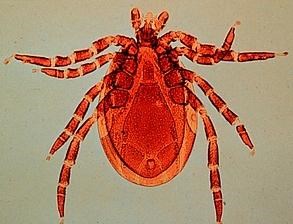
Deer tick
Tick Habitat
Many people think ticks are only present in the woods. However, ticks can be found in many areas.
• Where woods/fields meet lawn
• Wooded areas
• Tall brush/grass
• Under leaves*
• Very small numbers on cut/raked lawns or sports fields
• Under ground cover (plants) in yard *
• Around stone walls and woodpiles where mice & other small mammals live
*under plants/leaves to prevent dehydration
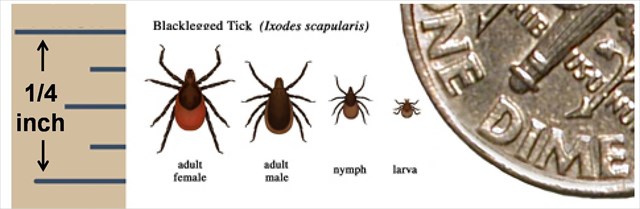
Fortunately, when a tick bites you, it does not automatically transfer diseases to their host. Instead, they need to be attached to the host around 6–8 hours before they are capable of transferring the disease. This gives the host an opportunity to remove this parasite before disease transmission occurs.
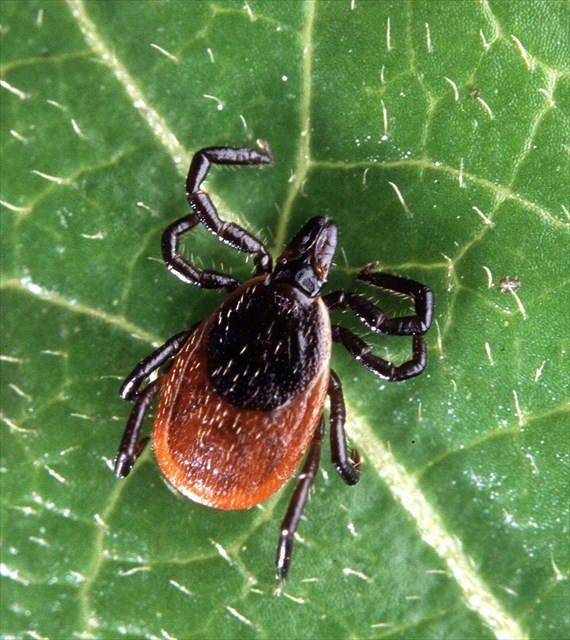
Adult deer tick, Ixodes scapularis.
Ixodes scapularis is commonly known as the deer tick or blacklegged tick (although some people reserve the latter term for Ixodes pacificus, which is found on the West Coast of the USA), and in some parts of the USA as the bear tick. It is a hard-bodied tick (family Ixodidae) of the eastern and northern Midwestern United States. It is a vector for several diseases of animals, including humans (Lyme disease, babesiosis, anaplasmosis, Powassan virus disease,etc.) and is known as the deer tick owing to its habit of parasitizing the white-tailed deer. It is also known to parasitize mice, lizards, migratory birds, etc. especially while the tick is in the larval or nymphal stage.
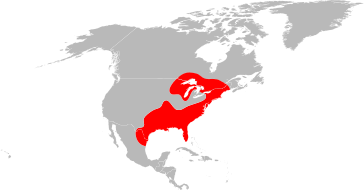
Map of the range of the Deer Tick (Ixodes scapularis).
Description
Most images of Ixodes scapularis that are commonly available—show an adult that is unengorged, that is, an adult that has not had a blood meal. This is natural, since ticks are generally removed immediately upon discovery to minimize the chance of disease. However, the abdomen that holds blood is so much larger when engorged and looks so different from the rest of the tick that it would be easy to assume that an engorged specimen of Ixodes scapularis is an entirely different tick (see photo below).
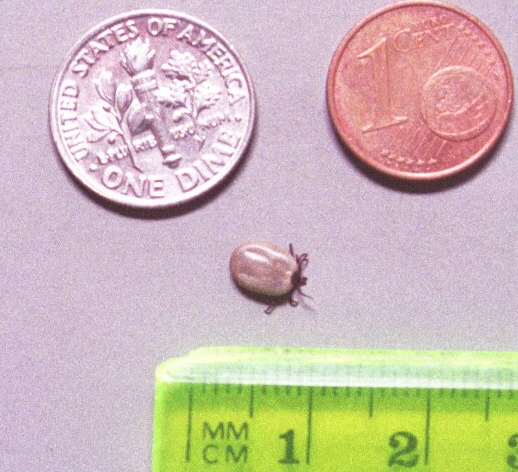
Engorged deer tick
When the deer tick has consumed a blood meal, its abdomen will be a light grayish-blue color, whereas the tick itself is chiefly black. In identifying an engorged tick, it is helpful to concentrate on the legs and upper part of the body.
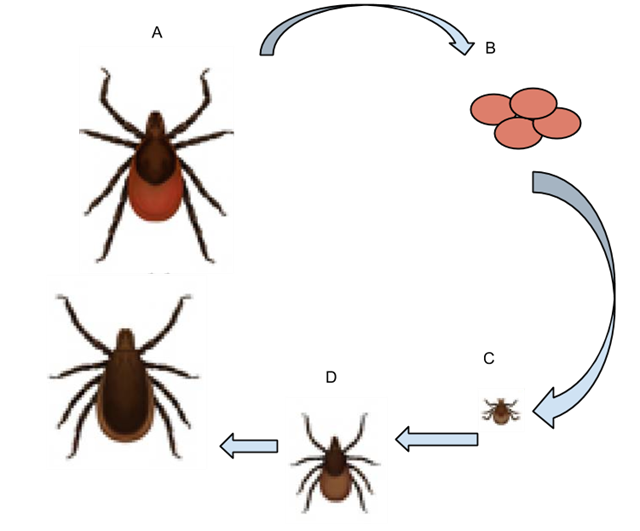
Deer Tick life cycle
Behavior
I. scapularis has a two-year life cycle, during which time it passes through three stages: larva, nymph, and adult. The tick must take a blood meal at each stage before maturing to the next. Deer tick females latch onto a host and drink its blood for four to five days. Deer are the preferred host of the deer tick, but it is also known to feed on small rodents. After she is engorged, the tick drops off and overwinters in the leaf litter of the forest floor. The following spring, the female lays several hundred to a few thousand eggs in clusters. Transtadial (between tick stages) passage of Borrelia burgdorferi is common. Vertical passage (from mother to egg) of Borrelia is uncommon.
Ticks are very hardy creatures and I. scapularis is no exception. They will be active even after a moderate to severe frost, as daytime temperatures can warm them enough to keep them actively searching for a host. In the spring, they can be one of the first invertebrates to become active. Deer ticks can be quite numerous and seemingly gregarious in areas where they are found.
As disease vector
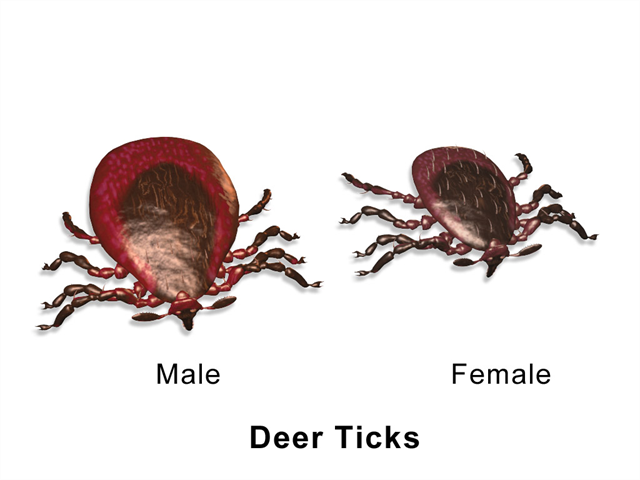
3D rendering of a male and female deer tick (note: labels are incorrect; female is actually on the left).
Ixodes scapularis is the main vector of Lyme disease in North America. It can also transmit other Borrelia species, including Borrelia miyamotoi. Ticks that transmit B. burgdorferi to humans can also carry and transmit several other parasites, such as Theleria microti and Anaplasma phagocytophilium, which cause the diseases babesiosis and human granulocytic anaplasmosis (HGA), respectively. Among early Lyme disease patients, depending on their location, 2%–12% will also have HGA and 2%–40% will have babesiosis.
Co-infections complicate Lyme symptoms, especially diagnosis and treatment. It is possible for a tick to carry and transmit one of the co-infections and not Borrelia, making diagnosis difficult and often elusive. The Centers for disease Control’s emerging infectious diseases department did a study in rural New Jersey of 100 ticks, and found 55% of the ticks were infected with at least one of the pathogens.
Although they are the preferred mammalian hosts, deer cannot transmit Borrelia spirochetes to ticks. Ticks acquire Lyme disease microbes by feeding on infected mice and other small rodents.
Tips to Prevent Tick Bites
Using the right insect repellent and other preventive actions can discourage ticks, mosquitoes, and other biting insects from landing on you. Here are tips for other preventive actions you can take against ticks.
Avoid Tick Habitats
• Reduce time spent in potentially tick-infested habitats such as tall grass and shrubs.
• Reduce leaf litter and mow tall grass or brush that may serve as tick habitat.
• Walk in the center of trails to avoid contact with adjacent vegetation.
Avoid Tick Bites
• Keep ticks away from exposed skin by wearing long-sleeved shirts, long pants, and high boots.
• Tuck shirts into pants and pants into socks to cover gaps in your clothing where ticks can get in.
• Wear light-colored clothing to be able to see ticks more easily.
The cache is a tied in, camoed, "micro" pill bottle, that you have to push hard to open and close. As usual, try to keep track of the contents, the rubber band makes it easier to get the log in and out of the bottle and the plastic bag keeps it dry. BYOP and camo the hide if needed.
Additional Hints
(No hints available.)
Treasures
You'll collect a digital Treasure from one of these collections when you find and log this geocache:

Loading Treasures