An Earth cache is a special type of Virtual Cache that is meant to be educational. Therefore to log a find you must demonstrate that you have learnt something from the site and experience.
Send your answers to us in an email via our profile page.
Any logs not accompanied by an email will be deleted.
Logging Tasks:
The listed co-ordinates will take you to a road cutting. You will need to examine the rocks in this cutting and answer the following questions:
- When standing at the listed coordinates you will see three distinct layers of rock. Starting at the bottom layer and going up to the top layer describe each layer in terms of colour, texture, grain size and identify each rock type.
- In your own words describe how you think these different coloured layers were formed.
- Do these two rock types come from the same rock classification and if so what classification?
Geology of the Beaufort Group
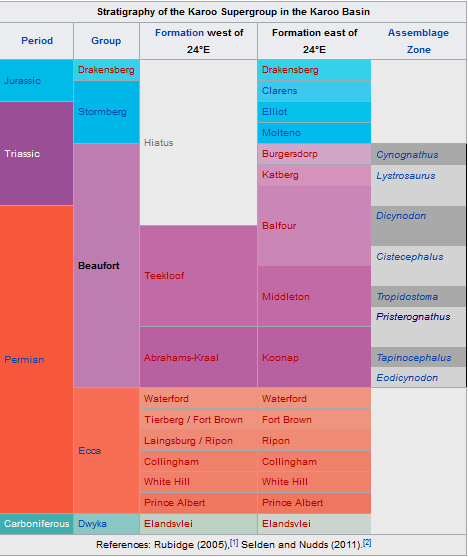
The Beaufort Group is the third of the main subdivisions of the Karoo Supergroup of geological strata in Southern Africa. It follows conformably after the Ecca Group and consists essentially of sandstones and shales, deposited in the Karoo Basin from the Middle Permian to the early part of the Middle Triassic periods.
In the Eastern Cape Province the Karoo Basin fill commenced with the deposition of the Dwyka Group, followed by the Ecca Group, the Beaufort Group, the Molteno, Elliot and Clarens formations of the Stormberg Group and the igneous Drakensberg Group. The basin followed the typical evolution of foreland basins, with the Ecca Group representing the ‘flysch’ component and the Beaufort Group, the overlying Molteno and Elliot Formations representing the ‘molasse’-fluvial type sediments.
Deposits in this group include (in order of deposition):
Lower Adelaide Subgroup comprising:
Koonap Formation: Transitional brackish lacustrine to fluvial. Greenish-grey sandstones grading upwards into fine-grained siltstones and mudstones.
Middleton Formation: Semi-arid climate supported a lush flora and fauna that thrived along meander belts and semi-permanent lakes. Cyclic deposits of lenticular sandstone bodies grading into greenish-grey mudstone. The thickest formation in this succession, constituting 37% of the Beaufort Group and 47% of the Adelaide Subgroup. The formation has lenses of red mudstone which are likely to have been deposited in a sub-aeril fluvia environment.
Balfour Formation: The upper part of the Adelaide Subgroup and part of what was called lower to middle Beaufort.
Upper Tarkastad Subgroup comprising:
Katberg Formation: Arenaceous deposits of red and olive-yellow mudstones. Deposited in a braided fluvial system.
Burgersdorp Formation: Deposited in a low-sinuosity fluvial system.
The 3 basic rock Classifications
Igneous Rocks
Igneous rocks are crystalline solids which form directly from the cooling of magma. This is an exothermic process (it loses heat) and involves a phase change from the liquid to the solid state. The earth is made of igneous rock - at least at the surface where our planet is exposed to the coldness of space. Igneous rocks are given names based upon two things: composition (what they are made of) and texture (how big the crystals are).
Sedimentary Rocks
In most places on the surface, the igneous rocks which make up the majority of the crust are covered by a thin veneer of loose sediment (deposits), and the rock which is made as layers of this debris get compacted and cemented together.
Metamorphic Rocks
The metamorphics get their name from "meta" (change) and "morph" (form). Any rock can become a metamorphic rock. All that is required is for the rock to be moved into an environment in which the minerals which make up the rock become unstable and out of equilibrium with the new environmental conditions. In most cases, this involves burial which leads to a rise in temperature and pressure. The metamorphic changes in the minerals always move in a direction designed to restore equilibrium. Common metamorphic rocks include slate, schist, gneiss, and marble.
References:
http://jersey.uoregon.edu/~mstrick/AskGeoMan/geoQuerry13.html
https://en.wikipedia.org/wiki/Beaufort_Group
Geology off the beaten track by Nick Norman