This EC located at a formation of stones in the Bay of Islands near Motorua Island. You'll need a boat to get here to get the information for this EC. If you plan to go alone please inquire before your planned trip about the weather and water conditions, as you will drive over open water. Be sure that somebody knows where you are going! A safe option is to book trips around Bay of Islands which will show you around the bay and visit the Black Rocks too- there are some very nice options! Some tour operators are found in Pahia near the harbor or booking over the internet is possible too.
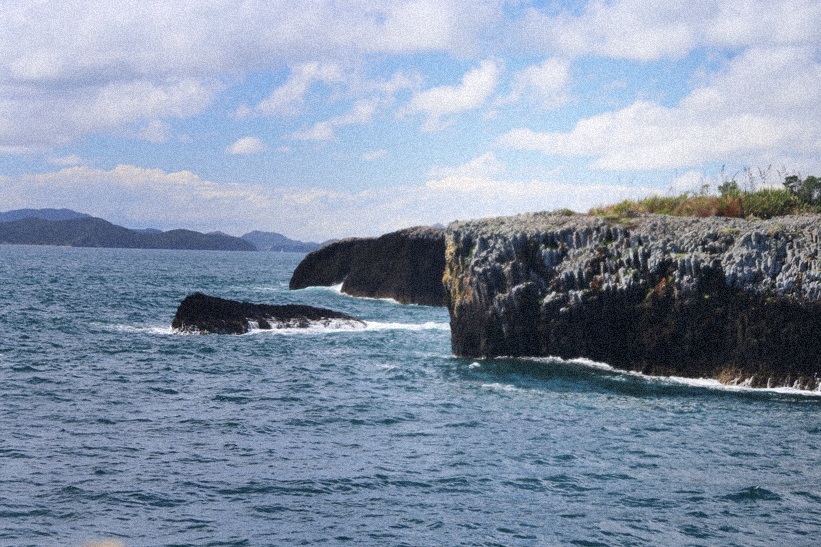
The Black Rocks are a group of islets off the north and eastern coasts of Moturoa Island and are a very special feature of the Bay of Islands landscape. The islets are the visible tops of basalt lava flows from volcanic eruptions which have not been entirely covered by the rise of the sea to its present level. Believed to be around 1.2 million years old, their distinctive shape makes them very rare and of outstanding conservation value. Most of the black rocks fall sheer to the sea floor at depths of up to 30 metres. The underwater caves in and around the Black Rocks are well populated with crayfish, kina (sea urchins) and mussels as well as other marine life.
<>Although the basaltic columns are impressive, they are not unique. Basalt columns are a common volcanic feature, and they occur on many scales (faster cooling produces smaller columns).
The columns consist from basalt which was formed of magma. Under the right conditions, magma can cool in such a way as to form polygonal shapes that can be straight or bend and twist – we call these phenomena columnar joints. They can be spectacular, created with what looks like the precision of a master sculptor, but really it all boils down to the physics of cooling. Columns can form in a variety of patterns, mainly hexagonal (but can be found with anywhere from 4-8 sides). They can vary in size from only a few centimeters to meters across. They form when a thick body of cooling magma or even ash starts to contract and cracks begin to form. These cracks start at/near what is called the “cooling surface”, which might be the top or bottom (or sides) of the lava flow, magmatic intrusion or ash deposit. The cracks propagate into the cooling material making (upon close examination) stacks of plates that form the columns. The plates are usually aligned parallel to the flow surface (see above), while the columns form perpendicular to the cooling surface. If you look closely at a column, you will see feather-like fracture patterns called “pluma” that represent the cracking of the cooling material in response to the strain that the material is feeling as it contracts. The parts of the flows with clear columns are called the colonnade while the areas where the columns are less-than-perfect or absent are the entablature. Typically, colonnades form at the top and bottom of the flow (starting from the cooling surface) with a middle area of entablature. If lava flows out over water or soft, muddy sediment, that seems to help to get columns to form, likely thanks to all that extra cooling the water adds.
To claim this EC as a found please answer these question:
1. Do we see here the colonnade or the entablature?
2. Please describe the form and surface the components formation Black Rocks including the most important features considering what you have learned about it and what you have observed while visiting the place. For example, do you think they are large or small, describe the color and surface structure, try to observe the form of one single column, etc.
3. For an bonus point requiring some internet research: Name another place of finding of this phenomenon!
Write an email with the Name of the EC in the subject line with your answers , please don't post your answers here!
Source:
http://www.newzealand.com/de/article/visit-the-black-rocks-in-the-bay-of-islands/
https://www.wired.com/2015/02/volcanoes-create-towering-columns-rock/