The soil in Australia naturally contains salt, having accumulated over thousands of years. This salt may come from prevailing winds carrying ocean salt, the evaporation of inland seas and from weathered parent rocks. Rainfall absorbs the salt on the surface, and carries it down into the subsoil where it is stored in unsaturated soil profiles. Through this process the salt concentration of groundwater has built up over many thousands of years.
Prior to British settlement in 1788, groundwater levels were in equilibrium. Seasonal recharge, and year-round utilisation of ground water by deep rooted native vegetation resulted in ground water levels remaining static. As a result the absorbed salts remained well below the soil surface. There are areas in Australia where the salt heavy water comes to the surface naturally including Lake Tyrrell and Pink Lake in Victoria and Lake Eyre in South Australia forming salt lakes.
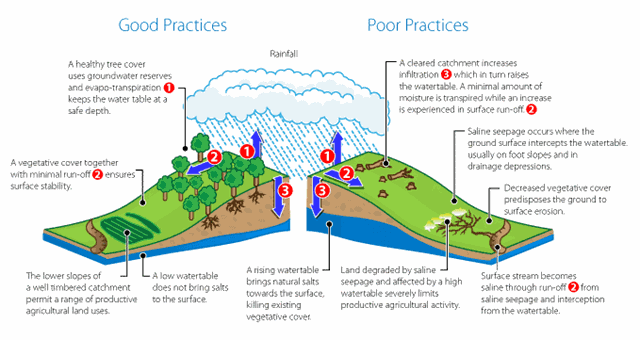
Land clearing in Australia has resulted in a loss of this native vegetation, replaced largely by agriculture and pasture crops. These plantings are often annual plants and shallow rooted, and thus, unable to intercept, and adequately absorb stored and rising ground water. As the rising groundwater evaporates it leaves behind concentrated salt closer to the soil surface. Plants growing in this environment are weaker and intercept and absorb less ground water resulting the water table slowly rising in a vicious circle. Ultimately the surface soil becomes so saline nothing can grow in it.
This soil salinity video explains the processes involved and the impacts way better than I can write it.
This recovery success story video shows salinity can be reversed with some effort.
To successfully log this cache please email me the answers to following questions:
Can you see any signs of salinity from the information board at the given coordinates? Explain why.
Name two types of trees planted in this plantation. Do the trees look salt affected?
What is the ‘man-made’ cause of salinity mentioned in the soil salinity video and does salinity only affect agriculture.
What plants have been used in the Yealering recovery plots (watch the recovery success story video carefully)?
Optional logging task: Name a location or area you have seen in your travels which has been affected by salinity.
Please feel free to log this cache once you've completed the EarthCache requirements while waiting for a response to your answers.
You will need to send me your answers to verify your find for this EarthCache and will most likely hear from me within a couple of days or so if in the unlikely event, a correction or more detail is needed.
Feel free to post your pictures of your visit in your logs, but, PLEASE, no photos that will give away the answers to the tasks.
Sources:
Good practices, bad practices image: http://www.blueplanet.nsw.edu.au
Salinity in Australia: CSIRO 2001
Saltbush Yealering: Department of Agriculture and Food WA