Burra History:-
Burra is a country town in South Australia located 160km north of Adelaide, with a population of approximately 1,200 people. Founded in 1845, it was from then until 1877 the site of one of the world’s major copper mines, the income from which did much to save the young colony from financial disaster. It is now a very pleasent town comprising of many of the old buildings sill being used and many interesting historical sites to visit.
By the time the mine closed in 1877 it was already also serving as a transport centre for the north-east of the colony and parts of western NSW and SW Qld. In the following decade it served the growing wheat farming areas to the west and for a while the untimely doomed expansion in the drier areas to the east.
Copper Facts:-
Copper is a ductile, coloured metal that has very high thermal and electrical conductivity. Copper was the first metal to be used by man (probably as early as 7000 BC) and was used as a substitute for stone; its malleability enabled tools to be easily shaped by beating. In the modern era, increasing use of copper is linked to the increasing use of electricity. In addition to being an excellent electrical conductor, copper is ductile enough to be drawn into wire and beaten into sheets without fracturing. It is therefore used to produce electrical cables and electrical equipment. Copper and its alloys are also widely used in plumbing components, building construction as well as industrial machinery. An average car contains more than 20 kilograms (kg) of copper and suburban homes have around 200 kg of copper. Demand for copper is often viewed as a leading indicator of global economic health.
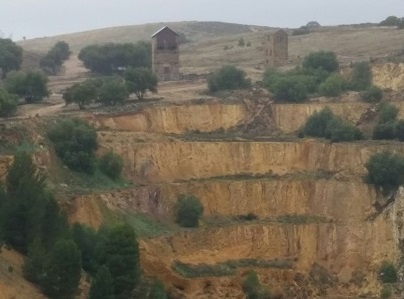
Burra Copper :- The burra orebody formed in a heavely fractured dolomite rock confined between two faults. The trace of one of these faults is visible on the Southern face of the open cut.as a distintly steeply dipping white band.The fault is up to 10mts wideand marks the western Limit of the Copper mineralisation. The ore zone contained brightly coloured oxidised copper materials, cheifly Malachite (Green) and Asurite (Blue). These occur as veins, blebs and nodules in the dolomite host rock. The rich Burra oxidised ores were formed from a much poorer body of copper sulphide mineralisation over millions of years by a process known as secondary enrichment.
The primary Copper Sulphide minerals were possibly deposited 300 to 400 million years ago at the end of the volcanic activity in this area.
The original oxidised ores were visible on the surface but have now been mined to a depth that is now not profitable to keep mining the ore.
Now for the Questions ;-
1/.What are the two faults the Copper was found between
2/. From here look directly south and you will see one of the Faults. What colour is it and how does it differ from the rest of the Open Cut?
3/. Why do you think it is a different colour?
IMPORTANT.;
As per the EarthCache guidelines, once you complete the EarthCache requirements you can post your find without delay.
BUT You will also need to verify your find by sending us a message and provide your answers to the above questions.
Above all we hope you enjoy your visit.