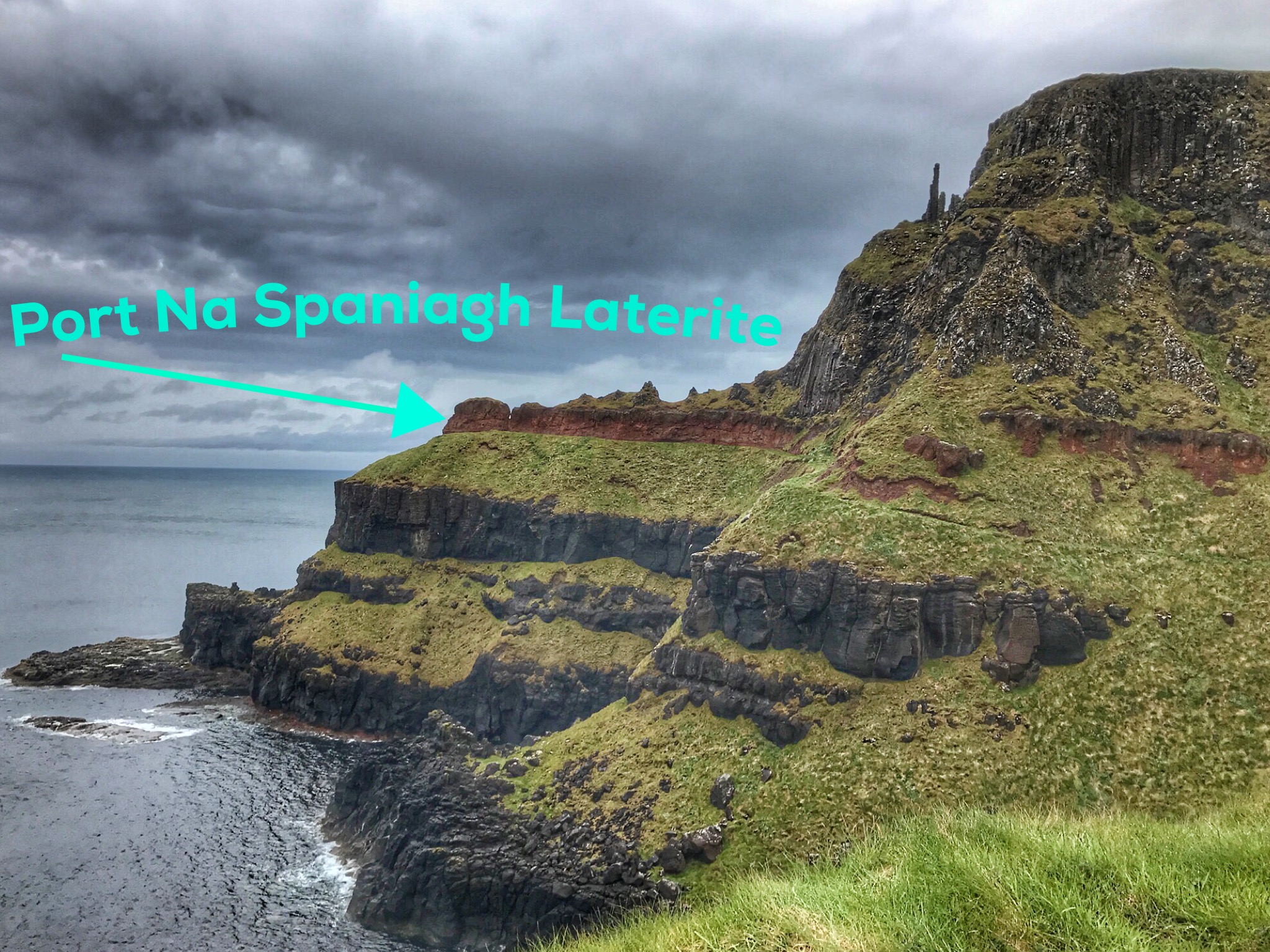
Take some time to explore this lesser-visited spot at the Giant’s Causeway, where an earlier series of basalt eruptions, followed by a distinct geological process, formed a remarkable red laterite layer in the cliffs rising up from the sea. This rock was formed by a process of weathering, whereby during the heavy rains in the wet season, the basalt was leached of silica and other minerals that are dissolved more readily, such as sodium, potassium, calcium and magnesium. In the dry season, the solution containing these leached ions was brought to the surface by capillary action and formed a soluble crust on the surface of the rock. This crust washed away during the next wet season, and the process of dissolving and leaching continued, eventually forming laterite: a soil and rock type developed though intensive and enduring weathering of the underlying parent rock.
During the period of formation, there were tens or hundreds of years between the successive eruptions of basalt which enabled this process of weathering to take place. Each eruption and deposit of basalt was subsequently weathered into laterite, enabling the red laterite cliffs here to reach a thickness of 30m in places. Two minerals that are harder to dissolve remained, which are responsible for the colouring and the chemical composition of the laterite that resulted. Laterite is found all over the world (it is estimated to cover at least a third of the Earth’s continental land area), although it is more predominant in the equatorial region and tropics, where the weather conditions of wet and dry seasons are conducive to its formation. The basalt eruption that formed the Giant’s Causeway itself happened later and was subject to different geophysical processes which resulted in a very different rock formation.
One of the unique characteristics of the laterite in this part of the Northern Irish coast is the ‘Giant’s Eyes’ which form part of the mythology here, but actually (unsurprisingly) have a geological explanation.
Tasks to complete this EarthCache:
INTERNET BASED RESEARCH:
1. Which TWO minerals are prevalent in laterite?
2. Describe the process that causes ‘Giant’s Eyes’ found in the basalitic laterites at the Giant’s Causeway.
LOCAL OBSERVATIONS:
3. At the given coordinates describe the shape, size, colours and textures of the Giant’s Eye that can be seen here.
4. At Waypoint 2, the visible band of laterite is about 2m high. This is split into three distinct layers which illustrate some of the successive eruptions that produced this band of rock. Describe each layer in terms of colour, height, texture and any other notable characteristics. Can you think of an explanation for these differences?
OPTIONAL EXTRA:
5. Find a different Giant’s Eye in the cliff face (not the one at the given coordinates) and take a photo of it, including yourself or your GSPr if you like.
The National Trust have kindly granted permission for this EarthCache. Please access the cache only from either the lower path up from the Giant's Causeway or from the cliff top path via The Shepherd's Steps. Stay on the path at all times and observe all safety signage about rockfalls, landslips and path closures. PLEASE DO NOT INTERFERE WITH THE LATERITE IN ANY WAY - the on-site tasks require only visual observations from the given coordinates.
<