Currently the 1st stage is missing. I am providing the final coords until the Stage 1 hiding spot is replaced. The final is at N 44° 23.481 W 084° 48.863.
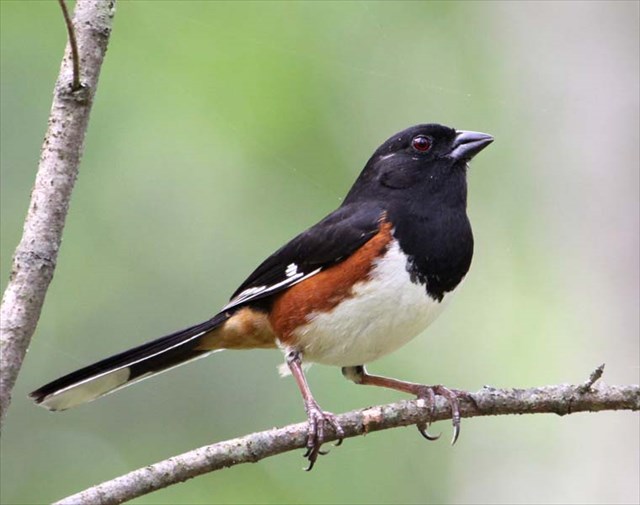
Eastern Towhees (Pipilo erythrophthalmus) spend most of their time on the ground, scratching at leaves using both feet at the same time, in a kind of backwards hop. They spend lots of time concealed beneath thick underbrush. You may see this bird more often when it climbs into shrubs and low trees to sing. The classic Eastern Towhee song, given by males, is a loud drink-your-tea! Eastern Towhees are characteristic birds of forest edges, overgrown fields and woodlands, and scrubby backyards or thickets. The most important habitat qualities seem to be dense shrub cover with plenty of leaf litter for the towhees to scratch around in. Males are striking: bold sooty black above and on the breast, with warm rufous sides and white on the belly. Females have the same pattern, but are rich brown where the males are black. Eastern Towhees usually nest on the ground, the nest cup sunk into the fallen leaves up to the level of the rim. In some cases they build their nests in shrubs or grape, honeysuckle, or greenbrier tangles, up to about 4 feet off the ground. They were once called Rufous-sided Towhees, but the name was changed when they, and the Spotted Towhee, which were once considered the same species, were split into two separate species.
The cache is a short 2-stage multi, placed along a seasonal road, which is not plowed in the winter. As with many of the caches along this road, you probably want to have boots with you. You will need to bring your own scribing instrument to sign the log.