MINERIA A CIELO ABIERTO EarthCache
Please note Use of geocaching.com services is subject to the terms and conditions
in our disclaimer.
Se sitúa este Earth en las inmediaciones de una de las canteras de granito mas grandes e importantes de España. Porriño ha sido un referente en minería a cielo abierto en todo el mundo conocido.
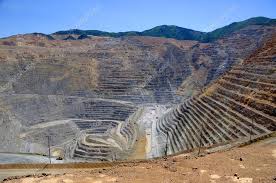
Se llaman minas a cielo abierto y también minas a tajo (o rajo) abierto a las explotaciones mineras que se desarrollan en la superficie del terreno, a diferencia de las subterráneas, que se desarrollan bajo ella. Para la explotación de una mina a cielo abierto, a veces, es necesario excavar, con medios mecánicos o con explosivos, los terrenos que recubren o rodean la formación geológica que forma el yacimiento. Estos materiales se denominan, genéricamente, estéril, mientras que a la formación a explotar se le llama mineral. El estéril excavado es necesario apilarlo en escombreras fuera del área final que ocupará la explotación, con vistas a su utilización en la restauración de la mina una vez terminada su explotación. Las minas a cielo abierto son económicamente rentables cuando los yacimientos afloran en superficie, se encuentran cerca de la superficie, con un recubrimiento pequeño o la competencia del terreno no es estructuralmente adecuada para trabajos subterráneos (como ocurre con la arena o la grava). Cuando la profundidad del yacimiento aumenta, la ventaja económica del cielo abierto disminuye en favor de la explotación mediante minería subterránea.
Tipos de minas:
Canteras:
Las canteras son minas a cielo abierto, generalmente de pequeño tamaño, que explotan materiales que no requieren una concentración posterior, sino, como mucho, una trituración o clasificación por tamaños. Los materiales obtenidos en canteras son los áridos, las rocas industriales y las rocas ornamentales. El esquema típico de explotación es mediante bancos y bermas.
Las descubiertas:
Son básicamente, labores bidimensionales que se utilizan en yacimientos horizontales o casi horizontales. De esta manera la explotación se realiza a una cota más o menos constante. La secuencia típica de una explotación por descubierta es: Retirada de la cubierta vegetal; Arranque del recubrimiento; Explotación de la capa; y Restauración En algunos casos es posible realizar lo que se conoce como minería de transferencia. Consiste en utilizar los materiales arrancados del recubrimiento para realizar la restauración, sin necesidad de un apilamiento intermedio.
Aluviones o placeres:
Corresponde a la explotación de depósitos de arena en antiguos lechos de rìos o playas, con el fin de recuperar oro, piedras preciosas u otros elementos quìmicos valiosos
PREGUNTAS:
¿Que tipo de Mina es en la que se sitúan las coordenadas de este Earth?
¿Que forma tiene los trozos de piedra cortados y situados en la plaza de cantera?
¿ De que color y cuantos bloques hay en la plaza de la cantera?
EN INGLES:
Open pit mine They are called open pit mines, and also open-pit mines, to mining operations that develop on the surface of the land, unlike underground ones, which develop under it. For the exploitation of a mine to heaven Sometimes, it is necessary to excavate, with mechanical means or with explosives, the lands that cover or surround the geological formation that forms the deposit. These materials are generically called sterile, while the formation to be exploited is called mineral. The barren excavated must be stacked in waste dumps outside the final area that will occupy the farm, with a view to its use in the restoration of the mine once its exploitation is finished. Open pit mines are economically profitable when deposits surface on the surface, are near the surface, with a small coating or the competition of the ground is not structurally suitable for underground work (as with sand or gravel). As the depth of the reservoir increases, the economic advantage of the open sky decreases in favor of exploitation by underground mining.
Types of mines:
Quarries: Quarries are open-pit mines, usually of small size, which exploit materials that do not require further concentration, but at most a grinding or sorting by size. The materials obtained in quarries are the aggregates, the industrial rocks and the ornamental rocks. The typical scheme of exploitation is by banks and berms.
The discoveries:
They are basically, two-dimensional works that are used in horizontal or near-horizontal reservoirs. In this way the exploitation is carried out at a more or less constant level. The typical sequence of a bare farm is: Removal of vegetation cover; Coating start; Exploitation of the layer; And Restoration In some cases it is possible to perform what is known as transfer mining. It consists of using the materials stripped from the coating to perform the restoration, without the need for an intermediate stacking.
Flurries or Pleasures:
Corresponds to the exploitation of deposits of sand in old beds of rivers or beaches, in order to recover gold, precious stones or other valuable chemical elements
QUESTIONS: What kind of Mine is the location of the coordinates of this Earth? What shape does the cut stone cut into the quarry? What color and how many blocks are in the square of the quarry?
Additional Hints
(Decrypt)
FR ERPBZVRAQN UNPRE YN IVFVGN ZRWBE RA SVA QR FRZNAN LN DHR YN NPGVIVQNQ L YNOBERF ZVARENF RFGÁA CNENQNF. RFGN CEBUVOVQB RAGENE RA YNF VAFGNYNPVBARF B RA YN ZVAN FVA NHGBEVMNPVÓA. VG VF ERPBZZRAQRQ GB ZNXR GUR ORFG IVFVG NG GUR RAQ BS GUR JRRX NF GUR NPGVIVGL NAQ ZVAVAT JBEX NER FGBCCRQ. VG VF CEBUVOVGRQ GB RAGRE GUR SNPVYVGVRF BE VA GUR ZVAR JVGUBHG NHGUBEVMNGVBA
Treasures
You'll collect a digital Treasure from one of these collections when you find and log this geocache:

Loading Treasures