Earthcaches have no "box" to find. Rather, with this earthcache, you discover something about the geology of Bald Head Island. For more information, see earthcache.org.
Logging Tasks: (Required)
Please send your answers via geocaching message center (preferred) or email.
- What three things does the geologic future of Bald Head Island depend upon?
- At the posted coordinates AND at the two listed waypoints, use the sediment key posted at the entrance kiosk and identify the soil and explain why you think it is that soil type.
- Please post IN YOUR LOG a picture of you, your GPS, your group, an appendage, your geo-pet on the nature trail.
This Earthcache takes you to the M. Kent Mitchell Nature Trail on beautiful Bald Head Island.
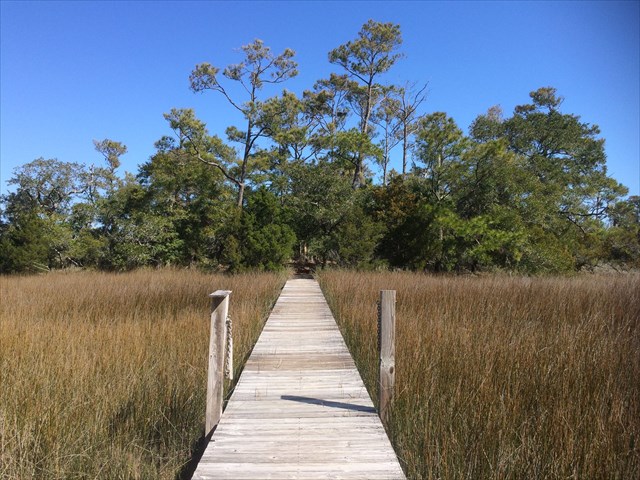
The terrain for this Earthcache is a little higher as Bald Head Island is reachable only by a ferry, and then you need to walk, rent a bike, or rent a golf cart to get to this location.
The M. Kent Mitchell Nature Trail is on Bald Head Island, a barrier island off North Carolina.
Barrier islands might make you think of of beaches, boardwalks, and vacation homes, but barrier islands function as more than just areas for tourism and recreation. As the first line of defense during storms that threaten coastal communities, barrier islands are very important for reducing the devastating effects of wind and waves and for absorbing storm energy. They are also important marine habitat that supports commercially important fish species, as well as birds, sea turtles, and other wildlife species.
Coastal sand is organized into barrier islands when three conditions are met:
- There is a supply of sand sufficient to form islands.
- Sea level is rising
- There are winds and waves with sufficient energy to move the sand around.
Barrier islands are long, narrow, offshore deposits of sand or sediment that run parallel to the coastline. They are separated from the mainland by a shallow sound, bay, or lagoon. The islands themselves are separated by narrow tidal inlets.
A barrier island is made up of the following habitat zones:
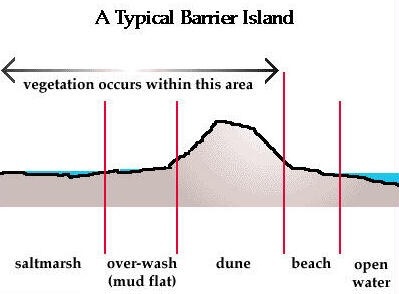
- Salt marsh—Low-lying area on the sound-side of a barrier island that is stabilized by cord grasses and flooded by daily tidal activity. Helps purify runoff from main land streams and rivers.
- Barrier flat (overwash)—Formed by sediment pushed through the dunes by storms and stabilized by grasses. Often flooded daily during high tide.
- Dunes—Sand carried and deposited by winds and stabilized naturally by plants and sometimes artificially by fencing. Can be flooded during storms.
- Beach—Ocean side of the island with sand deposited by wave action. Covered by salt water twice daily.
Barrier islands are subject to change during storms and other wave action, but absorb energy and protect the coastlines and create areas of protected waters where wetlands can flourish.
The M. Kent Mitchell Nature Trail winds through a coastal salt marsh part of the barrier island.
This salt marsh was formed by a combination of water level and sediment accretion behind the dunes. This marsh floods twice a day with the tides, and absorbs excess water like a sponge. This marsh creates a natural buffer, thus minimizing flooding during storms and hurricanes.
Marshes trap sediments, expanding and strengthening barrier systems to resist storms. This added sediment adds distance away from land and helps reduce the strength of storms by bearing the initial brunt of the storm. By bearing the brunt of the storm, the ferocity of the storm is reduced when it hits land.
Permission for this Earthcache was granted by the Bald Head Island Conservancy.
Sources
http://www.mbgnet.net/salt/sandy/barrier.htm http://science.howstuffworks.com/environmental/conservation/issues/barrier-island.htm