For the line to get some return on its investment, especially while it was being built, it needed early patronage. To assist in this the Government, especially the Liberal Government under Ballance, Seddon and Ward, purchased large grazing estates and subdivided them (admittedly this was also to allay fears that the large estates were creating a wealthy elite). Here the purchase of the Starborourgh estate and subsequent breakup in 1895 lead to the establishment of Seddon township in 1899, one of the few towns named after a sitting prime minister. The rail line was brought into town three years later, in 1902. Over 1500 people came to celebrate and watch as the Minister of Railways, Sir Joseph Ward, drove a train through the ribbon to mark the opening of the line. (Ward was to become Prime Minister four years later). Alas, the station is now closed but the station building lives on as a cafe and art gallery.
Seddon Station opening day, 10 October 1902.
The cache can be found 183m away from the published coordinates at 333 degrees true north. You know what you are looking for!
Richard Seddon
Richard John Seddon was born in England in 1845. His father was a headmaster, his mother a teacher. They had eight children of which three sadly died before their tenth birthdays. Despite his parent, Seddon was unruly and removed from school at age twelve and apprenticed into a foundry, attaining a Board of Trade Certificate as a mechanical engineer. At 16 he emigrated to Australia, worked the goldfields, then moved to Waimea in New Zealand's West Coast, working the goldfields there. He opened a store and became an advocate for miners rights. Seddon became the first mayor of Kumara in 1877 and two years later successfully elected to the House of Representatives for neighbouring Hokitika, then Kumara in 1881, both as an independent MP then Westland with the Liberal Party from 1890 till his death in 1905 at age 60. The Westland seat was succeeded by his son, Tom.
Initially Seddon was mocked in Parliament for his provincial accent and lack of education however he proved effective, and established himself as an authority on mining issues. Although Seddon joined the Liberal Party, he did not have any leanings to classical liberalism. Rather he saw Liberals as champions of "the common man" against large commercial interests and major landowners. As a champion for the common New Zealander he won enormous popularity, and attacks by the opposition on his educations and sophistication only reinforced his reputation. |
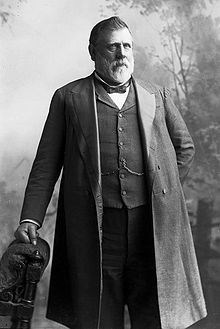
Rt Hon. Richard Seddon, 1905.
|
In 1892 the Premier, John Ballance, fell ill, and made Seddon the acting leader of the House. After Balance's death in April 1893, Seddon avoided a re-election and became Premier. Ballance, as a classical liberalist, was for equal rights and women getting the vote. Seddon was against this. Despite his opposition, the second of two major petitions tabled just two months after his premiership led to the bill for Women's Sufferage. Seddon's underhanded attempts at overthrowing the bill caused two Councillors, previously against the bill, to vote for it, ensuring that it passed into law.
Seddon was a strong supporter of Britain, and intended New Zealand to be the "Britain of the South". He attempted dominion over a number of Pacific nations, although only the Cook Islands came under New Zealand control during his time in office. He was hostile to the "yellow peril" and restrictions on Chinese immigration were increased. Seddon also introduced an old age pension, which became the basis of the welfare state later expanded by Savage.
Seddon's government style was almost autocratic. He valued loyalty over ability, and was often accused of cronyism. At one point he even stated: "A president is all we require", and it was from this almost autocratic nature that his nickname of King Dick was applied, both by his opponents and within the Liberal Party. Seddon died of a massive heart attack just 12 days before his 61st birthday. There are numerous memorials to him around the country, and one in St Paul's Cathedral, London. The post of Prime Minister was taken over by Sir Joseph Ward, recognised in the next town in this rail series.
References:
Merrifield, R: "Beyond Dashwood", published by the New Zealand Railway and Locomotive Society, 1990
McGavin, T.A.: "A Century of Railways in Marlborough 1876-1976", published by the New Zealand Railway and Locomotive Society, 1977.
Scoble, J: "Names and Opening and Closing Dates of Railway Stations", published by the Rail Heritage Trust of New Zealand, 2010
Wikipaedia: "Richard Seddon"
nzhistory.govt.nz: "Seddon and Ward, premier towns - roadside stories"
Supporting the GeoKids program - my caches have treasure, makes them fun for kids to find!