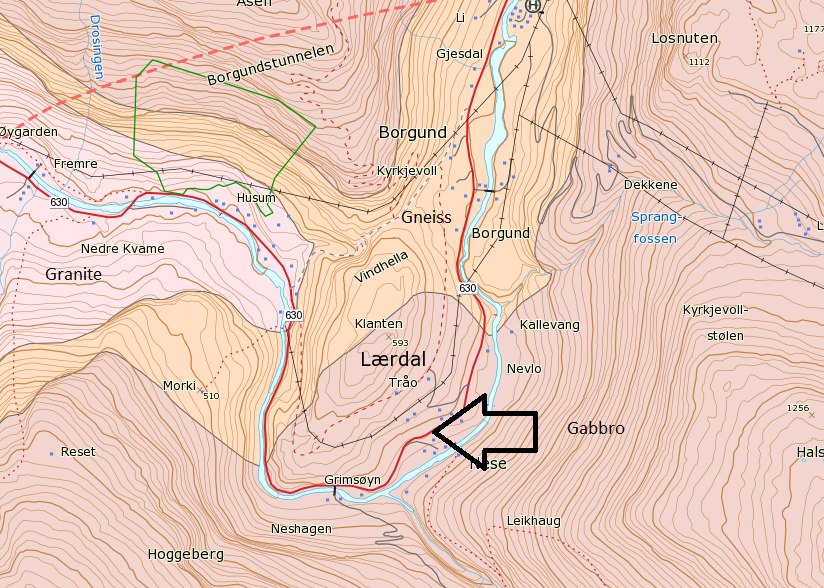
Geologisk kart over området. Geological map of area.

Geologien i Norge er et stort og omfattende tema. En av de viktigste geologiske prosesser bak denne er den kaledonske fjellkjedefoldningen. Den skjedde for 450-400 millioner år siden ved at kontinentplaten som bestod av Amerika/Grønland kolliderte med den europeiske platen. Dermed ble en del bergarter presset langt ned i jordskorpen og ble utsatt for høye trykk temperaturer, slik at alt ble omformet og nye mineraler ble dannet. Om man studerer det geologiske kartet under, vil man kunne se at de fleste bergartsenhetene i området er metamorfe bergarter. Gabbroen som er tema for denne earth cachen er et untak da gabbro er en magmatisk dypbergart.
Gabbro er det grovkornete motstykket av basalt. Den finnes blant skyvedekkene i den kaledonske fjellkjeden, der den danner høye fjell, som i Jotunheimen.
Gabbro er en mørk (ofte svart-koksgrå) magmatisk bergart, en dypbergart, eller noen ganger en intrusiv gangbergart, dannet under høyt trykk og høg temperatur. Den består av jern, plagioklas, mørkt pyroksen, amfibol og olivin. Gabbro er en basisk bergart. Den mørke fargen kommer av et høyt jerninnhold sammen med det mørke pyroksenet. Gabbro er hvit og svartspettet, og ofte med noe brunt eller grønt. Den er massiv og ganske grovt kornet i motsetning til basalt som er mer finkornet. Dette skyldes at basalt dannes lengre opp mot overflaten og har hatt mindre tid til å forme og vokse krystaller.
Noen ganger har gabbro en lagdeling. Massive gabbroer er harde, motstandsdyktige bergarter og danner ofte åser i terrenget. De forskjellige varietetene av gabbroene klassifiseres etter innholdet av de mørke mineralene augitt, hypersthen, hornblende og olivin, se tabell. Mindre mengder kvarts eller kalifeltspat kan forekomme i enkelte gabbroer.
De hører til de sterkeste bergarter som finnes og blir derfor brutt og knust til bruk i veidekker. Også som bygningsstein og monumentstein blir de anvendt; her går de under betegnelsen ”sort granitt".
Når du kjører langs gamlevegen nå merket 630 vil du ved GZ kunne parkere og observere en tydelig markert svart klippevegg mot nord. Du kan fra kartet over se at du nå beveger deg i et gabbro dominert området. Dette er likt deler av den nærliggende Jotunheimen hvor gabbro er en viktig bestanddel. Der kan du lett få tilkomst til gabbro for å studere gabbroen egenskaper og besvare oppgavene under.

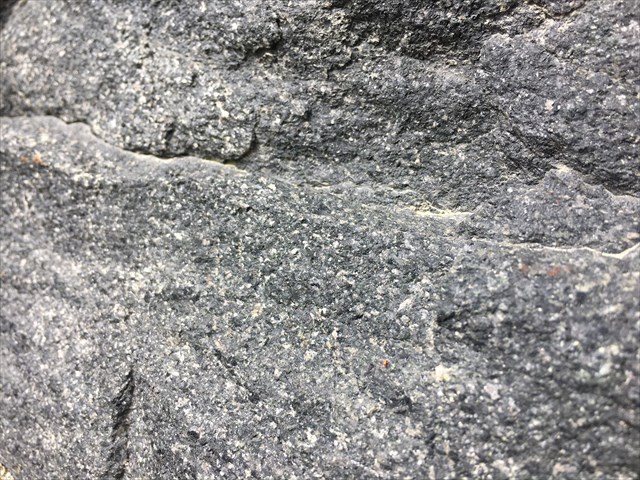
Gabbro.
The geology in Norway is complex. The most important geological processes is the Caledonian orogeny roughly 450-400 Ma. The Caledonian orogeny was a mountain building era recorded in the northern parts of Ireland and Britain, the Scandinavian Mountains, Svalbard, eastern Greenland and parts of north-central Europe. This explains the rich variety of igneous and metamorphic rocks in this area and the rest of Norway. If you study the geological map above you may notice that the area is dominated by metamorphic rocks. Gabbro, the focus of this earth cache is an exception.
Gabbro refers to a large group of dark, often phaneritic (visible coarse-grained), mafic intrusive igneous rocks chemically equivalent to basalt. It forms when molten magma is trapped beneath the Earth's surface and slowly cools into a holocrystalline (regular pattern) mass. Gabbro is dense, greenish or black-charcoal-colored and contains pyroxene, plagioclase, and minor amounts of amphibole and olivine. Gabbro is one of the main rocks of which the neighboring Jotunheimen mountain range consist of.
The speed at which the molten rock becomes solid rock determines whether it becomes basalt or gabbro. Molten rock can also be called magma or lava. Magma is any molten rock that is below the surface of the Earth. Lava is what you call magma that has managed to rise above the surface of the Earth. Gabbros are only made by magma. Basalts can be made by magma, but they are also made by lava. Because it is much cooler above (and near) the surface of the Earth than it is beneath it, lava does not stay molten very long. When lava comes in contact with the cold ocean water near the surface of the ocean plate, it cools very quickly forming the small grained rock we call basalt. The grains in the rocks are actually crystals. When molten rock cools quickly, crystals do not have a chance to grow very big. When magma is able to intrude into the ocean plate near the bottom of the plate, the rocks of the plate are cooler than the magma, but they are much warmer than the rocks near the surface that are right under the ocean water (and farther away from the hot mantle). The magma here also cools into rock, but at a much slower speed than the lava at the surface. This gives crystals more time to grow, making the larger-grained rock known as gabbro. So that’s why basalt is at the top of the ocean plate and gabbro is at the bottom.
When you drive on the old road, now number 630 you can observe the characteristic dark – black gabbro on the rock to the North of the road. You can from the map above observe that you are now driving in an area where gabbro should be the predominant rock. The gabbro is easily accessible for inspection of its properties so you can address the logging tasks described below.
Please email me any suggestions for improvements, corrections or additions to the text of this cache.
Vennligst email meg forslag til korreksjoner og forbedringer til denne cachen.
Send the answers by e-mail via the cache owner's profile page on Geocaching.com. You can log immediately after you have emailed me your answers.
Send svarene på spørsmålene via min email. Du kan logge straks etter at du emailet meg svarene på spørsmålene.
Logs without answers emailed to CO or with pending questions from CO will be deleted without any further notice.
Logger uten at jeg har mottatt svar på spørsmålene blir sletter uten forvarsel.
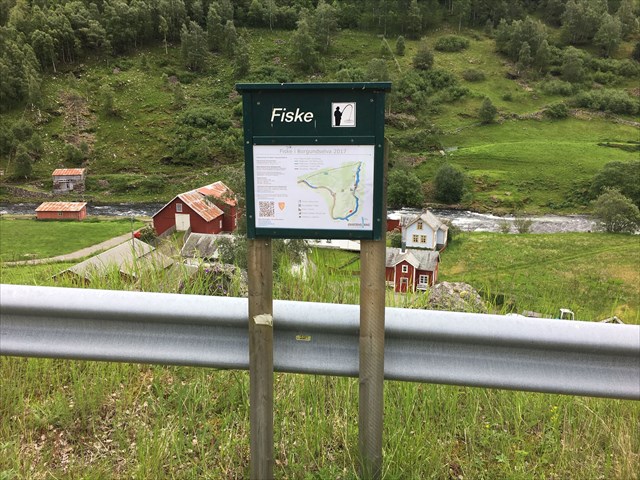
The GZ area is the rocks when you have your back to this sign. Området du skal studere er det du ser når du har ryggen til dette skiltet.
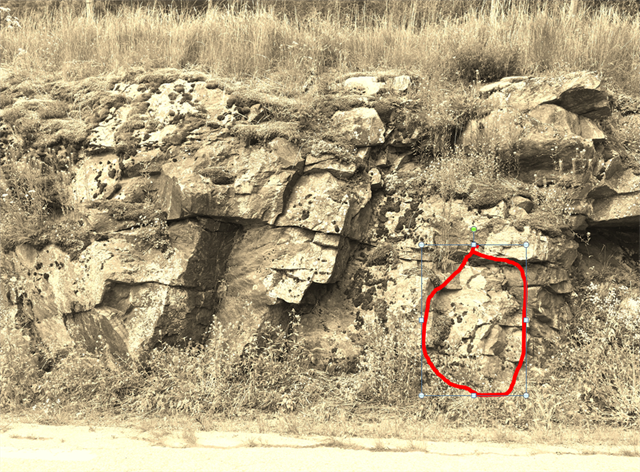
View at GZ with area for Question 2. GZ med området aktuelt for spørsmål 2 .
Spørsmål/Questions (Gjør ditt beste – innsats teller mer enn rette svar/ do your best – effort counts more than correct answers):
Question 1. Studer Gabbroen (den koksgråe bergarten) på nært hold – kan du observere at gabbroen har synlige krystaller. Hva betyr det for hvor (dypt, grunt) den er formet, begrunn svaret. Study the Gabbro (the charcoal-colored rock) closely. Can you observe the crystals in the rock. What does that imply for where the rock is formed ?
Question 2. Gå til GZ og studer området vist på figuren over, Der finner du et helt annet mineral. Hvilket mineral kan dette være ? Position you selves at GZ and study closely the area shown in the figure above. In this area you can clearly observe a different mineral. Which mineral do you believe this is ?
OPTIONAL. Ta et bilde av deg eller din GPS ved site uten å røpe svarene på spørsmålene over. Take a picture of your or your GPS at the site without revealing any of the answers to the questions above.
Sources: Wikipedia