While walking along this beach, a little scuffing of the sand beneath your feet will produce a squeaky sound! How cool is that.... but how does this happen?
Scientists aren’t totally sure, but a few things they can agree on;
1-The sand has to contain Silica,
2-The sand grains are well rounded, of similar size, with no sharp edges and no shell material.
Scientists have differing opinions on what is going on with the sands, and, besides the items listed that they agree on, there is no definitive answer as to why this only happens on a few beaches and sand dunes in the world. There are, however, a couple of theories:
Flowing/Friction
Some theorize that because the grains of sand are of uniform shape and size, with no obstructions like pollutants or shell bits, they are able to flow over each other, kind of like liquid. The sand, being of similar shape and size, flows together in unison, and that sets off a series of vibrations between the grains that causes the sound to occur.
Air Cushion
There are small amounts of air between the sand grains. When pressure is placed upon the sand (like your footsteps or your hand moving the sand), the grains shift, and the air is displaced. The sound is caused by the movement of the air escaping between the grains of sand.
Interesting, eh? Whatever the reason, it is happening here on this beach, and therefore, we know this sand has a high component of silica.
Silica
Silica or silicon dioxide (SiO2) is a chemical compound consisting of one silicon and two oxygen atoms. Quartz is a common mineral with the same chemical composition but quartz and silica are not the same, just like carbon is not a diamond. Minerals have a definite crystal structure while chemical compounds don’t. Quartz is made of silica and is known as a polymorph of silica.
The most common sand-forming mineral is Quartz. A pure silica sand beach is said to be mature, because quartz is a very hard mineral and outlasts other rock forming minerals. Quartz is one of the principal mineral ingredients of Granite, Pegmatite and Aplite found in this area.
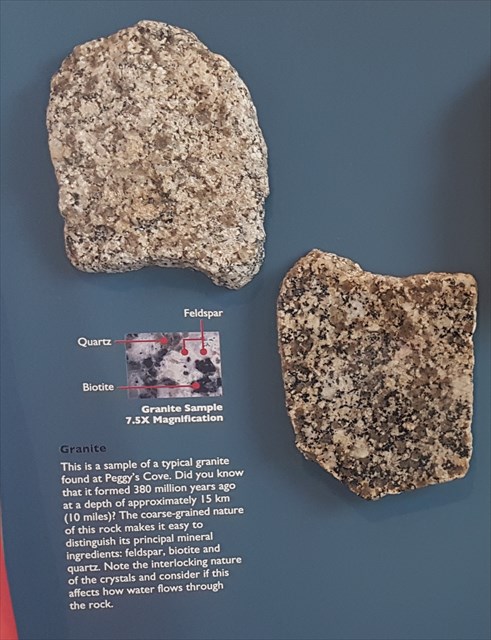
Granite
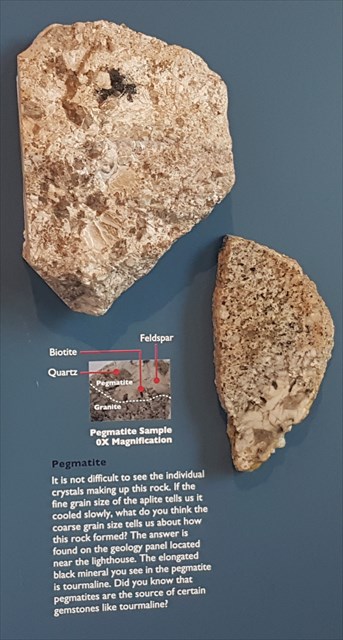
Pegmatite
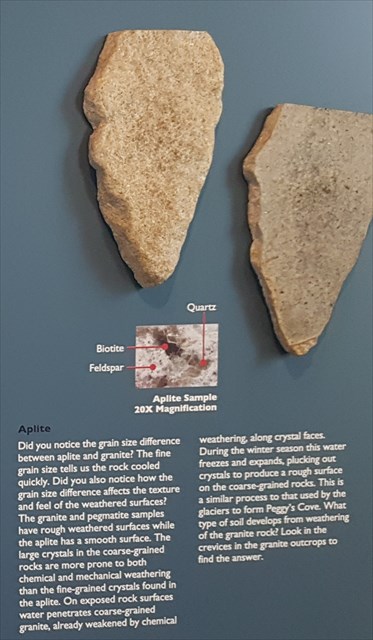
Aplite
To log this earthcache as found, send me the answers via my profile page:
- Try scuffing your feet/shoes along the sand, then try moving the sand with your hand(s). Were you able to make sounds? Which way was louder?
- Which of the theories mentioned, or a combination, do you think causes the sand to make sound?
- Do you see any nearby rocks/boulders that would contain quartz? Can you identify them from the pictures on the cache page.
Pictures are always welcome! Thank you for visiting!
Resources:
https://en.wikipedia.org/wiki/Singing_sand
https://books.google.com/books?id=hTPOi8urYKwC&pg=PA534
http://www.sandatlas.org/silica-and-sand/
http://www.abc.net.au/catalyst/stories/2601532.htm
Information sign inside Peggy's Cove Information Center