Buried Rivers of Gold Trail
The Australasian Mining Company (sometimes called Australasia Mining Company) began prospecting in 1867 and soon discovered the Australasian Lead. Within twelve months returns were being paid to investors. The lead was rich but this first shaft (Australasia No.1) was abandoned after nearly ten years due to mine shafts flooding. A new company, the New Australasian Gold Mining Company, was formed in 1878 and a second ‘new’ shaft (Australasian No.2) was sank 80m down and about 200m away from No1.
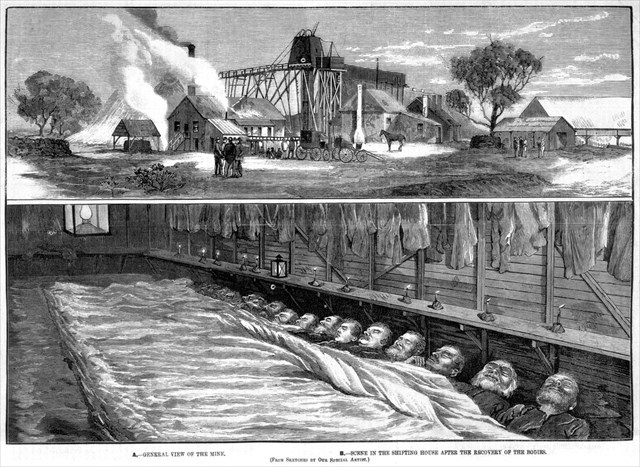
In the early hours of December 12, 1882 work was progressing in a drive connected to the second shaft. Without warning water began flooding the drive – the miners had accidently broken into abandoned workings full of water. The miners ran back along the drive towards the shaft, frantically tapping on the air pipes to warn others and trying to beat the black torrent of water rushing behind them. Only five miners could out-race the rising water, and climbed the ladder of the shaft more than 80 metres to the surface to raise the alarm. The boiler men sprung into action and stoked their boilers to the maximum, as much power was needed now to pump the water out quickly, or the twenty-seven miners below would drown.
TIMELINE TO DISASTER
1851 Gold was discovered in the Creswick area and the township
began to develop.
1854 Rich deposits of gold were discovered in the deep leads which
ran under the basaltic lava just north of Creswick. Large mining
companies were created to mine this gold and the town
boomed.
1874 The railway to North Creswick from Melbourne and Ballarat
Opened
1866 The Australasian mining company was formed and worked on
the rich deep lead which ran to the north of Creswick. Their mine
The Australasian worked for ten years then closed because the
pumps in the mine could not control the large volume of
underground water.
1876 The New Australasian Gold Mining Company was formed which
bought the old mine. Deciding the mine was too prone to
flooding they closed the Number 1 shaft and opened a new shaft
2,000 feet to the north-west.
June 8th, 1878 The pumps were moved from the old number 1 shaft to the new
number 2 shaft - but trouble with water was still reported.
April 29th, 1882 George Douglas, the mine manager died. Douglas had been
manager at both mines was aware of all the recurring problems
with water. He was replaced with William Nicholas.
June 1882 Nicholas decides to extend a drive to the south which the
previous manager, Douglas had decided was too dangerous
because it was too close to the flooded Australasian workings.
December 11th, 1882
Monday midnight Forty-one miners working the night shift in the New Australasian
mine descended 250 feet in the cage to begin work along the
main north drive (tunnel). Henry Reeve and William Mason, two
contractors, walked in the opposite direction to the face of the
south drive where they were working.
December 12th, 1882
Tuesday 5.30am Reeve and Mason struck the old (and flooded) mine workings of
the neighbouring Australasian mine and a torrent of water
gushed into the tunnels. They raced along the tunnel to the main
shaft and warned the platman, Michael Carmody, of the
approaching wall of water before making their escape up the
incline.
Tuesday 6.00am 14 miners managed to escape up the shaft
After two attempts to force their way through the flooded water
the 27 men trapped underground make their way to the no 11
rise where they are imprisoned by the rising water.
6.00am Mr. Nichols, the mine manager, arrives and takes control of
rescue efforts
9.00am Word of the disaster reaches the town and people flock to the
mine site. A telegram is sent to Melbourne
5.00pm A reply telegram arrives from Melbourne saying four navy divers
with underwater apparatus are being sent to help
December 13th 1882
Wednesday 2.47am The special train carrying the divers leaves Melbourne
5.55am The special train arrives at North Creswick station
The hose sent with the divers is too short – another telegram
is sent to Melbourne
3.00pm A second train leaves Melbourne with extra hose
5.07pm Train reaches Ballarat
5.27pm Train reaches North Creswick - the hose is still too short
December 14th 1882
Thursday 12.15am Rescuers are able to reach number 9 rise, but past this point
the drive is blocked with flood debris
7.00am Two rescuers crawled over the obstructions to near the no 11
rise and calling out hear the reply “We are all right – we are all
safe” This message is relayed to the surface and rejoicing and
celebrations begin in Creswick.
8.25am The first miner is bought to the surface too weak to talk.
Four other men are bought, weak but alive, to the surface.
9.30am Captain Hodge, who had been in charge of the shift at the time
the water burst in, and whose son was among the trapped men,
emerged grim faced with the news - there were no more men
alive.
11.00am The first of the bodies is bought to the surface
12.30pm All the bodies had been bought up and laid out in the
changing house
December 30th 1882
The inquest into the tragedy commenced.
Ref: Sovereign Hill Education October 2009