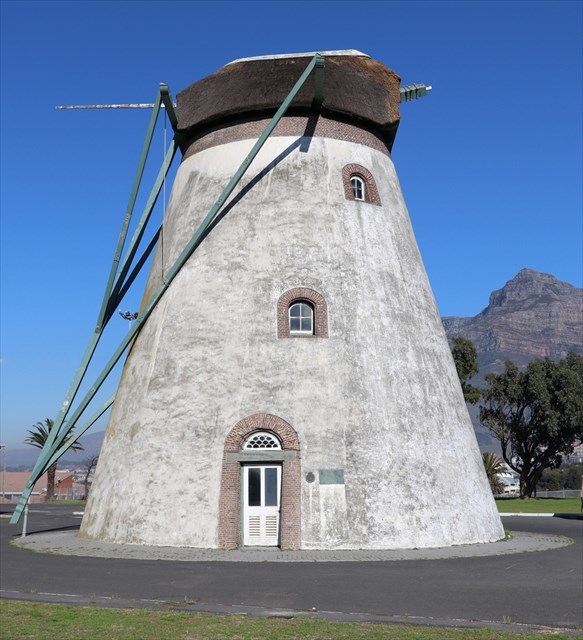
De Nieuwe Windmolen, Maitland, 2017
The truncated-cone tower of the oldest windmill structure in South Africa
South Africa’s oldest standing windmill was completed in 1782, it will be 240 years old in 2022, it is fourteen years older than the well-known Mostert’s Mill on De Waal Drive, Mowbray. It is a national monument and provincial heritage site that stands in the grounds of the Alexandra psychiatric hospital. Persons with a serious interest in South Africa's mill heritage are granted access following application to the CEO of the hospital and completion of minor formalities.
As there is no good vantage point close to the old mill geocachers will find that the tower is best observed across the floodplains of the Liesbeek and Black Rivers from the junction of the Liesbeek Parkway and Malta Road, almost exactly 1000 metres away (look east). Walking 30 meters south-east from GZ there are slightly better views of the mill tower: but stopping on Malta road at this point is both prohibited and dangerous.
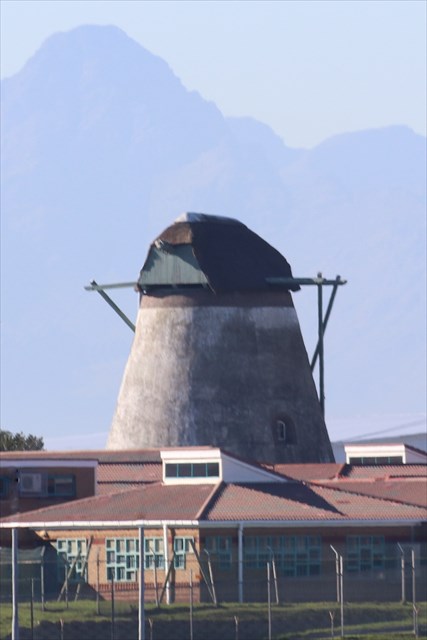
De Nieuwe Windmolen as seen from GZ
The mill, marked Nieuwe Molen on the maps of that time, is a massive truncated-cone tower-type structure 42m high and has three interior levels. It has a thatched revolving cap that once permitted the sails to be turned into the wind. The tower has sloping sides composed of random rubble Malmesbury hornfels which are about a metre thick at the base and are cemented by lime mortar. It was once the prominent landmark to the east of the Black River with white walls and enormous sails. The sails were mounted on a slightly tilted wind-shaft to allow the sails to rotate without hitting the tower's sloping sides.
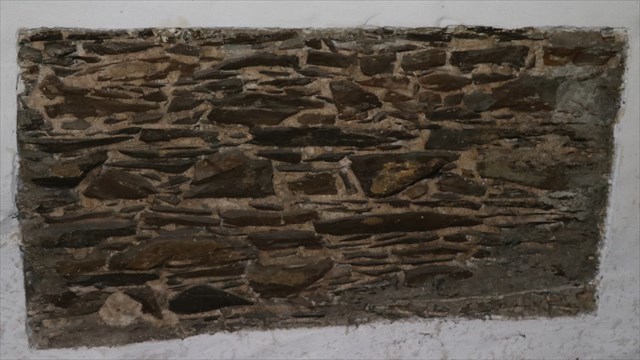
Unplastered interior wall showing original building construction materials
The mill was called De Nieuwe Windmolen as there was already a windmill on a neighbouring farm Oude Molen. The Oude Molen was in use until the 1860s but has disappeared completely and is now only commemorated by the name of an Eco-village near Pinelands.
The history of the Nieuwe Molen goes back to 1779 when the Burgher Council which owned the land decided to erect the mill as the existing mills were not able to grind all the grain harvested. In the stone lintel above one of the doors are the words: “Die mool is begotten in ’t jaar 1780 door den burger en baasmetselaar Johan Gottfried Mocke. Voltooyt 1782”. Above the other door are the names of the members of the Burgerraad who supervised the construction of the mill: C V D Poel, G C E Maasdorp, G H Meyer.
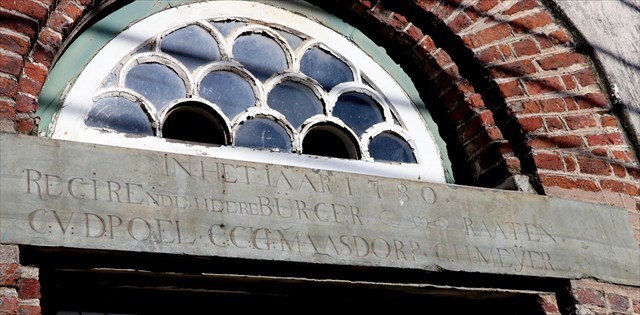
1780 Inscription commemorating construction of the mill
In 1801 the Cape Government decided to sell by public auction both “des Colonies Nieuwe Wind Moole” and the older mill. The Nieuwe Windmolen was sold to Barend Carolus van Niekerk. Van Niekerk was the owner for only a short period, for in 1806 it was bought from Van Niekerk’s widow’s estate by Jacob Hendriks who held it for only six months. These first two private owners seem to have been more interested in farming the land than milling, so the mill was neglected and fell into disrepair. It was the next owner, Kassien Claasen Dekenah, who set about putting it into full working order again. The mill became known as Dekenah’s Mill. When it was advertised for sale in 1843 it was claimed to be "in full working order and surpassing in power any mill in the colony”. This claim was probably true as its heavy granite mill-stones were 1.5 m in diameter. After it stopped working the mill tower remained a prominent landmark on the rise east of the confluence of the Liesbeek and Black rivers.
Windmills became obsolete in the Cape with the introduction of steam mills in the 1860s -- although the Nieuwe Windmolen still functioned during the 1870s. In 1901 the Cape Colonial Government bought the mill and associated grounds to build a hospital - the corner stone of which was laid in 1906. During the 1914-18 World War it became a military hospital and during this time the hospital records show that the mill tower was used as a detention barracks.
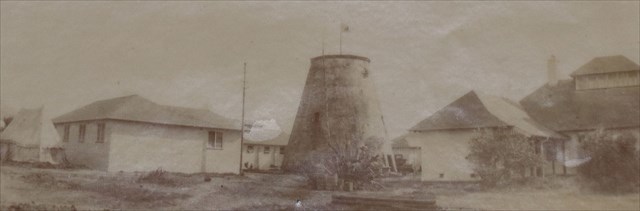
Circa 1915 The tower was used as a detention barracks in the military hospital
(Photograph courtesy of Alexandra hospital records)
In 1918 the hospital became an institution for the treatment of patients requiring psychiatric care. James Walton's book on the watermills, windmills and horse-mills of South Africa records that the mill machinery was removed in the 1920s. The hospital has over the years used the mill tower for several purposes. It has served as a venue for music therapy and in 1928 the mill was renovated and the ground floor fitted out as a chapel; a plaque on the inside wall of the first floor states: “A D 1928. This mill was renovated for the worship of the Almighty God by the benefaction of the late Helena C. Steytler.”
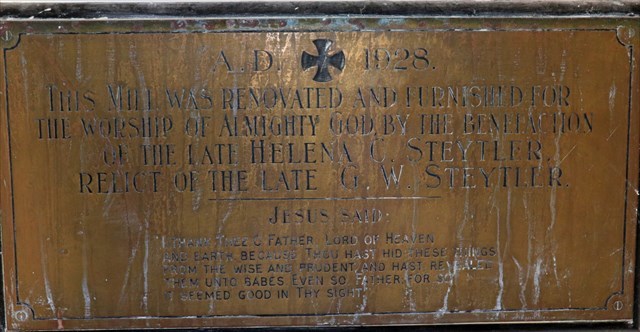
The mill tower stopped being used as a chapel for patients and staff of the Alexandra hospital in 1954 due to its poor ventilation. The provision of electricity and the large chandelier in the centre of the ground floor ceiling probably dates from this renovation.
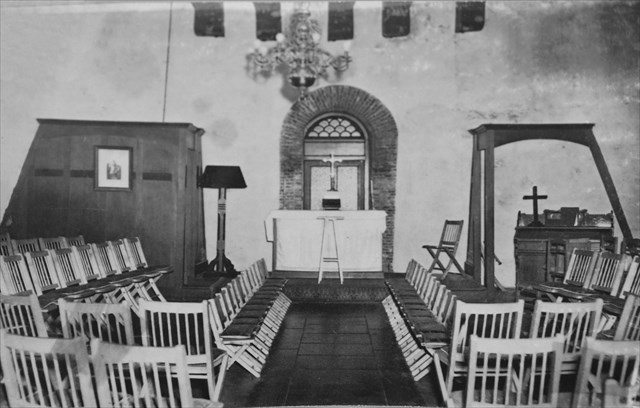
The Chapel in the Mill, circa 1935
(Photograph courtesy of Alexandra hospital records)
The heavy beams in the ceiling, the doors and fanlights are the original timber. In the arches over the doors and windows, small hand made clay Dutch klompie bricks were used. Several courses of klompie brickstop the tower, just below the thatch cap, provide a regular smooth base for the curb ring - the metal ring on which the cap rotates. To make rotation easier pig's fat and graphite were used as lubricants .
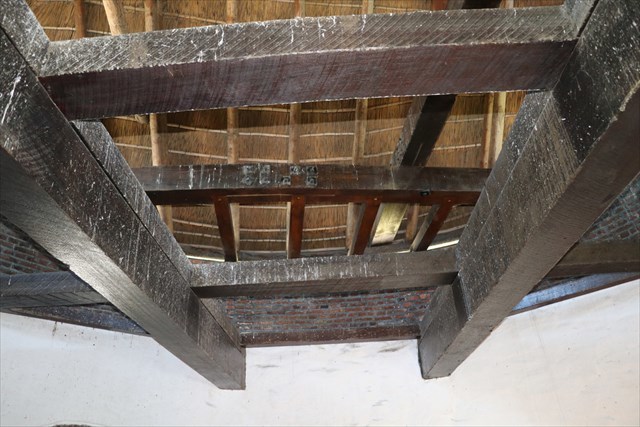
Original roof timbers, klompie bricks below the curb, and thatched cap
The original heavy granite millstones approximately 1,5 m in diameter are now preserved on the ground floor. They were at one stage embedded in the ground outside each of the ground floor entrances. The fixed bed-stone has harp dressing and the rotating runner-stone sickle dressing.
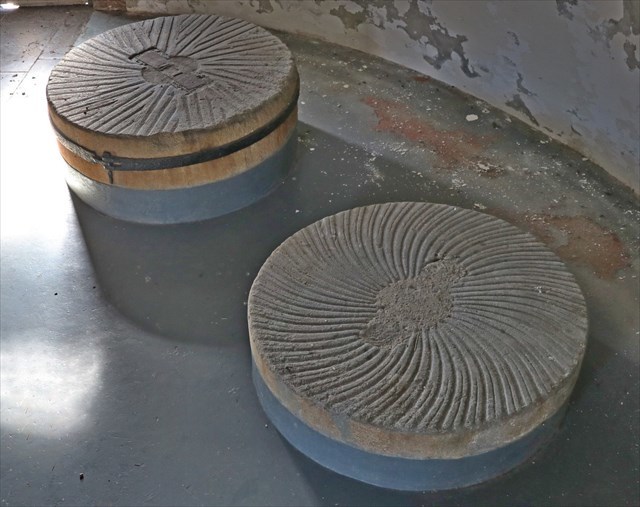
The original millstones
(Note the harp and sickle dressing on the stones)
The old mill is at present (2017) rather shabby in appearance and in need of attention. The staff of the Alexandra hospital are acutely aware of the historical value of the old mill and of its need for refurbishment. A detailed proposal and costing of what is required has been prepared and submitted to both South African and Dutch sources of heritage funding. The hospital management hopes to have the mill structure restored and thereafter to have it open for controlled public viewing.
Geocachers with an interest in Cape Town's historic Dutch windmills are encouraged to also visit MS: Mostert's Mill [GC64JGZ] and MS: Onze Molen [GC63CK1]. The Mill Series [MS:] of caches also covers other types of mill that may be of interest.
Sources and Additional Reading
Ivor Dekenah, 1981: South Africa’s Oldest Windmill, Restorica, Simon van der Stel Foundation
www.theheritageportal.co.za
James Walton, 1974: Watermills, Windmills and Horse-mills of South Africa. C. Struik.
Alexandra Hospital Records pertaining to De Nieuwe Windmolen.
The link to the Geocache Mill Series Website is:
www.geocachingmillseries.weebly.com