Introduction
There are many earthcaches that look at weathering - here at Portrane you can see a rather unusual but often quite attractive type - honeycomb weathering. Although it is very close to another existing earthcache, this looks at an entirely different and relatively rare geological feature.
This is a straightforward earthcache and is one of two looking at occurrences of honeycomb weathering I have created along the coastline north of Dublin. Both locations are very different so despite similarities in the listing, if you have done one, do not expect to see the same thing at the other and the answers you get will be very different. I find the variation in the locations fascinating which is why I have set two earthcaches and one of the locations demonstrates a variation of honeycomb of weathering I hadn't ever seen before.
Honeycomb weathering, also known as fretting, cavernous weathering, alveoli/alveolar weathering, stone lattice, stone lace or miniature tafoni weathering, is a form of salt weathering found on coastal and semi-arid granites, sandstones and limestones.
There are some superb examples of honeycomb weathering here but the location is definitely tidal. You must visit this location at low tide, you will not be able to get to GZ or view the honeycomb weathering when the tide is in. Please note the d/t rating. The difficulty includes the tidal nature of the earthcache. To complete this earthcache you must physically reach the given coordinates, which involves climbing across the rocky foreshore which could involve some minor climbing and traversing wet/slippy rocks.
Ingredients needed for a rock honeycomb
For this honeycomb weathering to have occurred, a few basic ingredients are required.
- A source of salt is needed because the basic mechanism for this kind of weathering is salt heaving. Salt is deposited on the surface of the rock by direct contact with the sea, saltwater spray or wind. The presence of water allows the salt to settle on the rocks. When the water dries, the salt solution also evaporates and the salt begins to crystallize within the pore-spaces of the rock.
- Permeable rock is the next ingredient. A permeable rock is one that will absorb water. This means there will be pore-spaces for the salt to crystallize within. When these salt crystals form, they pry apart the mineral grains, leaving them vulnerable to other forms of weathering.
- Time is the final ingredient. It takes prolonged periods for this weathering to become visible, as the rock goes through cycles of wetting and drying.
Types of coastal honeycomb
There are two distinct types of coastal honeycomb weathering - intertidal and supratidal.
“The intertidal zone, is the area that is above water at low tide and under water at high tide.”
Intertidal honeycomb weathering is found on horizontal planes in rock within the tidal zone. Cavities of the intertidal zone typically consist of shallow concave depressions separated by low ridges. During high tides, these cavities become filled with seawater. When the tide recedes this saline water may evaporate to leave white crystalline residue. Growth of intertidal cavities may be self-limiting. As cavities increase in size, the depth of trapped seawater may become so great that the sun can not evaporate all of the water left in the gap, so the holes are as large as they will get, because the salt can not dry out and wedge grains apart any longer.
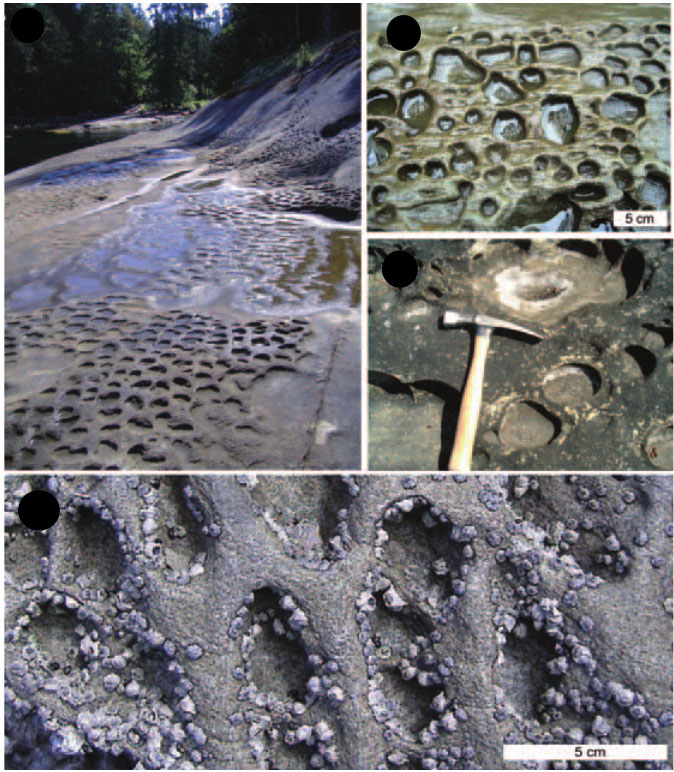
Examples of intertidal honeycomb erosion elsewhere
“The supratidal zone, is the area above the spring high tide line, on coastlines and estuaries, that is regularly splashed, but not submerged by ocean water. Seawater penetrates these elevated areas only during storms with high tides.”
Honeycomb cavities in the supratidal splash zone commonly consist of deep depressions separated by thin walls of unweathered rock. Supratidal honeycomb cavities are commonly oriented along exposed bedding edges, cross-bedding, and lithologic, but many examples can be found in apparently uniform outcrops.
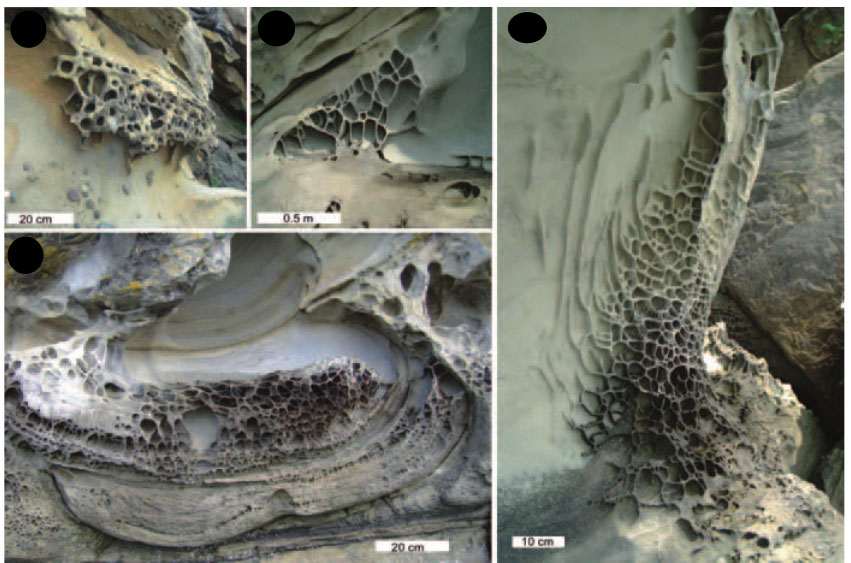
Examples of supratidal honeycomb erosion elsewhere
Logging Requirements
Please follow your GPSr to the listed co-ordinates. Ensure you have read the introduction as the location is tidal and involves traversing the rocky foreshore. You need to send me the answers to the questions below, you can do this by following links at the top of the page, or use the 'send answers' option in the app.
- Estimate the size/depth of the biggest and smallest holes in the honeycombs. Is there a big difference between the biggest honeycomb sizes and the smallest and why might this be?
- Carefully feel inside the honeycombs. There is growth on some. Do you notice a difference in texture compared to the nearby rock which has not weathered in this way and where do you find the growth?
- Where on the rocks are the honeycombs found (e.g. are they horizontal on the rock as you look down at your feet, or are they found in vertical rock, when compared to the sea?)
- Bearing in mind your answer to the previous question, do you think this honeycomb is intertidal or supratidal and why? (see descriptions and pictures above)
- Why do you think the honeycomb weathering is affecting this area so much but not other areas of the nearby coastline?
- How quickly do you think the honeycombs are weathering away here? What do you think they may look like in perhaps 50 years? Think about the local rock type (a neighbouring earthcache will help with that).
Optionally, please include a photograph of yourself and / or GPSr with one of the boulders containing honeycombs nearby, many people still like this evidence of their visit - please only take photos of the boulders, because they have broken away this does not give away any answers.
You must send in your answers in order to log a find on this earthcache. I do read all answers and try to reply to them all; I may not reply immediately so please do not wait for a reply before posting your find. Ideally, please send your answers at the same time you submit your log, or within a few days of your visit. I do check answers have been sent for every log, if you do not send answers within a week your log may be deleted. You are not expected to have any previous geological knowledge, your best attempt at the answers is all that is required.
Please enjoy your visit to Portrane's Honeycombs.