 [PL]
[PL]
Karol Estreicher jr
Karol Estreicher młodszy (1906-1984, ur. i zm. w Krakowie), syn znanej krakowskiej rodziny Estreicherów, był polskim historykiem sztuki, profesorem Uniwersytetu Jagiellońskiego, dyrektorem Muzeum UJ (1951-1976), wykładowcą w Akademii Sztuk Pięknych w Krakowie i w Wyższej Szkole Sztuk Pięknych we Wrocławiu, a także prozaikiem i autorem licznych publikacji.
Zasłynął swoim zaangażowaniem w oszacowanie strat i rewindykację polskich dzieł sztuki zagrabionych w czasie II wojny światowej, czemu poświęcił się już w czasie okupacji niemieckiej, jako sekretarz premiera RP na uchodźstwie gen. Władysława Sikorskiego. Owocem prac jego londyńskiego zespołu była wydana w 1944 roku ponad 500-stronicowa książka Straty kultury polskiej. Katalog strat kultury polskiej pod okupacją niemiecką 1939-1944.
Po wojnie Karol Estreicher powrócił do Polski z transportem dzieł sztuki i archiwaliów odzyskanych z brytyjskiej strefy okupacyjnej Niemiec. Dzięki jego misjom rewindykacyjnym odnalazły się także i powróciły z Niemiec do Krakowa takie dzieła, jak Dama z gronostajem Leonarda da Vinci czy ołtarz Wita Stwosza z kościoła Mariackiego.
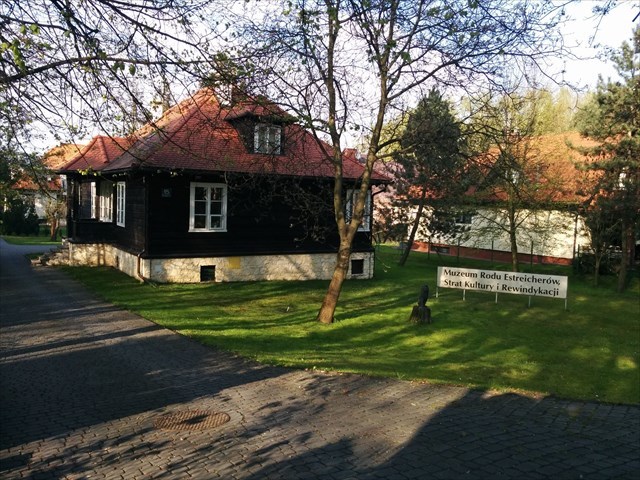
Od roku 1957 aż do śmierci prof. Estreicher był prezesem Towarzystwa Przyjaciół Sztuk Pięknych w Krakowie, któremu tuż przed śmiercią przekazał w testamencie swoją willę na Woli Justowskiej. Zmarł 29 kwietnia 1984 roku i został pochowany na Cmentarzu Rakowickim. Willa, wpisana do rejestru zabytków, po długim okresie dewastacji, doczekała się generalnego remontu, który nastąpił w latach 2005-2009. 29 kwietnia 2009, w 25. rocznicę śmierci profesora, w jego dawnym domu otwarto Muzeum Rodu Estreicherów, Strat Kultury i Rewindykacji. Można je zwiedzać w weekendy, po wcześniejszym umówieniu.
Źródła: Wikipedia i inne
Kesz
Pojemnik mikro. Zawiera logbook, ołówek, certyfikaty dla trzech pierwszych znalazców. Okolicznych posesji pilnują szczekające psy ;) Parkowanie możliwe w kilku miejscach wzdłuż ul. Sarnie Uroczysko, tam gdzie jest utwardzone pobocze.
 [EN]
[EN]
Karol Estreicher Jr.
Karol Estreicher (junior; 1906-1984, born and passed in Krakow), son of a famous Krakow's Estreicher family, was a Polish historian of art, professor at Jagiellonian University and the head of the university's museum (1951-1976), a lecturer at the Academy of Fine Arts in Krakow and the College of Fine Arts in Wroclaw, as well as a writer and author of many publications.
He is best known for his involvement in the estimate of losses and revendication of Polish works of art, stolen during the 2nd world war, which he began to work on during German occupation, as the secretary of Poland's Prime Minister in exile, general Władysław Sikorski. The efforts of his London-based team resulted in an over 500-page book, published in 1944, entitled The losses of Polish culture. A catalogue of losses of Polish culture under German occupation, 1939-1944.
After the war Karol Estreicher returned to Poland together with a transport of works of art and archives regained from the British zone of occupation in Germany. Thanks to his revendication missions, several works of art returned from Germany to Krakow, with Leonardo da Vinci's Lady with an Ermine and Veit Stoss altarpiece of St. Mary's church.
From 1957 till his death, prof. Estreicher was the president of Krakow Society of Friends of Fine Arts, to which he saved in his last will, shortly before death, his villa at Wola Justowska. He died on April 29th, 1984 and was buried at the Rakowice Cemetery. The villa, a listed building, after a long period of devastation, has finally undergone an extensive renovation, which lasted from 2005 till 2009. On April 29th, 2009, marking the 25th anniversary of professor's death, at his former house, The Museum of the Estreicher Family, Losses of Culture and Revendication was officially opened. It can be visited on weekends, after prior appointment.
Sources: Wikipedia and other
The Cache
A micro container with the logbook, a pencil and certificates for the first three finders. The neighbouring properties are guarded by barking dogs ;) You can park your car on several places along the Sarnie Uroczysko street, where the side of the road has been hardened.