Every day, we use numerous products that would not exist without sand.
The most important sands are the so-called quartz sands. They contain a particularly high proportion of the mineral quartz. The silicon required for the production of microchips is provided by the silicon dioxide contained in quartz sand. One of the oldest products produced with the help of quartz sand is glass. Due to its material properties such as high strength and transparency, glass is indispensable. Since the industrial age, sand is present as a filler in toothpaste, rubber, paints and polishes, paper and medicaments. They are particularly popular as filter sand. In the ceramic industry, quartz sand is used for the production of earthenware, stoneware, sanitary porcelain, floor and wall tiles. Sand is also used as an abrasive. Meanwhile, mankind consumes so much sand that this indispensable raw material, despite its apparent abundance, threatens to become scarce.
What is Sand?
Sand is a naturally occurring granular material composed of finely divided rock and mineral particles. It is defined by size, being finer than gravel and coarser than silt. Sand can also refer to a textural class of soil or soil type; i.e. a soil containing more than 85% sand-sized particles by mass.
The composition of sand varies, depending on the local rock sources and conditions, but the most common constituent of sand in inland continental settings and non-tropical coastal settings is silica (silicon dioxide, or SiO2), usually in the form of quartz. The second most common type of sand is calcium carbonate, for example aragonite, which has mostly been created, over the past half billion years, by various forms of life, like coral and shellfish. For example, it is the primary form of sand apparent in areas where reefs have dominated the ecosystem for millions of years like the Caribbean.
Sand is a non renewable resource over human timescales, and sand suitable for making concrete is in high demand.
In terms of particle size as used by geologists, sand particles range in diameter from 0.0625 mm to 2 mm. An individual particle in this range size is termed a sand grain. Sand grains are between gravel (with particles ranging from 2 mm up to 64 mm) and silt (particles smaller than 0.0625 mm down to 0.004 mm). Sand feels gritty when rubbed between the fingers (silt, by comparison, feels like flour).
More interesting: finer loose rock is called Schluff (0.002 mm to 0.06 mm) or clay (less than 0.002 mm).Of course, there are also mixtures, such as sandy gravel or sand. A semi-uniform mixture of clay, silt, sand and perhaps finer gravel is called clay. The differentiation of the loose rocks is easier than you think. Sand, gravel and everything what is coarser, can be measured easily with a ruler. Silt differs from sand, that the individual grains are no longer recognizable with your eyes and you can knead it with the fingers. It is plastic, it means, it retains its form. Clay can even be rolled out between two fingers to a thin sausage. If you're not sure, make the chewing gum: it crunches between your teeth, it's silt, otherwise clay.
Back to the sand:
Depending on the diameter of the individual grains one speaks of:
- 0,06 mm - 0,20 mm: fine sand (just still visible grains),
- 0.20 mm - 0.63 mm: medium sand (such as semolina),
-0.63 mm - 2.00 mm: coarse sand (2 mm diameter has a matching head).
What is sand made of?
Sand can consist of everything, but mostly it is quartz.
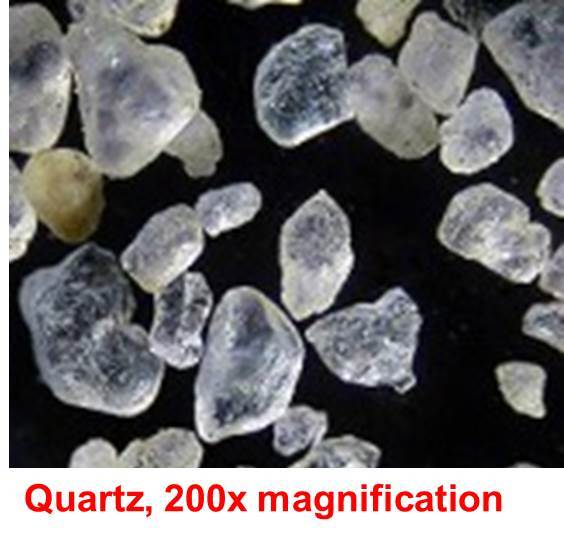
This is due to the fact, that quartz in the rocks of the earth's crust occurs in large quantities and is also very hard. Sand may for example also consist of calcium carbonate (coral sand, mussel sand), or volcanic rock like basalt.
Accordingly, the sand grains may look very different:
Granular material (such as sand) has an internal frictional angle, which depends inter alia on the roughness of the grains. If the material is poured into a pile, a bulk cone is formed.
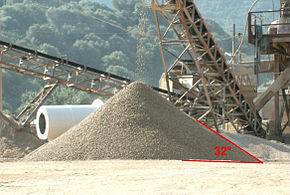
The angle of repose is dependent on the following properties:
-Roughness, the rougher, the greater the angle.
- Different grain size, the more different grain sizes are available, the larger the angle.
-Compaction: the more the filling is compacted, the greater the angle.
-Humidity content, the angle increases with increasing cohesion between the grains.
To log this cache successfully, please answer the following questions and mail the answers to us. After that you can give your log directly. Then post a photo of you at the location to your log. Of course, if you do not want to appear in the photo, a personal item in the photo is enough proof of your presence. (According to the Earthcache Guidelines, photo-proofing has been required since June 2019.)If anything is not ok, we will contact you.
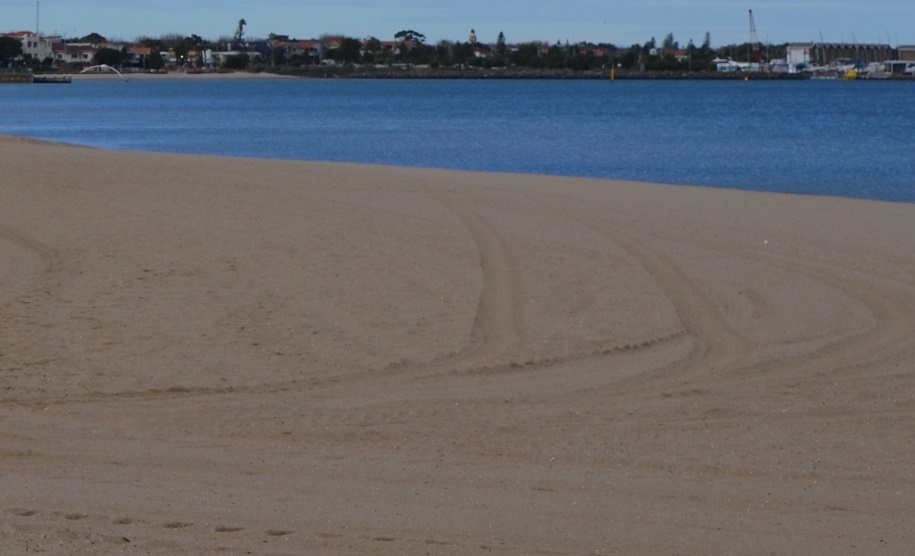
1.) Collect a Little bag or bucket of sand at GZ. What exactly have you collected (pure sand, a sand-gravel mixture, only gravel, ...?)
2.) Look at the sand with a magnifying glass / microscope: What do you estimate the quartz proportion to be (you can use the picture above to help to see how the quartz looks)?
And now the flour is used:
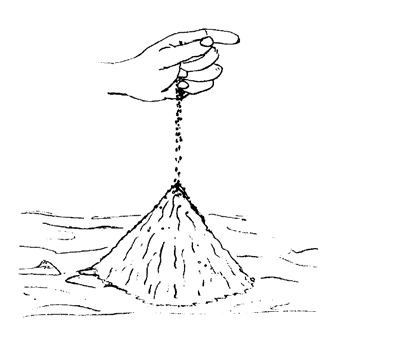
3.) Pour the flour onto a horizontal surface and determine the angle of the top of the cone (angle of repose). Now do the same with your sampled sand (dried!) from GZ and determine the angle of repose again. Give us the two determined angles and explain which conclusions might explain the results for the respective angles.
IMPORTANT:
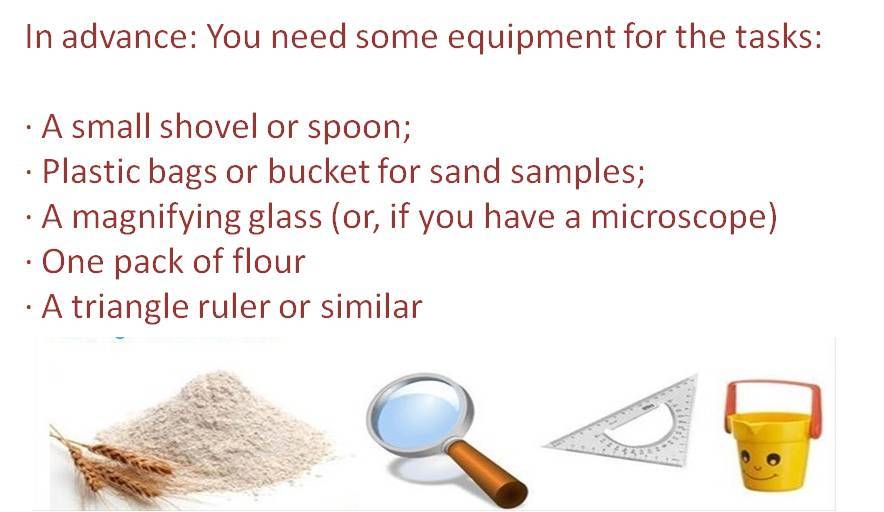
- Please think about the bucket or bag, the magnifying glass, the flour, the triangle ruler or angle knife !
source directory:
-Wikipedia
-google
-Picture by my own