The American Bison also known simply as buffalo, is a North American species of bison that once roamed the grasslands of North America in massive herds. They became nearly extinct by a combination of commercial hunting and slaughter in the 19th century and introduction of bovine diseases from domestic cattle. They have since made a recent resurgence largely restricted to a few national parks and reserves.
A bison has a shaggy, long, dark-brown winter coat, and a lighter-weight, lighter-brown summer coat. The male bison is slightly larger than the female and, in some cases, can be considerably heavier. Their head and body lengths range from 6.6feet up to 11.5feet. (Their tails add another 12inches to 36inches). Shoulder heights in the species can range from 60 to 73inches above the ground. Weights can range from 700 pounds to 2205 pounds. The heads and forequarters are massive, and both sexes have short, curved horns that can grow up to 2 ft long, which they use in fighting for status within the herd and for defense.
Bison are herbivores, grazing on the grasses and sedges (a type of grass-like ground cover that is bushy) of the North American prairies. Their daily schedule involves two-hour periods of grazing, resting, and cud chewing, then moving to a new location to graze again.
The American bison is the national mammal of the United States.
Information for this cache has been extracted and adapted from the following sources.
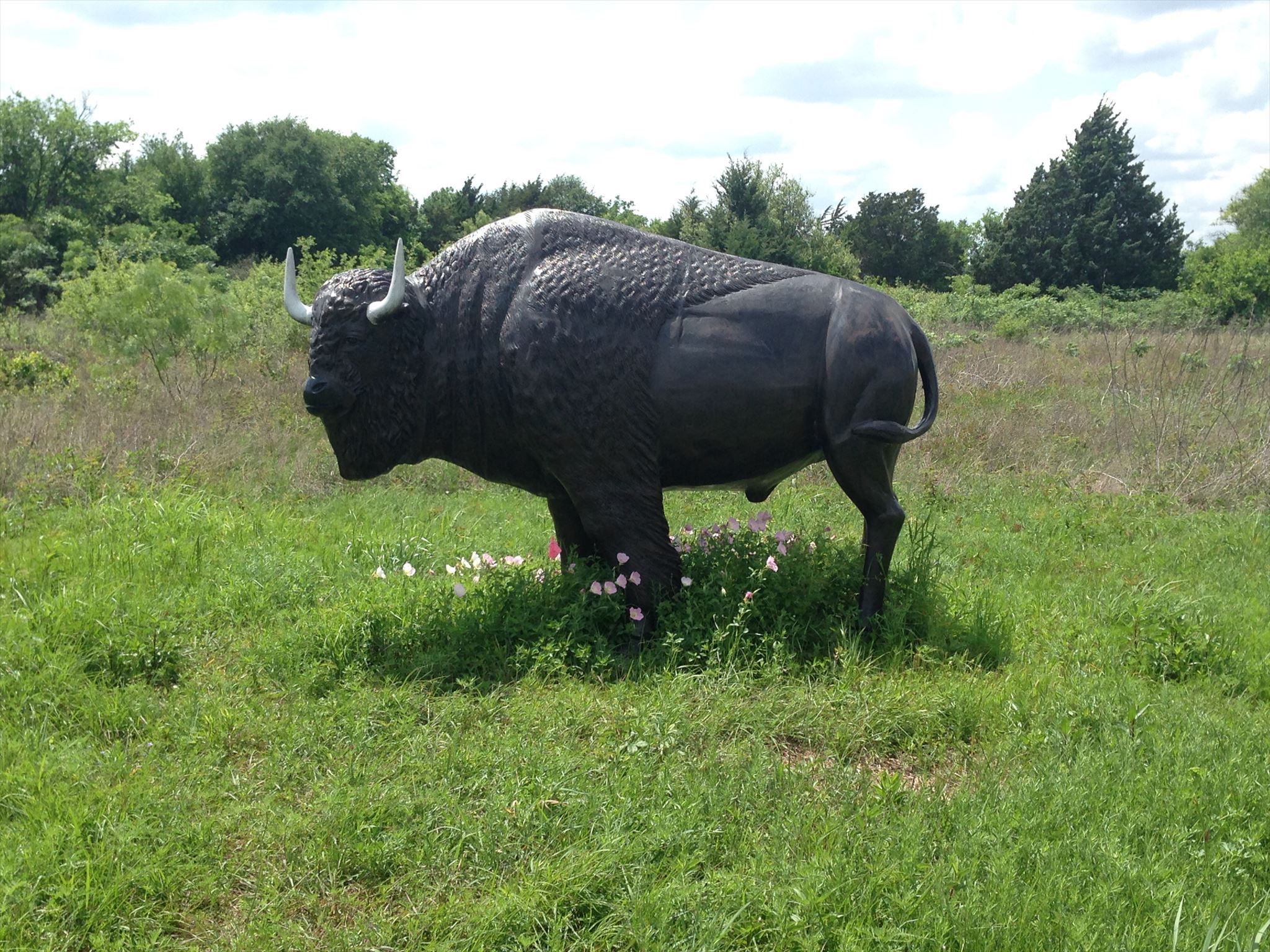
This is a simple 2-stage puzzle located in Ennis, TX. on the east shore of Lake Clark. The Kachina Prairie is a 22-acre patch of undisturbed native prairie. This park is one of the few remaining remnants of Blackland Prairie in Texas. It has a gravel parking area adjacent to a sign that lists several groups focused on preservation, wildflower types, and major animals found in Texas. There is also a map depicting the park trails, park benches, and a bison statue.
Buffalo
Travel down one of the trails to the posted coordinates. The trail goes in a circle around the perimeter of the park (so it doesn’t matter which way you go except that one of the trails takes you to the cache sooner). The trail is uneven and made of grass with some exposed roots which could be muddy or inaccessible n bad weather
The first stage is a plaque with some information about American Bison (Buffalo). Answer the following questions at the plaque. The second stage is the final container and is located a short distance from the sign.
1. What is the Native American word for Bison according to the plaque?
“tatanka”-N 32° 19.896
“awas-atak”- N 32° 19.838
“tasiwóo”- N 32° 19.851
2. In this area, the bison’s presence was vital for what reason?
“as the primary diet of the Tonkawa Indian…” - W096° 39.324
“to alert fronitersmen of Brucellosis disease…”- W096° 39.244
“to the diversity and success of prairie flora…” - W096° 39.382
There is a gift card for the first to find. And there is some random swag. Plenty of room for trinkets, toys, and travels bugs
Do not post the answers in the log or share any pictures of the plaque! There is a photogenic Buffalo Statue nearby for pictures.
You must sign the log to claim the find. No exceptions, no excuses. Blank logs may be deleted without notice. Avoid the use of acronym only logs and cut 'n paste logs. Be sure to put the lid back on securely so that this cache and contents will last.
Congrats to Justin Smith and UMZAKA 1807 Year as the first to find.
Second to Find: TP-Conductor
Third to Find: threehikers16
Also Mary Hyde Tag by eberhartmark is the first known TB to be in this cache.
Update 01/23/18: The Park did some brush clearing that completely exposed the original final. I moved the cache and adjusted the cache page accordingly. It is 30 feet west of the original location and is now approximately 45feet from the main path (although there are some other little trails for easy access). Due to the movement and the greater tree/brush interference, I also adjusted the difficulty up to 2stars. Gps accuracy average within 7feet.