Levantada sobre una capilla anterior del año 1770. La Cofradía encargada de la custodia de la imagen y del mantenimiento de la ermita, se planteó la construcción de un nuevo recinto sagrado más amplio y acorde a las necesidades de la devoción y culto. Con este objetivo, en 1848, se nombró a mosén Joseph Español, vicario y beneficiado de la Parroquia, depositario y administrador de los fondos para la construcción de la nueva capilla. En 1849, después de la fiesta del 3 de mayo, se procedió al derribo de la antigua ermita y el día 14 a excavar los cimientos. Fue inaugurada solemnemente -sin el camarín y el atrio proyectado- el día 29 de abril de 1856.
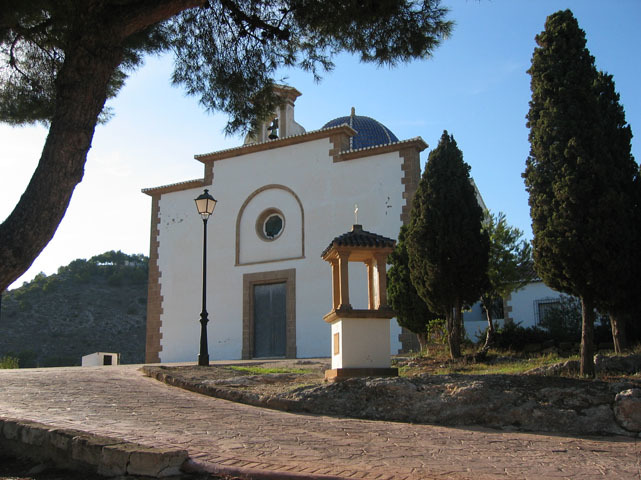
Edificio exento, construido con obra de mampostería y tejado a dos aguas en las naves y cúpula sobre tambor de teja vidriada en azul. La fachada, orientada a mediodía, tiene forma rectangular con un perfil superior que acusa la distribución interior de nave central más alta y capillas laterales más bajas. Superficie enyesada y esquinas de sillares en escala. Portada de sillares, dovelada. Óculo redondo en el frontón dentro de un espacio delimitado por arco de medio punto, motivo característico de identificación. Espadaña con estribos, tímpano triangular y hueco de medio punto. La planta, se ha dicho en cruz griega, pero en realidad es en forma de cruz latina. Tiene nave a los pies, con capillas entre los contrafuertes. Pilastras a la faz con capiteles corintios entablamento y arcos fajones, que soportan la bóveda de cañón. El crucero tiene la anchura de la nave más las capillas y se cubre con cúpula sobre tambor, pechinas y arcos torales. Todo el patrimonio mueble fue destruido en el verano de 1936
Sobre el caché:
Disponibilidad 24h/7d. Solo contiene logbook, llevad maquina de escribir.
No está permitido poner fotos del caché y comentarios relevadores y de su aspecto y ubicación y mimetizaje. Cualquiera que se salte esa norma, se le borrará el registro automáticamente. Gracias
English
Raised on an earlier chapel of the year 1770. The Brotherhood in charge of the custody of the image and the maintenance of the hermitage, it was proposed the construction of a new sacred enclosure ampler and according to the needs of devotion and worship. To this end, in 1848, Joseph Joseph Spanish, vicar and beneficiary of the Parish, was appointed administrator of the funds for the construction of the new chapel. In 1849, after the feast of May 3, the old hermitage was demolished and day 14 to excavate the foundations. It was solemnly inaugurated - without the dressing room and the projected atrium - on April 29, 1856
Exempt building, built with masonry work and gable roof in the ships and dome on glass tile tile in blue. The façade, oriented at noon, has a rectangular shape with a superior profile that accuses the interior distribution of higher nave and lower side chapels. Plastered surface and corners of ashlars in scale. Cover of ashlars, folded. Oculo round in the pediment inside a space delimited by a half point arch, characteristic motif of identification. Scythe with stirrups, triangular tympanum and hollow of half point. The plant, it has been said in Greek cross, but in fact is in form of Latin cross. It has a ship at its feet, with chapels between the buttresses. Pilasters on the face with Corinthian capitals entablature and arches fajones, that support the barrel vault. The cruiser has the width of the nave plus the chapels and is covered with dome on drum, pechinas and torales arches. All the furniture heritage was destroyed in the summer of 1936
Availability 24h / 7d. It only contains logbook, take typewriter.
It is not allowed to put photos of the cache and relay comments and their appearance and location and mimicked. Anyone who skips that rule will automatically be deleted from the registry. Thank you
