This cache is a small white container with a log book; please bring your own pen or pencil for signing. After you have found the cache and signed the log book, please ensure that you leave it suitably concealed in its hiding place.
The cache is hidden at the Cave of Pherecydes (Σπήλιαο Φερεκύδη) which is a 20 minute walk along a path going north from the settlement of Richopo (Ρηχωπό), or alternatively about 35 minutes going south from Plati Vouni (Πλατύ Βουνί).
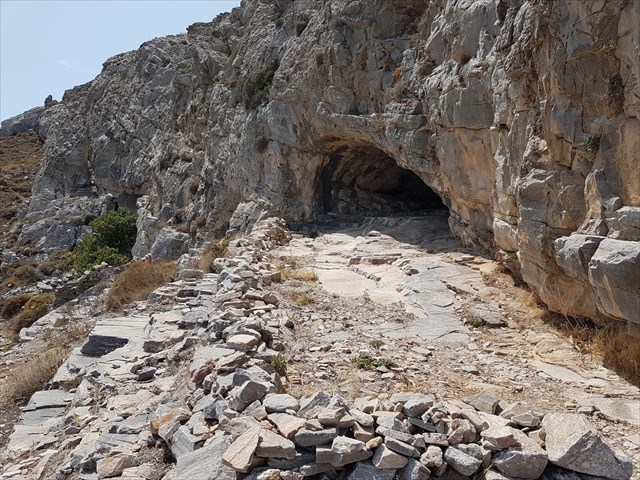
The path has beautiful views out across the Aegean Sea to the island of Tinos and is well worth walking despite being somewhat spoiled by windborne plastic and paper rubbish from the local waste landfill site down near the coast. The short ascent from the coastal path to the cave itself is necessary if you want to find the cache and, while not too difficult, has meant the terrain difficulty level has been raised.
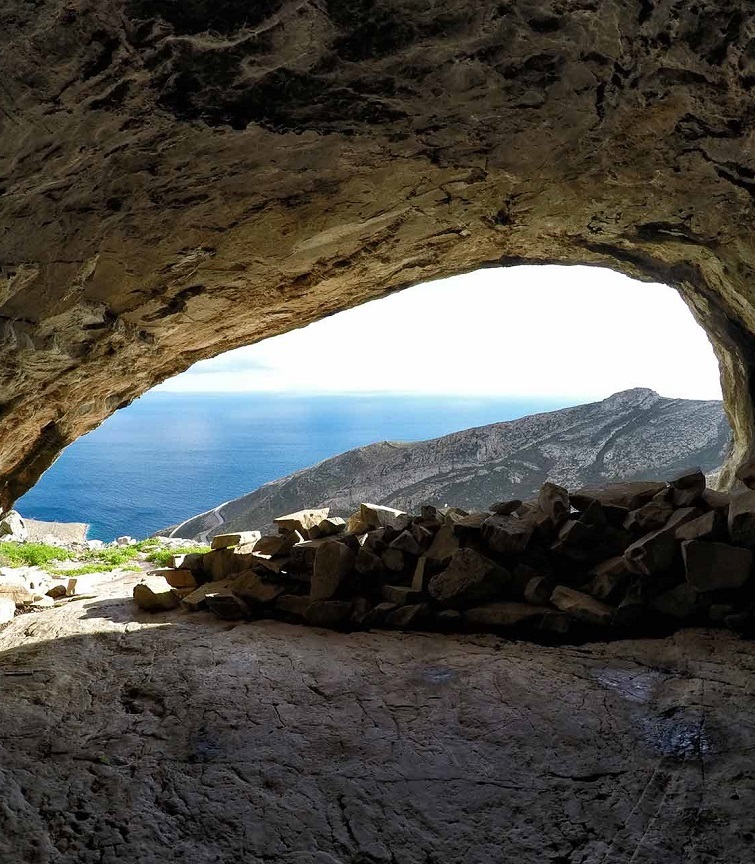
Pherecydes (or Ferekidis), a philosopher and native of Syros, was born around the year 580 BC and tradition states that he lived for much of his life in the cave, and other great philosophers and scholars, including Pythagoras, counted among his students. His writings were extant in the Hellenistic Period, although only fragments have survived to the present day. His works were written in prose rather than verse and he has been said to have been the first to have communicated or conveyed philosophical musings in this form.
He is most famous for his book, the Pentemychos (Πεντέμυχος), a detailed discussion on the creation of the Cosmos, and for his thoughts on the Immortality of the Soul. As such, his work is said to have greatly influenced that of Aristotle and Saint Augustine.
Hermann S. Schibli, in his book "Pherecydes of Syros" (Clarendon Press, Oxford, 1990) has attempted to piece together the main themes of the Pentemychos from existing fragments and ancient references, and from the works of later philosophers who had seen and been influenced by his work:
CHRONOS and Zas always were, and also Chthonie (Ζὰς μὲν καὶ Χρόνος ἦσαν ἀεὶ καὶ Χθονίη). Once Chronos, alone and without a partner, cast forth his seed. From his seed he made fire, air, and water, and deposited these in five hollows. Lo, from the mixtures of fire, air and water in the hollows arose another generation of gods. The fiery gods dwelt in Ouranos and gleaming Aither, the gods of wind in gusty Tartaros, the watery gods in Chaos, and the gods of darkness dwelt in black Night.
After the generation of gods, born of the seed of Time, assumed their habitations, Zas became Eros and married Chthonie. The other gods built many large palaces for him; they provided all the necessary goods, the banquet tables, servants and maids, and when all the needful things had been accomplished, they performed the wedding. On the third day of the wedding, Zas fashioned a big and beautiful robe, and on it he embroidered Earth and Ogenos and the mansions of Ogenos. When he had finished his task, he presented the robe to Chthonie and said: 'Because I wish to marry you, I honour you with this robe. Rejoice and be my consort!' This they say was the first feast of unveiling, and hence arose the custom for both gods and men. And she responded as she received the robe from him: 'I take this as my honour, and henceforth I shall be called Ge...' The gods celebrated, feasting on ambrosia. And the Earth was like a winged oak, strong and mighty; its roots extended into the depths of Tartaros, its trunk was encircled by Ogenos, and its branches reached into Ouranos. The Earth flourished and Zas rejoiced.
But below the Earth, in a hollow of Tartaros, Ophioneus was born. He and his monstrous sons challenged Kronos. The battle-lines were drawn up, with Kronos the commander of one army and Ophioneus leading the Ophionidai. The terms of the battle were stated: whichever of them fell into Ogenos would be the defeated, while those who thrust them out and defeated them would possess Ouranos. A fierce conflict followed. Kronos had a strong ally in Zas; in single combat he overthrew Ophioneus. So Ophioneus and his brood were cast into Ogenos, and they dwell in the mansions of Ogenos to this day. Kronos, commander of the victorious army, was crowned by the other gods (from this arose the custom of the wearing of crowns by victors). Zeus honoured the victorious gods and assigned them their domains. Kronos had won Ouranos.
These are the shares of the other gods: below Ouranos is the fiery Aither; below Aither the portion of Earth; below that portion is Tartaros; the daughters of Boreas, the Harpies and Thuella, guard it; there Zeus banishes any of the gods who behave with insolence. There also are the souls of men who have committed bloodshed. Their souls are borne through the portals and gates of Tartaros on an outflowing river to birth; the river is like the seed that leads to new life. And the souls of men depart from life and enter again the caves and hollows of Tartaros through its portals and gates. Alongside Tartaros is Chaos and the realms of dark Night.
W (a.k.a. DidianRay)
