The Earthcache is located in a nature reserve. It is not necessary to leave the official way at any time. Follow from the parking area the signposted trail.
Honeycomb weathering? Has that got anything to do with bees?
No of course not. From honeycomb weathering occurs when a binder is dissolved in sedimentary rocks only and then solidifies again. This creates structures like honeycomb.
Geology / Petrographic
Here in Kings Canyon we find two different sandstones The above sandstone is called Mereenie Sandstone. Below is the Carmichael Sandstone. 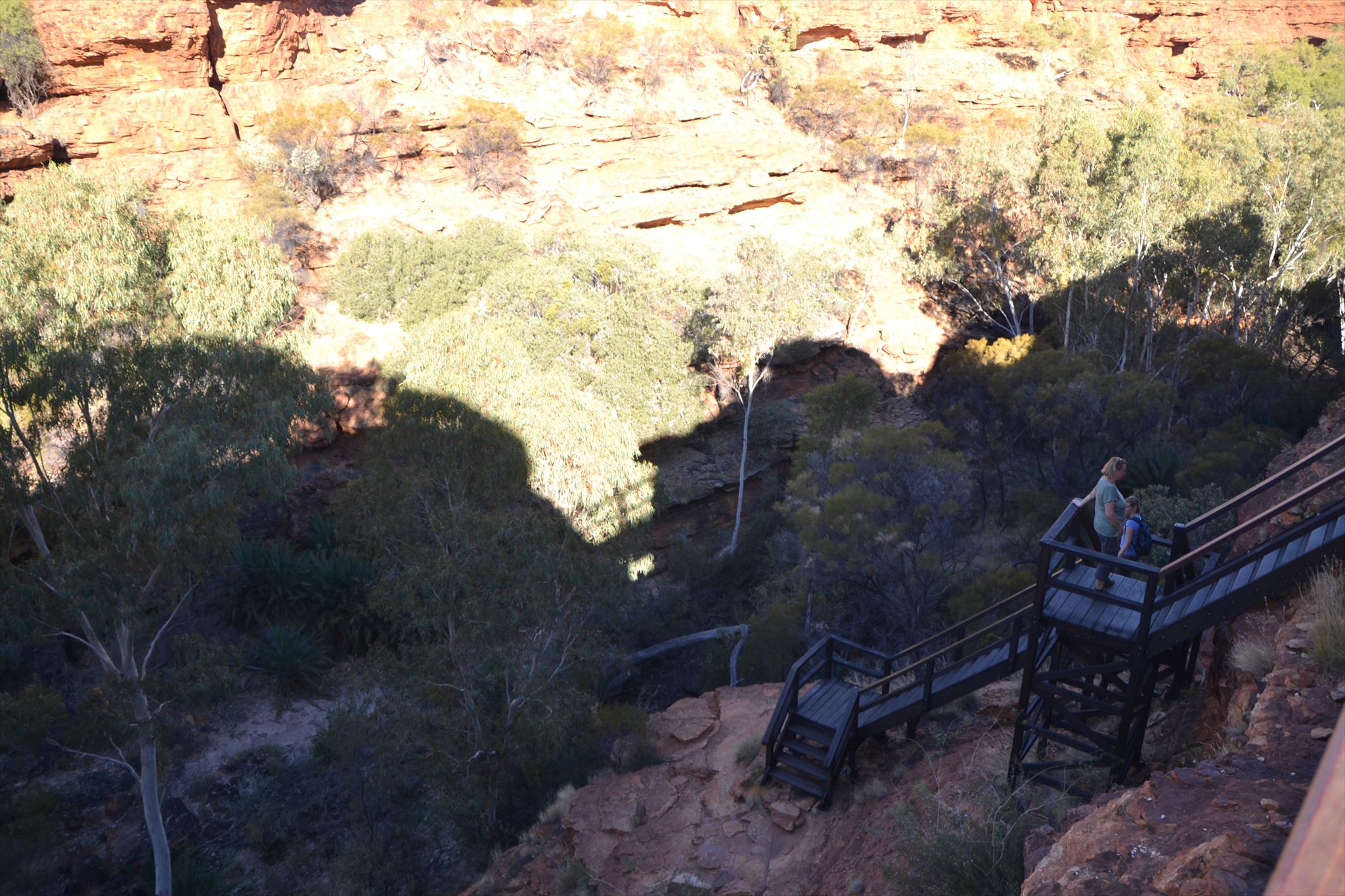
It seems that central Australia was a windswept plain, covered with sand dunes, 400 million years ago. The climate was dry but rivers still flowed and lakes dotted the landscape. That sand has become the Mereenie Sandstone of the canyon top. It's hard and brittle because it's made almost entirely of tough quartz grains cemented with silica. The walls of Kings Canyon are over 100m high, with Kings Creek running along the bottom. Part of the gorge is a sacred Aboriginal site. The dominant red-brown clouring on the surface of the Mereenie Sandstone results from either of two processes:
1.) Water, that has seeped in and soaked up iron oxide from the core of the rock, may deposit a crust on the outside when it evaporates.
2.) Iron-rich dust blown on the surface of the rock can be chemically fixed to the sandgrains by a form of fungus.
Carmichael Sandstone: Interbedded pale brown to red-brown sandstone, siltstone and mudstone. Sandstone is fine- to medium-grained, moderately to poorly sorted. Siltstone and mudstone sometimes have mudcracks and halite pseudomorphs. Age assumed to be Ordovician, but some authors give range into the Devonian. The Carmichael Sandstone of the slopes is 440 million years old. This sandstone is an important aquifer. It's softer because it's made from softer minerals mixed with quartz.
How now arises this weathering form?
Mostly the lime used as a binder in sandstone. He diffuses as a solution with the seepage through the rock For honeycomb weathering to occur, some research indicates that a source of salt is needed because the basic mechanism for this kind of weathering is salt heaving. 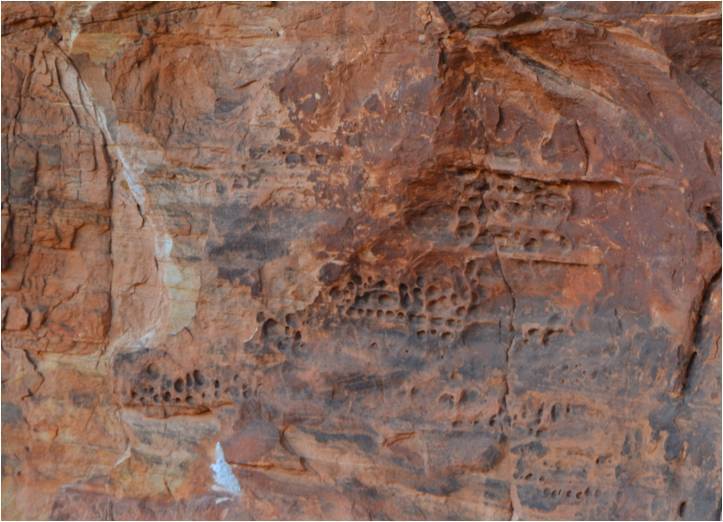 During evaporation of the water on the surface of the rock, mostly on steep walls or overhangs, the lime is deposited again and the rock in these areas solidifies. The process is similar if speleothems arise. It takes prolonged periods for this weathering to become visible, as the rock goes through cycles of wetting and drying. During the solidification also easily soluble alum is deposited. This sulphate salt destroys the structure of sedimentary sandstone and promotes the honeycomb formation. The honeycomb weathering is one of the types of chemical weathering.
To log this cache successfully, please answer the following questions and mail the answers to us to confirm your find within a reasonable time, say 14 days at most after you log it. If anything is not ok, we will contact you.Then post a photo of you at the location to your log. Of course, if you do not want to appear in the photo, a personal item in the photo is enough proof of your presence. (According to the Earthcache Guidelines, photo-proofing has been required since June 2019.)
1.) Look at this rock once closely and examine the strength of the rock. That will help you for answering the following questions.
2.) Look at the wall of the weathering. Is the honeycomb formation evenly distributed over the entire wall before you or only in certain places?
3.) Estimate the size of the honeycomb. Provide estimates of the largest and the smallest that you see!
4.) Why do you think that this phenomenon occurs here?
5.) Honeycomb weathering is a type of chemical weathering. Tell me other types of weathering!
source directory:
-Wikipedia
-journeyjottings.com
-Picture by my own