Virtual Reward - 2017/2018 This Virtual Cache is part of a limited release of Virtuals created between August 24, 2017 and August 24, 2018. Only 4,000 cache owners were given the opportunity to hide a Virtual Cache.
Learn more about virtual rewards on the Geocaching Blog.
See logging requirements below.
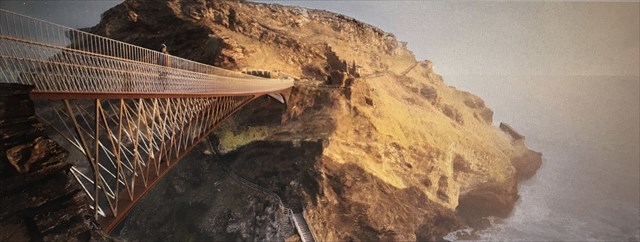 Tintagel Castle is one of the most spectacular historic sites in Britain and inextricably linked to the legend of King Arthur.
The above image shows the breathtaking new footbridge which was completed on August 9th 2019 at the historic Castle.
It may not be ideal for sufferers of vertigo but it is spectacular.
English Heritage, the custodian of Tintagel Castle, decided to launched a competition to build a 72-metre footbridge that would cross high above the waves and retrace the line of the original land bridge.
More than 100 architects from 27 countries expressed an interest in the bridge project which cost an estimated £5m.
The daring design has one cantilever on the Cornish mainland and the other on the island fortress,the two structures stretch out to each other across the void but do not quite meet in the middle.
According to the team behind the design, this gap represents the “transition between the mainland and the island, the present and the past, the known and the unknown, reality and legend; all the things that make Tintagel so special and fascinating”.
Requirements to log: Only if you are satisfied that you have the correct answers to the four questions below, please go ahead and log.
You must also message me so that I can verify your answers.
This may be one of the more trickier virtuals but your best attempt at the questions is all that is required.
Question 1. It's the 6th century and from the cove below Tintagel Island a trading ship has just left for the near continent after having exchanged it’s goods for much sought after streamed tin.
The boat has a mast height of 30ft…..from the height above sea level at the cache coordinates calculate at what point (in miles, nautical miles or kilometres) the ship will disappear over the horizon?
Question 2. In which century did the land bridge, the narrow neck of land that linked the island with the mainland…. collapse into the ocean?
Question 3. Overlooking Tintagel village stands an historic treasure, the 11th century church of St. Materiana.
Standing at the HEADLINE coordinates......how many finials (Christian crosses) can be counted on the roof of the church.
Question 4.There have been three types of ores mined at Tintagel, Galena, Manganese and Copper.
Galena ore was mined at the Island, the mine entrance being high to the right of Merlins Cave . This mine went right through to the other side of the island, just inside the mine entrance was a shaft that ran out underneath the sea.
A. What was the highly valuable by-product of the ore mined?
B. In the smelting process, what is the name of the ore added to the crucible to extract out this highly sought after by-product?
_____________________________________________________________________________________________________________________________________
TINTAGEL CASTLE: HISTORY AND LEGEND
History and legend are inseparable at Tintagel. The two Roman honorific mile stones from the area, one now in Tintagel's St. Materiana's church, suggest a presence in the area in the 3rd and 4th centuries. Various finds, including pottery and some late 3rd- and early 4th-century Roman coins, also suggest activity on the headland at this period.
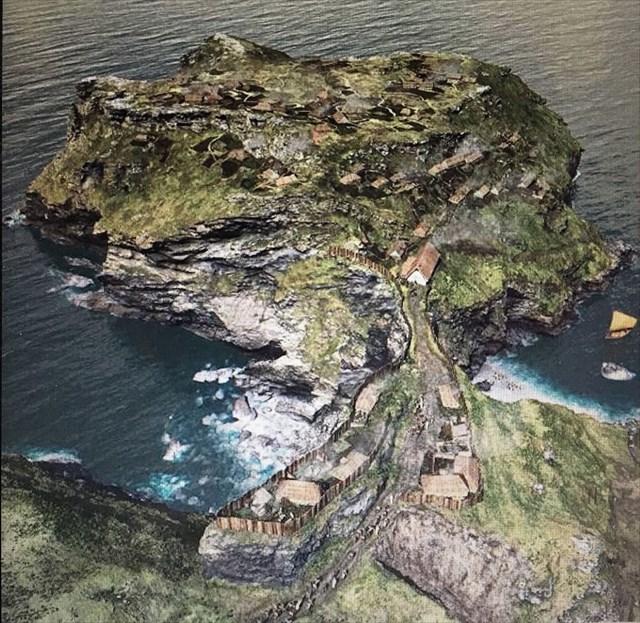
Tintagel as it may have looked in about 600AD
TINTAGEL AND THE MEDITERRANEAN WORLD
During the Dark Ages (about the 5th to the 7th centuries AD) it was an important stronghold, a residence of rulers of Cornwall.
Both the importance and the date of the Dark Age occupation of the site are evident from the many pieces of imported Mediterranean pottery, including high-quality tableware, found on both the mainland and the island.
Such fragments have been found all over western Britain, but Tintagel has by far the largest quantity so far discovered.
Fragments of Mediterranean glass of the same period have also been found. These goods arrived in the south-western peninsula by ship as part of a systematic trade which brought luxury goods and in exchange presumably took tin, the most distinctive and desirable commodity produced here, back to the Mediterranean.
The pottery finds, combined with the buildings on the island, some of which have hearths, suggest intensive occupation at this period.
THE BIRTH OF THE ARTHURIAN LEGEND
After the mid-7th century there is little evidence of activity on the headland for over 500 years. In about 1138 Geoffrey of Monmouth’s History of the Kings of Britain gave the figure of King Arthur, the legendary ruler of Britain, Ireland and large parts of continental Europe, its international fame.
Geoffrey’s of Monmouth’s racy story of how an ancient king of Britain, Uther Pendragon, is driven mad with lust for Ygerna, the wife of one of his barons, Gorlois of Cornwall. Gorlois prudently removes his wife to an impregnable stronghold on the coast, the castle of Tintagel, but then rather less prudently withdraws to another fortress nearby.
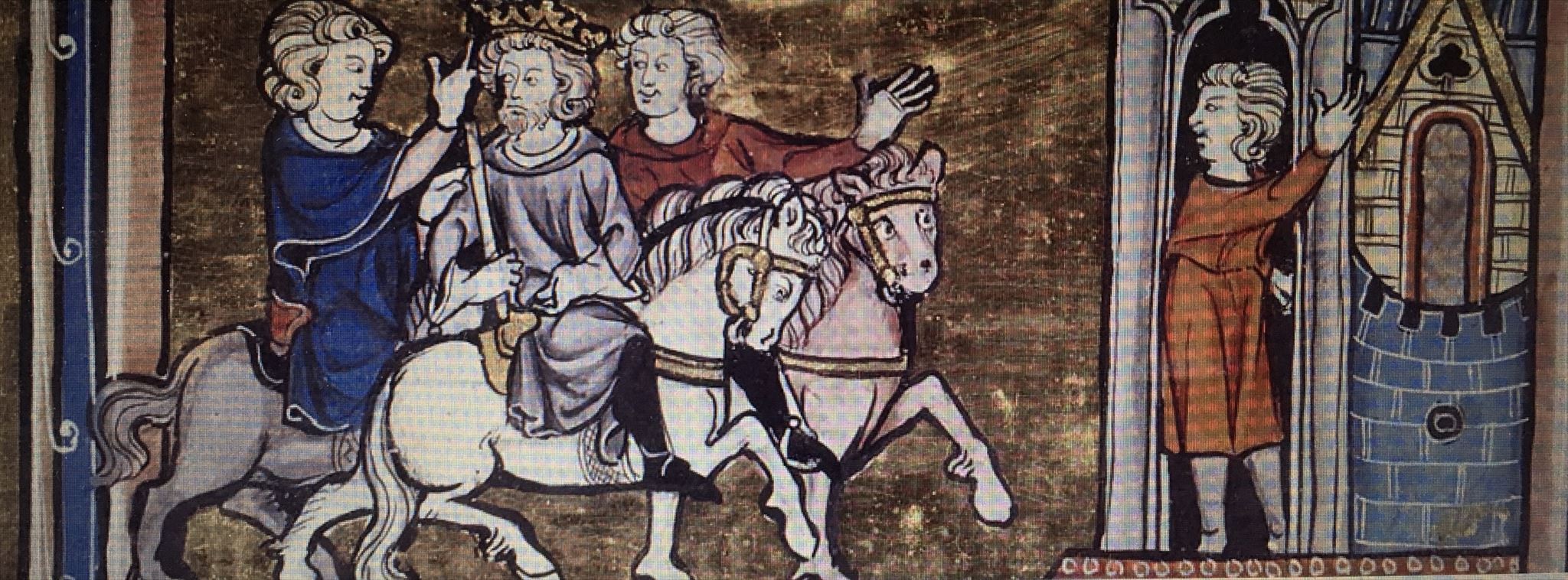
The arrival of Uther Pendragon and Merlin at Tintagel
The pursuing Uther and his men inspect Ygerna’s refuge and realise that no ordinary attack can succeed: The castle being built high above the sea, which surrounds it on all sides, with no way in except that offered by a narrow isthmus of rock.
At this point in the story, the ‘prophet’ Merlin proposes a supernatural remedy: by means of a magic potion, he transforms Uther into the exact likeness of Ygerna’s absent husband.
The ruse is entirely successful, the guards of Tintagel allow him into the castle, and Ygerna takes him into her bed: That night she conceived Arthur, the most famous of men, who subsequently won great renown by his outstanding bravery.
If these were not literary credentials enough, Tintagel also features in a second legend, which confusingly later became part of the Arthurian cycle, but almost certainly had completely separate origins.
This was the story of the adulterous love of Tristan and Isolt, the wife of King Mark of Cornwall, Tristan’s uncle.
Much more of the action in this late 12th-century story takes place at Tintagel, presented as the stronghold of King Mark.
In the year 1233 the younger brother of Henry III, Richard, Earl of Cornwall (1209–72), a cultured and literary man who would have known these legends extremely well exchanged three of his manors for a small parcel of land on the north Cornish coast. The land he coveted contained little more than an isolated and inhospitable rocky headland specifically mentioned in the deed of exchange – as ‘the island of Tyntagel’ – which was connected to the mainland by a narrow land bridge.
CLIFF-TOP CASTLE
Richard proceeded to build a castle here, with an outer bailey on the cliff tops of the mainland and an inner ward with a great hall and chambers on the headland. He probably fortified the neck of land between the two wards with a gatehouse and drawbridge. The overwhelming likelihood is that Richard built the castle to recreate the scene from Geoffrey of Monmouth’s story and, in so doing, write himself into the mythology of King Arthur.
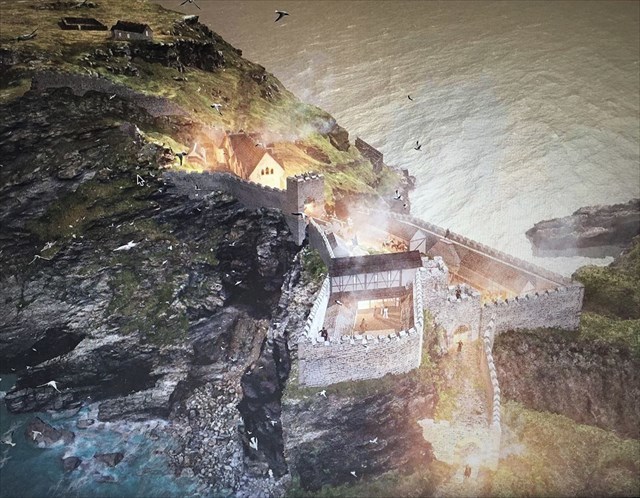
Richard of Cornwall's Castle as it may have looked in about 1240AD
Soon afterwards, other members of the earl’s family were creating similar ‘Arthurian’ monuments, notably his nephew, Edward I, who had a round table made at Winchester, seized the ‘Crown of Arthur’ from the Welsh princes, and rebuilt the supposed tomb of Arthur and Guinevere at Glastonbury Abbey in Somerset.
Tintagel Castle, meanwhile, only enjoyed the briefest moment of glory. Within as little as a decade the buildings on the cliff top were showing signs of instability; and by 1337, when the earldom was elevated into a duchy, the castle was described as ruinous – a state from which it never recovered.
_______________________________________________________________________________________________________________________________ __