Construction of Galway Cathedral began in 1958 on the site of the old city prison. It was completed in 1965, making it the last great stone Cathedral to be built in Europe.
Formation of Limestone
Limestone can be formed in two ways. It can be formed with the help of living organisms or by evaporation.
Ocean-dwelling organisms such as oysters, clams, mussels and coral use calcium carbonate (CaCO3) found in seawater to create their shells and bones. As these organisms die, their shells and bones are broken down by waves and settle on the ocean floor where they are compacted over millions of years, creating limestone from the sediments and the pressure of the ocean water.
The second way limestone can be formed is when water containing particles of calcium carbonate evaporate, leaving behind the sediment deposit. The water pressure compacts the sediment, creating limestone.
Because limestone is often formed from shells and bones, it is a light color like white, tan, or gray. The color of the limestone depends on the other sediments in the mixture besides the mineral calcite, which is white; impurities such as sand, clay, and organic material are also present in limestone and affect the colour.
Limestone in Galway Cathedral
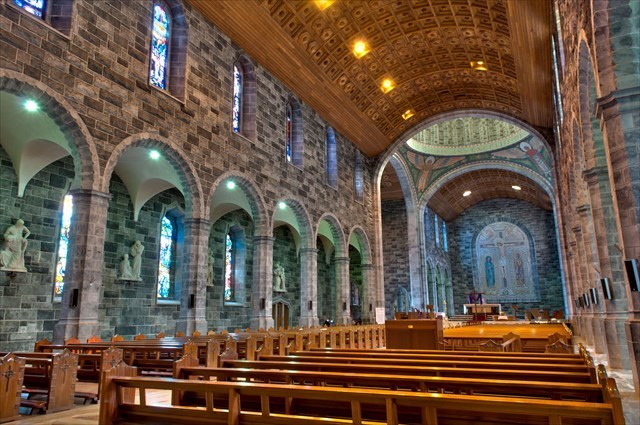
The decision to use Limestone for the main body of the cathedral was made because the land around Galway is rich in Limestone and granite but Limestone is much more easily worked than granite. There are also excellent Limestone quarries near Galway. Galway Limestone weathers well and does not discolour, you may notice that most of the important buildings in the city are made of Limestone. The Limestone used in the Cathedral came from two different quarries only a mile or so northeast of the city. One quarry produces slightly darker stone than the other producing the diversity of colour you see in the walls.
As you can see the Limestone is visible on the inside as well as the outside of the Cathedral, the stones were carved in rectangular blocks and laid in courses but their surface was left bold rock-faced finish. By contrast the stones of the arches, the pillars and around the windows and doors are finely chiselled and dressed adding contrast and texture.
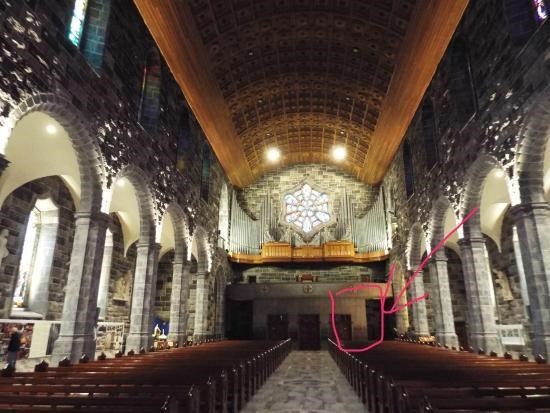
location of the wall for question3
To log this cache as a find
Please send your answers to the following questions to me via my profile. Please send the answers before you log your find. There is no need to wait for my reply before you log.
1. Do you think this Limestone has been formed by evaporation or with the help of living organisms? Give your reasons.
2. The rough hewn Limestone blocks clearly shown the layers in the stone, but the polished dressed blocks do not. Why do you think this is?
3. Look and the wall below the organ pipes, the right hand wall of the three, you can see it has clear wide, horizontal stripes that are not the colour of the original Limestone blocks, what do you think has caused these stripes?( see photo for location)
4. Why do you think the Limestone from the two quarries are different colours?
5. Please upload a photo to your log showing your caching name and a recognisable part of the inside of the cathedral
I want to place a Church Micro cache too The Church Micro IE series is open to everyone; if you have a church you would like to place a cache at then please contact THE_Chris through Geocaching.com. This is to keep track of the numbers of the churches and give you the general format for the cache page. In the UK there are over 10.000 caches in the series so we have some catching up to do! Also, if you currently have a published cache at a church that you would like to include in the series, get in contact and we can add it.