Waypoint 1: Le portail de St-Vincent
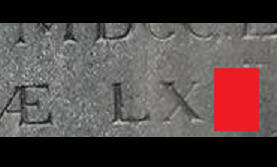
Difficile à croire aujourd'hui, mais lorsque St-Vincent-sur-Rive fut bâtie au XIe siècle, elle bordait la Seine! Sa paroisse voyait circuler de nombreux négociants et prélevait une taxe sur les cargaisons de sel --garantie d'un revenu confortable. Opulent bâtiment de style gothique, l'église fut fermée par les Révolutionnaires en 1793, puis fut rachetée par la famille Ribard avant de redevenir église paroissiale au XIXe s. Hélas, la Seconde Guerre mondiale fut fatale au prestigieux monument: bombardé, puis incendié, il dut être rasé presque intégralement. Il n'en subsiste que le portail sud, orné de la pierre monumentale dédicacée par sa famille à"Elisabeth Thérèse Sandelion, épouse de Jean Nicolas Ribard, décédée le 23 avril 1761".
Clé n°1: sur ce détail de la pierre tombale d'Elisabeth Thérèse Sandelion, quel chiffre a été masqué?
Waypoint 2 : La Tour Saint-André
Bien que située dans une paroisse modeste, l'église St-André-aux-Fèvres (mot signifiant forgeron), construite au XIe siècle, était jadis surmontée d'une impressionnante flèche octogonale. Hélas, celle-ci était régulièrement malmenée par le climat et fut renversée au XVe siècle par un ouragan. Bousculée par les intempéries, puis dévastée par les révolutions, l'église reçut finalement le coup de grâce lorsque Charles Verdrel fit percer la rue Jeanne d'Arc en 1867. Il n'en reste aujourd'hui que la tour de 42m.
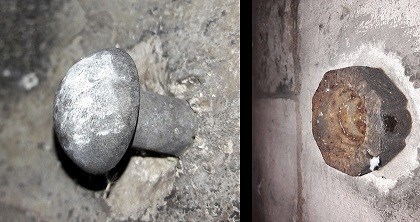
Clé n°2: combien de ces éléments trouve-t-on sur le pourtour de la tour, à 80cm du sol environ? (total des 2 types).
Waypoint 3: La rue fantôme
Derrière cette grille s'ouvrait jadis la rue Ricardière (qui existe encore sur sa moitié inférieure). A peine large de 1,25m, accueillant un hospice pour les aveugles, elle fut fermée en 1956 pour des raisons de sécurité et devint un passage privé, dont la façade, ornée de céramiques de Rouen, offre un petit condensé d'histoire locale. Outre la plaque commémorant l'éclipse de 1999, la plus remarquable rappelle que la rue dans laquelle vous vous tenez n'a jamais vu passer le moindre ursidé: son nom (d'ailleurs prononcé "our") est la déformation du nom d’un animal bien plus commun...
Clé n°3: Combien d' "ouës" apercevez-vous sur cette céramique?
Cache finale: Saint-Pierre-du-Châtel
Vous voilà arrivés devant les ruines d'une église qui faisait jadis partie du château où s'installa Rollon après son baptême (d'où son nom). Ce statut prestigieux n'aida guère le pauvre bâtiment: dégradé par le temps, converti en écurie par les Révolutionnaires, St-Pierre-du Châtel était en train d'être démonté en vue de sa destruction lorsqu'il fut inscrit Monuments Historiques en 1920. Cela ne fit que retarder l'échéance puisque les bombardements de 1944 achevèrent ce que les ans avaient entamé. Une partie des ornements qui faisaient la gloire de l'édifice avait pourtant été mise en sûreté, mais les travaux de reconstruction ne démarrèrent jamais vraiment...
La cache: Les chiffres relevés en chemin pourront vous aider... Soyez discret et replacez tout exactement comme vous l'aurez trouvé afin que la cache survive et garde son intérêt!

Waypoint 1: St-Vincent's South gate
Believe it or not but when St-Vincent-sur-Rive (St Vincent-on-the-bank) was built in the 10th, the River Seine flowed by the church's walls! The parish welcomed many rich traders and took a tithe on every shipload of salt that docked there --the promise of a comfortable income. The church, an impressive Gothic monument, was closed down by the French Révolutionnaires in 1793 and bought back by the Ribards before returning to its religious functions later in the 19th c. Sadly, the bombings and fires of the Second World War were fatal to the church, which had to be almost completely taken down. The only part left standing is the South Gate, with the gravestone praising "Elisabeth Thérèse Sandelion, wife of Jean Nicolas Ribard, who died on April 23rd 1761."
1st digit:On this detail from Elisabeth Thérèse Sandelion's gravestone, which number has been hidden?
Waypoint 2 :The Saint-André tower
Though it stood in a modest parish, the church of Saint-André-aux-Fèvres (an old word meaning "smith"), which dated back to the 11th c., once boasted an impressive eight-sided spire. Unfortunately, the thing was regularly shaken by storms and finally collapsed during a hurricane in the 15th c. After (barely) surviving the bad weather and several revolutions, the church finally succombed when Mayor Charles Verdrel had the area destroyed to let the current rue Jeanne d'Arc go through, in 1867. Only the 42m-high (138 ft) tower was left.
2nd digit How many of these items are there around the tower at knee height? (total of the 2 types).
Waypoint 3: The ghost street
Beyond this gate once lay Rue Ricardière (part of its southern part still remains). It was very narrow (4 feet wide) and was closed in 1956 for safety reasons, becoming a private lane. The entrance, with its Rouen ceramics, is a summary of local events: a plaque celebrates the 1999 solar eclipse, but the most remarkable plate serves as a reminder that no matter what the name suggests, no bear ever set paw in the Rue aux Ours: the word "Ours" (which, by the way, is pronounced differently: "oor" instead of "oorss") is actually derived from "Oies/Ouës", meaning "geese"--a much less exotic animal!
3rd digit: How many of these "ouës" are there on the main plate?
Final location: Saint-Pierre-du-Châtel
You are now standing before the ruins of a church which was once part of the castle where Rollo, the Scandinavian founder of Normandy, came to live after his conversion to Christianism: hence the name Saint-Pierre-du-Châtel (Saint-Peter-of-the-Castle). Such a prestigious past was of no use to the building. Time took its toll on it, then the French Revolution turned it into stables; by 1920, the poor church was in such disrepair that the City was about to take it down when it became a listed monument. This turned out to be but a respite, as the poor church was finally bombed in 1944. Part of the most prestigious decorations had been stowed away, but no serious restoration was ever launched...
The cache:The elements you collected along the way might come in handy here! Please be discreet and put everything back as you found it so the cache remains active and fun!