
This Amtrak disaster stuck in my mind from the minute I heard of it and despite the fact I had no connection to this area at the time. I was deployed in the Persian Gulf, in UAE, September 22, 1993. We were breaking activities for lunch when the accident occurred (2:53am Central time). I heard of it by mid-afternoon. Sometimes things stick with you, seemingly, for no reason. This is one that did.
Later, I met my wife who is a Mobile native, which brought me here. So this is why I put this cache here seemingly in the middle of nowhere, to pay respect for the 47 people that passed here, early in the morning, late in September. To the group of heroes that were on the train and the huge group of responders that made it here in a short time to pull people from the diesel covered water, flames and sinking train cars.
The Sunset Limited
Before the start of Amtrak on May 1, 1971, the Sunset Limited was operated by the Southern Pacific Railroad. The Sunset Limited is the oldest named train in the United States, operating since November 1894, along the sunset route (though originally named the Sunset Express). The Sunset Route (originating in New Orleans) is the southernmost of the three gateways to the West Coast, envisioned through the Transcontinental Railroad Act. The Sunset limited was extended to as far as Miami at one time. After Hurricane Katrina damaged the Amtrak and tracks in Mississippi and Alabama, Amtrak service between New Orleans and Jacksonville stopped in 2005. Currently, the Sunset Limited is running from New Orleans to Los Angeles.
Hurricane Harvey’s extreme damage to the Houston area in August 2017 has caused the Sunset Limited to terminate in San Antonio until service through Houston to New Orleans is restored.
Currently, there is interest in restoring the Sunset Limited service from New Orleans to Jacksonville, Florida. Which would route the train over the Big Bayou Conot bridge once again. Hurricane Irma appears to be putting any forward progress on hold of this effort.
Leading up to the fateful events that occurred, The Sunset Limited left from its originating station in California, stopping in its usual stops along the way. Then the day prior, the train had been delayed in New Orleans to repair an air conditioning malfunction. This would play a major role in the accident that would happen just hours later.
Big Bayou Canot
Late in the evening the towboat Mauvilla was traveling from the City of Mobile up the Mobile River. Its pilot, Willie Odom, whom had not been properly trained in the use of the radar on board, would make a wrong turn in the dense fog that morning. With no markers visible at the entrance, unknowingly the pilot proceeded into the Bayou thinking he was still in the Mobile river at the upcoming bend.
As he eased forward in the fog, he saw on the radar screen what he thought was another towboat in front of him. He approached, expecting to tie up to the other tow boat in the fog.

The Bridge
The bridge, owned by CSX, had actually been designed to rotate so it could be converted to a swing bridge by adding suitable equipment. No such conversion had ever been performed, but the span had not been adequately secured against unintended movement.
The Accident
As the towboat approached, it bumped the bridge, just slightly. The chipped concrete is still visible in the photo below. The swing bridge pivoted but the continuously welded rails only bent and did not break. Had one rail broke, the circuit would have been broken and the aspect (light) would have turned red and the train could have stopped in time. Unfortunately, neither broke and the bridge was 18-24 inches out of alignment. Twenty minutes later, traveling over 70 miles per hour, the lead engine struck the bridge rail head on causing the engine to rise up and fly the remaining gap of the Bayou embedding itself in the far bank. The second two engines and next four cars followed destroying the bridge past the extension span. The fifth car stayed on the extension but hung off over the water. Diesel was on the water from the engine tanks, fire followed. The some of the cars were sinking, some on fire. Forty-two passengers, and five crew members were killed. One hundred and three were injured.
As you can see when you seek this cache, it is quite a distance from anywhere. The Mauvilla was still on the scene, still not realizing they caused the wreck in front of them. They cut their barges free and began to rescue the people in the water. The Coast guard did not get there till 4:25am and the first helicopters and hour later than that.


Forward
The wreckage was cleaned up and bridge was repaired within 7 days, rail traffic was restored.
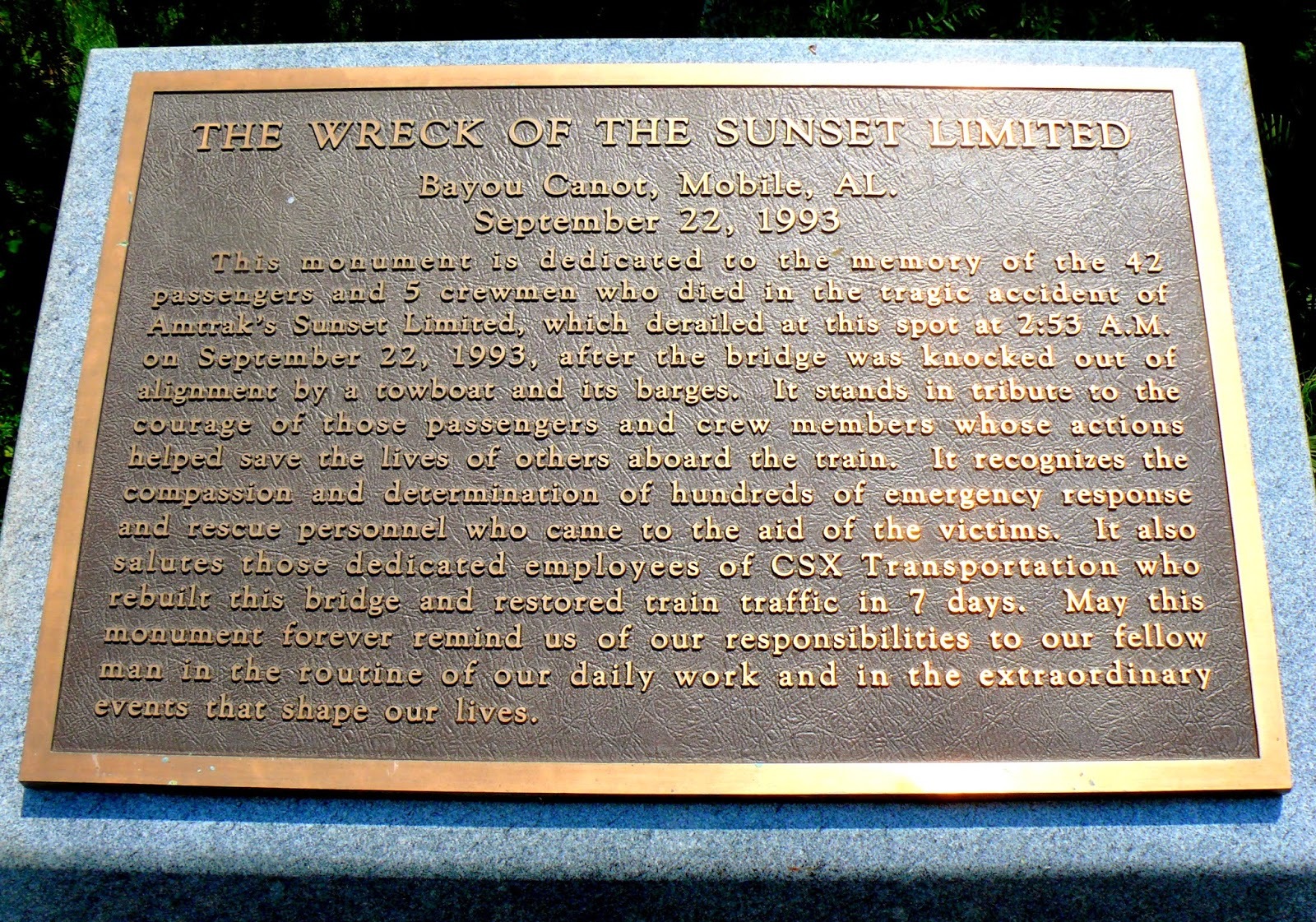
Every year, there is a trip chartered to the site to memorialize the disaster. I am unsure who to contact to be on that trip or if it is open to the public. There is a granite memorial on the Southeast side of the bridge that memorializes the disaster. Unfortunately, it is on the railroad right of way and cannot legally visited. Here is a picture of it so you don’t try.
The Geocache
This cache is quite a ways from any of the nearby launches on the West side of the delta the closest would be Bayou Sara in Saraland, Steele creek in Satsuma, William Brooks park in Chickasaw. Then on the West side: Byrnes lake, Hurricane landing, Cliffs landing, Cloverleaf landing and Blakeley park landing.
I suggest using a motor boat of some type, though there are a few hardcore cachers out there that could kayak to them. Any way you choose, I recommend completing a float plan and always tell someone when to expect you back. Getting lost in the delta is possible.
There is a lot of boat traffic under the Big Bayou Canot bridge due to the Saraland swing bridge being so low. Most boaters will run the gas line to the north that connects Bayou Sara and Big Bayou Canot, then under the bridge here because it is much higher.
I used many sources, but used some directly from wikipedia.