Church Micro 11229...Bath - St John the Evangelist EarthCache
Church Micro 11229...Bath - St John the Evangelist
Please note Use of geocaching.com services is subject to the terms and conditions
in our disclaimer.
Bath Stone's distinctive beige appearance is evident throughout the city of Bath and beyond, giving the city a distinct character. This EarthCache focuses on this stone type, and since EarthCaches have to be site-specific, I've chosen St John's church to highlight this stone as a building material.
St John's Church
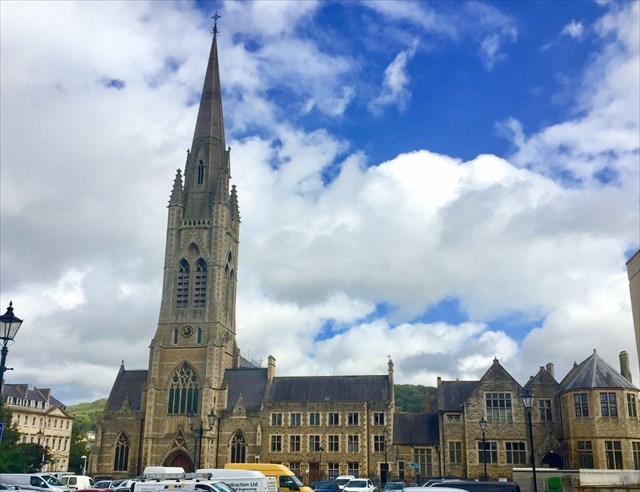
The Roman Catholic church of St John the Evangelist is a 19th century Gothic-inspired church located on the South Parade in the south-east section of Bath City Centre – the old Ham District where John Wood the Elder, the Georgian architect, had originally planned his gigantic "Forum". The church's majestic 68m (222ft) spire dominates the city's skyline. Like the majority of buildings in the city, the church is built entirely of Bath Stone.
Bath Stone
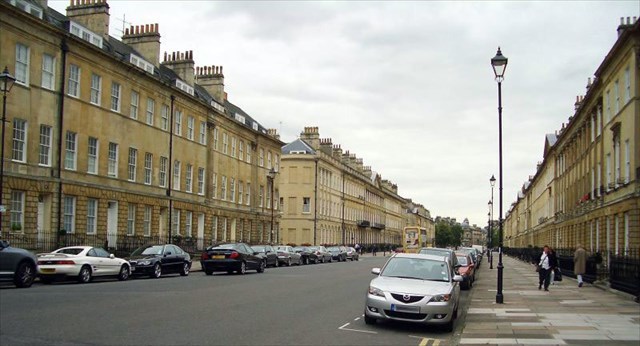
Despite its sandy and beige appearance, Bath Stone isn't sandstone; is an oolitic limestone. Oolitic limestone is a carbonate rock made up mostly of ooliths (or ooids) which are sand-sized (2-5mm diameter) carbonate particles that have concentric rings of calcium carbonate. These rings are formed around grains of sand or shell fragments that were rolled around on the shallow sea floor, gathering layer after layer of limestone, forming the Bathonian Series of rocks.
Bath Stone is a freestone, meaning it can be cut in any direction, as opposed to rocks like slate which form layers when cut, allowing for almost any shape to be carved. This freestone nature, along with easy availability (it is locally mined at Bathampton) means that Bath Stone is a popular building stone throughout the city and beyond- in architecture as far as Chippenham and Barnstaple.
Being a city central church, it is frequently surrounded by air pollution, particularly from air fumes. Unfortunately, pollutant chemicals in these fumes can react with Bath Stone and give it a darker and dirtier appearance than its natural colour. Sulphur dioxide, found in exhaust fumes, reacts with Bath Stone, forming crystals of calcium sulphate. If not washed away by rainwater, these crystals trap pollution, staining the stone black. With repeated staining, the Bath Stone can decay.
Questions
To log this EarthCache, please send the answers to the following questions by email or message. Due to owning many EarthCaches I receive numerous emails per day so there is often a delay in replying, therefore feel free to log before awaiting a reply. Only answers that are drastically incorrect or photos that reveal answers will be deleted.
1) Describe the textures of the stone.
2) Have a feel of a blackened patch of the stone where a pollutant reaction has occurred. How does this feel different compared with a natural, unpolluted patch of the stone?
3) What evidence is there, particularly around the main doors of the church, that Bath Stone is a good freestone?
4) At the listed coordinates, tell me how many Polish masses occur in a month, and when. (white signpost)
Photos of you/GPS at the church would be nice to see, but not compulsory.
**************************************
For full information on how you can expand the Church Micro series by sadexploration please read the Place your own Church Micro page before you contact him at churchmicro.co.uk
See also the Church Micro Statistics and Home pages for further information about the series.
*************************************
Additional Hints
(No hints available.)
Treasures
You'll collect a digital Treasure from one of these collections when you find and log this geocache:

Loading Treasures