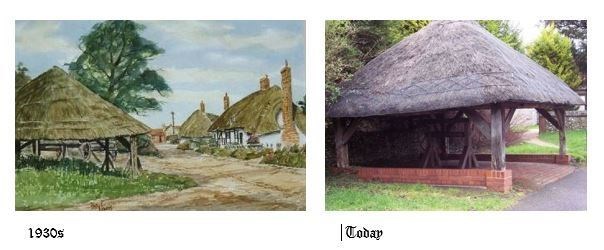
An ordnance map dated 1910 shows just a few houses clustered around both St. James’ Church and the Well with only 4 named roads. The first census in 1801 listed the population at 153 and 100 years later it had risen slightly to 213. Up to the 1930’s the Well was the main source of fresh water for its residents - water for the animals came from the village pond.
The open sided Well has a thatched roof supported by large timber posts and is reputed to be flint-lined and nearly 250ft (76m) deep. The thatch and some of the original machinery was restored in 1977 and made safe for visitors to enjoy. The landmark appears on the village signs as you approach Clanfield. Today, the population of Clanfield has grown significantly to over 4,500 and rising!
Can you imagine that number of people queueing up for their water nowadays?
The tasks:
1. Stand at the wellhead. You will see a metal handle and chain that once hauled the bucket. Study the wooden structure and looking at the top wooden bar only, count the number of wooden bolt-heads (both sides). This = A.
2. Face the church, look up at the rafters and count the number of exposed beams sloping towards the church. This = B.
3. Now take a 1/4 turn to your right and face the shops. Now count those exposed wooden beams. This = CD.
PLEASE NOTE: New formula for final as from 19/9/21
Final: N50 56. A B (A+C) W001 00. (A-D) (B-C-D) (A*2)
The checksum for all 15 digits is 53.
This cache is part of a series of caches around the country that are placed at or near ancient wells, pumps and water holes. Please click here to see the bookmark list for all the caches in the series.
If you would like to expand the Ancient Wells Series by placing a cache of your own please contact LizMar2010 to request a number and to add the cache to the bookmark list. This series will encompass both ancient and non ancient wells such as springs and other water features which will always be worth a visit.